






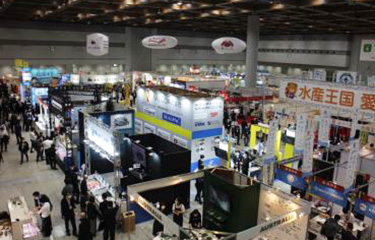
At the 24th Japan International Seafood & Technology Expo in August, one of the aisles had the appearance of a ghost town – with many booths unstaffed and no product on display. The desolate scene was the result of China’s “zero-COVID” policy, which prevented the Chinese staff meant to be in the booths – organized by the China Aquatic Products Processing and Marketing Alliance – from traveling overseas.
The show was held on 24 to 26 August, 2022, at Tokyo Big Sight and had around 20,000 visitors, with approximately 930 booth spaces occupied by 550 companies. The affected pavilion was assigned to 23 companies, most from Zhoushan, a prefecture-level city about a hundred miles south of Shanghai. As a makeshift solution, Snowpine Co., a Saitama prefecture-based online language company that provides training in English, Chinese, and Japanese, was hired to recruit college students in Japan to stand at some booths and pass out pamphlets, though coverage appeared incomplete.
China imposed a de-facto ban on international travel in May 2022, forbidding citizens from going overseas for "non-essential" reasons. Passports and travel documents are only issued for essential purposes, such as resuming work, study, business, scientific research, or seeking medical care. Reentry requires multiple tests and quarantine upon arrival, making travel impractical.
During the show, Japan’s infection numbers were just coming off a peak. On 24 August, Japan still had 232,275 new cases in a day, with a seven-day average of 193,333. By 12 September, those numbers had fallen to 39,919 and 53,298, respectively. Though Japan does not ban foreign travel by its citizens, its COVID-19 related entry requirements have been the strictest among the developed countries – but are now being gradually loosened.
Japan was requiring and a negative PCR test performed within 72 hours of the scheduled departure time of the flight, a rule that applied to both citizens and foreigners. On the opening day of the event, Japanese Prime Minister Fumio Kishida announced that the PCR test requirement would be dropped for triple-vaccinated travelers from 7 September.
While Japan allows business travel, it has maintained a general ban on foreign tourists since 29 November, 2021, to slow the spread of the omicron variant of COVID-19. The government eventually decided to admit a limited number of tourists, but only those taking part in guided tours. In June and July 2022, just 8,155 foreign tourists visited Japan, according to the Immigration Services Agency. Kishida also announced that the daily cap on tourist entries would be increased to 50,000.
On 21 September, he went further, announcing during a visit to New York City to attend the United Nations General Assembly meeting that Japan would further relax its border-control measures from October.
“The government is currently in the process of removing the cap on the number of visitors, allowing individual travel, and waiving visa requirements for short-term stays,” Kishida said.
Kishida then announced on Thursday that Japan will allow visa-free, independent tourism and abolish a daily arrival cap as of 11 October, the Japan Times reported. The government is also planning to launch a nationwide travel discount program.
Taiwan and Hong Kong have announced similar plans, leaving mainland China as the last major regional tourist destination with closed borders.
Photo courtesy of Japan International Seafood & Technology Expo
