






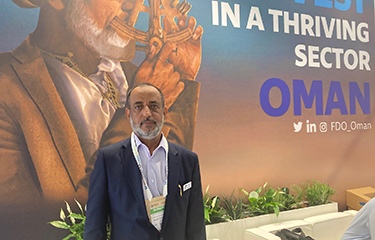
Oman’s government has committed to revamping its seafood industry via significant investments in its aquaculture, commercial fishing, processing, infrastructure , and services sectors through Fisheries Development Oman. Oman Pelagics CEO Dawood Al Wahaibi, who is also an FDO board member, provided an inside perspective on this effort to SeafoodSource at the 2023 Seafood Expo Global in Barcelona, Spain.
SeafoodSource: What is the impetus behind this initiative?
Al Wahaibi: Fishing has always been part of the story of Oman, and we have embarked on an ambitious plan to expand on our fisheries resources in a sustainable way. Oman has been dependent on oil and gas for many years, and to diversify our economy, a decision was made by the government to develop other sectors. And one of the main pillars of that plan is fisheries. So out of that, Oman consulted with the World Bank and other international experts, and they recommended the development of the small pelagics sector and aquaculture. We have since done work to decide where to start on this project. We admit we have started late on this, but as a result, we can learn from what has already worked elsewhere and try to make quicker advances.
SeafoodSource: Can you describe in greater detail the role FDO is playing in this effort?
Al Wahaibi: FDO is directly overseen by senior government officials. So the level of support is huge. It is the umbrella that holds shares in all of these investments, with a hand in eight group companies operating in Oman’s fisheries sector. It's the catalyst to help the successful deployment and sustainable development of our fisheries industry. It's not a matter of just adding another product or another certificate of origin; There is a bigger plan behind it to impact the local economy, to invest the foreign currencies that are coming through the Central Bank, and to create jobs, boost opportunities for small- and medium-size enterprises and individuals, and to create a viable seafood industry in Oman, where it has always been fragmented.
FDO has been trying hard to send the message to the whole industry in Oman that we are not here to compete, but we are here to reengineer the situation and deliver it in such a way so that it is acceptable for the international market. Currently, a lot of raw material is delivered into Oman, but the origin of that raw material might become Oman, because Oman has been a net exporter of fisheries product for many years. Oman has been exporting to many countries for years, starting in 1996 to Greece, Italy, and Spain, but other countries like the U.A.E. and China are now importing bulk material, reprocessing it, and reexporting and we must do something differently.
One of the plans now to go downstream and capitalize on this opportunity. FDO is also managing the Duqm fisheries port, the largest fishing port and the Arabian Sea. The port was developed precisely for fisheries activity, and we were fortunate to understand and now we are deploying all the investment, all the requirements, to address fisheries and international hub. Even distant-water vessels can use the port to discharge their fish, preprocess, and then export through the international airport via very strong infrastructure connections. So there are opportunities coming up.
We are trying to capitalize on the infrastructure available without adding more burden for the government to invest in infrastructure. We are utilizing what we have in a smart way in relaunching Oman seafood as a brand. We are delivering a message of ambition and promising the industry that we are coming out with a new mindset. The plan is very, very ambitious, and to achieve that, we need and have the [government] in direct support both politically and technically. And financially we are very well supported, because FDO was set up by the Oman Investment Authority.
SeafoodSource: Is this purely a domestic initiative or are you looking for international partners?
Al Wahaibi: We are doing this for two main reasons: economic diversification and food security. Seafood has always been a part of the Omani diet, and at the moment, our per capita consumption is around 36 kilograms. Oman has 3,000 kilometers of coastline, a lot of in isolated areas even with low or zero population. One major idea is to locate all of these projects in isolated areas to help bring services and jobs to those localities in a way that directly and indirectly impacts the local economy and of course the overall economy of Oman.
We have realized local migration to the cities can be eased by initiating these massive fisheries projects. So for the government, there is a social purpose to this investment. But of course international partners are most welcome and the environment for foreign investment is very friendly in Oman. The only thing here is that we have a list of priorities for finance – downstream processing, enhancing the fisheries, and enhancing local communities are what we are looking at in this moment. FDO is trying to act as a catalyst. We create things and move on and hope that others will take the lead.
A lot of people previously feared to invest in the sector in Oman, because the data was sparse and the industry was fragmented. Now we have collected all that base information and we made it available for those who are interested to invest. So we have the development. We have an investment team and they are all eager to meet their international counterparts and discuss the opportunities available to them in Oman.
SeafoodSource: What is the state of regional development of the seafood industry across the Middle East? It seems like many Middle Eastern countries are looking at investing in the seafood industry to diversify beyond oil and gas.
Al Wahaibi: I know Saudi Arabia and other countries are doing something similar [as Oman]. Within the Gulf Cooperation Council [GCC], we have 80 million [people] in Saudi Arabia, about 48 million Yemen, and about 5 million in Oman, and all these people need to eat. Plus, of course, we have millions and millions of tourists. These countries are connected by roads and the borders are open. We look at it as complementing each other rather than competing. We know what they're doing and what they are trying to do, and it is the same for them with us.
We also know where they have failed and they know where we have failed. And we would like to share lessons learned across the GCC, particularly around biosecurity. [Recently], Saudi Arabia and Qatar announced the stoppage of import from India due to white spot disease, and Oman followed that. So the whole zone is becoming like one entity when it comes to these matters.
Global demand for shrimp is 9 million tons, and combined production from Saudi Arabia and Oman after development would be a fraction of that. So [other countries] are not worried about this expanded production. They are all thinking it will all to go niche markets, like we will be growing the shrimp to a size other countries cannot produce.
Historically in Oman and Saudi Arabia, local capacity was not focused on fisheries, but now the game is changing. We see more and more of our young people studying fisheries and working in the field. We have young graduates working in our hatcheries and our processing plants, and in logistics. The field is becoming more and more exciting, and the future is bright. I got my professional start in the early 1990s, and to me, this is the best shape our industry has been in since I began. And we are trying to do things the right way.
SeafoodSource: You mentioned biosecurity as a major priority for FDO and the government. As part of that initiative, Oman is completing a national aquatic quarantine facility in Rumais, Oman, to hold imported broodstock to ensure they are free from disease before being transferred to farms. Why was that initiative important for you?
Al Wahaibi: I am one of those people who believe in science and believe in expertise. The first line of protection for the country’s aquaculture development was the principles of quarantine and the [creation of] the national quarantine center. If there's a problem like a disease, it will have an impact on the entire country. So the center was a must-do for the country, initially for the safety and well-being of our own shrimp-farming initiative.
Now, there is 30 days of quarantine and samples to be taken and sent to certified lab to identify any disease. And we have done a partnership with the University of Arizona to do an analysis of broodstock before they arrive. Next, we are expanding the center to include a small nursery and exploring the opportunity to import fertile eggs. Eventually, we are planning to have our own hatchery with broodstock of sea bream and maybe yellowtail and barramundi.
SeafoodSource: How would you rate progress on the FDO initiative thus far?
Al Wahaibi: The initiative was created in 2017 and we started deploying our plan in 2018 and 2019, then we were hit with Covid and the Ukrainian war. It's a difficult time in the world, but next year, we will produce 10,000 metric tons of shrimp and we are going for 3,000 tons production of sea bass, which is just quite unique in all these difficult times. We are still working on some legislative issues within the country, but whether in Oman or Saudi Arabia, our young governments have that passion and openness to exploring this industry. Of course we are still learning, and nothing is assured, but I am confident we are leaning into something that will be good for our countries. I think we have made a good start.
Photo by Cliff White/SeafoodSource
