






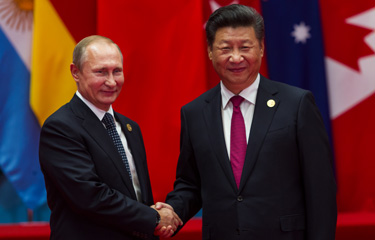
Russian President Vladimir Putin and Chinese President Xi Jinping will meet in Uzbekistan on 15 and 16 September to discuss political, economic, and security issues, as Russia's invasion of Ukraine has deepened ties between the two countries.
China's government has expressed tacit approval of the Ukranian invasion, while also positioning itself to avoid possible repercussions from supporting the Russian economy amid international sanctions, while Russia has focusing more of its economy on China by settling more of its trade in the Chinese currency. The Kremlin recently announced a plan to buy up to USD 70 billion (EUR 70.3 billion) worth of Chinese renminbi and other currencies from “friendly” countries that have not imposed sanctions on Russian trade, according to Bloomberg.
Russia and China have both long promoted the idea of displacing the role of the U.S. dollar in world trade, but the asymmetrical nature of Russia and China’s economies – China’s GDP of USD 14.7 trillion (EUR 14.75 trillion) vastly outweighs Russia’s GDP of USD 1.48 trillion (EUR 1.48 trillion) – means Russia would have to forego any misgivings about embracing the Chinese renminbi.
China, meanwhile, is grappling with a loss of confidence from foreign investors amid the repercussions of its zero-COVID policy and a lingering debt crisis.
In recent weeks, Chinese media has stressed the economic damage European economies have suffered after being cut off from Russian gas, and has cast the U.S. as a war profiteer benefitting from increased sales of gas to Europe as the continent shifts away from its dependence on Russian energy supplies.
The consequences of the growing closeness between Russia and China are still unclear. However, a March 2022 Natixis report found that use of Chinese currency for international seafood transactions isn’t a realistic outcome.
According to one executive at a Chinese processor with major clients in the U.S. and Europe, Russia's invasion of Ukraine has had a “marginal impact” on Chinese seafood processing factories. The processing executive asked for anonymity in order to speak candidly about the current economic situation in China.
“We did see the Norwegian cod price move up sharply due to some [Western] clients only accepting Norwegian cod,” the executive told SeafoodSource. “Otherwise, we see little difference.”
Photo courtesy of plavi011/Shutterstock
