






As a result of recently concluded negotiations between U.K. and Norwegian fishery representatives, U.K. fishers secured continued access to commercially important whitefish stocks in the Norwegian North Sea for next year.
Following Brexit, the U.K. has been negotiating fisheries deals as an independent coastal state, and this latest bilateral agreement – reached on 14 December – mirrors previous arrangements the country has enjoyed with Norway.
Specifically, it gives the U.K. fleet access to 30,000 metric tons (MT) of Norwegian whitefish stocks, including cod, haddock, and hake; access for up to 20,000 MT of herring in the countries’ respective waters; and quota transfers of key U.K. stocks, such as anglerfish.
“Leaving the E.U. has presented us with the chance to seize post-Brexit freedoms … [by] negotiating deals and implementing broader fisheries measures that will [move] our fishing industry toward a more profitable and sustainable future,” U.K. Fisheries Minister Mark Spencer explained in a statement. “The arrangements with Norway announced today will provide certainty and continuity, allowing fishermen to access important North Sea stocks.”
U.K. Government Minister for Scotland John Lamont added more detail about the Scottish fleet in particular, saying that Scottish trawlers securing continued access to Norwegian North Sea waters was “great news” and, alongside new funding from the GBP 100 million (USD 126.4 million, EUR 115.8 million) U.K. Seafood Fund, the U.K. is delivering on its commitment to providing the nation’s entire fishing industry with a “bright, sustainable future.”
During the negotiations, the U.K. and Norwegian delegations also agreed to cooperate on improving the gear used within North Sea fisheries, mainly focusing on the protection of small and juvenile fish. To this end, both sides will establish a joint working group of gear experts, who will report back on their findings by October 2024. Norway will host the group’s first meeting.
The U.K. government has calculated that through its latest bilateral and trilateral negotiations with Norway and the European Union, it has secured the country’s fleet access to 420,000 MT of fishing opportunities next year that is worth up to GBP 700 million (USD 884.7 million, EUR 810.8 million).
When added to the 330,000 MT – worth around GBP 270 million (USD 341.3 million, EUR 312.7 million) – from catch limits agreed upon earlier in the year with coastal states in the Northeast Atlantic, the total fishing opportunities locked up in the main negotiating forums for the U.K. fleet in 2024 amounts to 750,000 MT.
Meanwhile, new data released by seafood industry public body Seafish found U.K. fishers caught 618,759 MT of fish in 2022, which had a first-sales value of just over GBP 1 billion (USD 1.3 billion, EUR 1.2 billion). Of this, the fleet landed 410,563 MT at U.K. ports and harbors, valued at a total GBP 757 million (USD 957 million, EUR 876.8 million). While this volume was 1 percent lower than in 2021, its value was 7 percent higher.
At GBP 109 million (USD 137.8 million, EUR 126.3 million), mackerel was the most valuable catch of 2022, followed by nephrops at GBP 105 million (USD 132.8 million, EUR 121.6 million) and scallops at GBP 53 million (USD 67 million, EUR 61.4 million).
Seafish’s research, compiled into a report titled “Seafood in Numbers 2022,” also determined that imports continued to dominate the U.K. seafood market in 2022. The nation bought just over GBP 3.6 billion (USD 4.6 million, EUR 4.2 billion) of foreign seafood last year, which is up 16 percent year over year and nearly quintuples the value of seafood landed domestically.
Norway was the top supplier to the U.K. market in value terms, sending seafood totaling GBP 649 million (USD 820.6 million, EUR 751.7 million) – an increase of 30 percent on the previous year. Iceland was the next biggest supplier in value terms with GBP 286 million (USD 361.6 million, EUR 331.3 million) of seafood – up 3 percent year over year – and China followed with GBP 278 million (USD 351.4 million, EUR 322 million) – a rise of 44 percent compared to 2021.
In volume terms, the U.K. imported just below 1.2 million MT of seafood, which represented a very small year-over-year increase. China (153,266 MT), Norway (151,191 MT), and Iceland (90,945 MT) were the three main suppliers in terms of volume.
U.K. seafood exports in 2022 totaled just over 450,000 MT, worth over GBP 1.7 billion (USD 2.1 billion, EUR 2 billion), with the volume falling 2 percent and the value climbing 7 percent year over year.
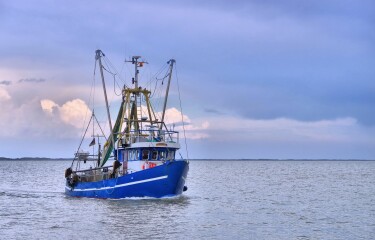
Photo courtesy of LianeM/Shutterstock
