






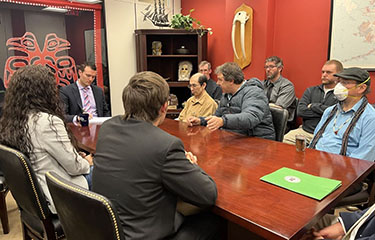
U.S. fishermen who work in New England, Alaska, the South Atlantic, and the Gulf of Mexico traveled to Washington D.C. from 6 to 9 February, 2023, to call for reform of current catch-share programs through the Magnuson-Stevens Act – a revision of which is currently being negotiated by the U.S. Congress.
Catch shares, or limited-access fisheries, are management strategies that assign a proportion of a total allowable catch or quota to a shareholder who then has permission to harvest that amount. There are 17 catch-share programs in the U.S. regulating major fisheries, such as red snapper in the Gulf of Mexico, pollock in Alaska, and scallops in New England.
“A big company can have a bunch of fishing rights, and they will lease out these rights so the fishermen have to pay rent to them. Basically, it creates a landlord-type situation,” North American Marine Alliance (NAMA) Media Coordinator Feini Yin said. “It disconnects access to the fishing rights themselves from the people who are actually out on the water and risking their lives on the boats.”
The NAMA fishermen who traveled to Washington D.C., called for an immediate moratorium to block the creation of new catch-share programs and for the implementation of safeguards for existing catch-share systems. In addition, they asked for rules to create more transparency in catch-share ownership and leasing data to make it easier to find out who owns the quota.
Quota assignment often depends on the historical participation of a shareholder for a historical time period. Once assigned, it becomes an “open market” where quota-holders can sell, trade, or lease to the highest bidders.
Though catch shares have been found to be effective at reducing overfishing, they can harm the social, economic, and ecological components of a fishery by privatizing the right to fish. According to NAMA, the privatization of fishing quotas reduce operations with the smallest ecological footprints – the small- to medium-scale community-based fisheries – due to the prohibitive cost of fishing rights.
“Because the catch-share programs are privatizing the rights to fish and turning fishing rights into a tradable commodity, that really opens the door for private investors, private equity firms, and big corporations to come in and buy up fishing rights,” Yin said. “It kind of turns fisheries into a stock market.”
The current system of catch shares enables wealthy investors to amass fishing rights and then rent those out at prohibitively expensive rates, according to Yin. This also prevents new entrants and younger generations of fishers from entering the trade.
“These fishing rights are so expensive and the margins so narrow that it makes their livelihoods really sort of untenable. It’s had an effect of displacing a lot of community-based, small-scale fishing folks … and prohibiting younger new entrants from coming into fisheries,” Yin said. “There used to be this dream of starting out as a deckhand, gradually working your way up to owning a boat, and then maybe your own little fleet. That really doesn't happen anymore because people can't advance. They're held under the thumb of these prohibitive costs of leasing quota.”
The privatization of fishing rights also allows foreign entities that do not physically participate in the U.S. fishing industry to buy quotas and lease them to U.S. fishermen in the area. One high-profile example is Bregal Partners, a New York City-based fund with ties to a wealthy Dutch family, which owns a minority share in Blue Harvest. According to a 2022 ProPublica story, a 2010 overhaul of federal rules meant to curb overfishing allowed Blue Harvest to become the largest quote-holder in the New England groundfish fishery.
“It's very easy for a non-U.S. entity to do it through a shell company, and that's what's happened with Blue Harvest,” Yin said. “It’s another angle to it – that this really opens the door to non-U.S. entities and governments that basically own shares of a U.S. public resource.”
Using historical participation as a quota basis also harms conservation by rewarding fishing vessels focused on one species rather than fishers aiming to catch multiple species during the year based on an understanding of the local ecosystem, according to Yin. It can also be detrimental to generational fishers who had issues fishing during the time period considered, though have fished for many years previously and after that particular time frame.
According to Yin, NAMA’s goal with the campaign is to ensure that bona fide fishermen are the only ones owning and receiving catch-share quotas. NAMA suggests catch shares be allocated using other measures, such as time spent fishing at sea, or income gained directly from fishing. NAMA is also calling for the allocation of a portion of quota in each fishery for young fishermen and other new entrants. NAMA is also advocating for the elimination of predatory leasing to ensure fishermen receive fair wages.
Louisiana’s Attorney General Office Representative Larry Marino has been one of the most-vocal public critics of catch-share schemes. Following a series of stories on the so-called “snapper barons” in the Gulf of Mexico red snapper fishery, Marino has called for an end to “intimidation, blackballing, and abuse of power that big shareholders in the Gulf’s red snapper fishery employ to exercise control over the allocation of those fishing rights.”
“This has global implications because the catch-share model has spread worldwide,” Yin said. “Catch-share programs have been implemented in New Zealand, Australia, and Iceland. In all those places, we've seen similar lost cultural connections to seafood because fishing folks that have been fishing for generations have suddenly had that access disconnected. Economic collapse with communities that are built around fishing has been seen, and the issue of young fishermen not having access persists.”
Photo courtesy of North American Marine Alliance
