






The latest statistics for Norway’s seafood exports in May are revealing a deepening of existing 2026 export trends regarding both growth in Poland and China and stagnation in the U.S. market.
The Norwegian Seafood Council (NSC) reported the May seafood export totals, and marked the fourth month of value declines this year, with exports totaling NOK 13.4 billion (USD 1.44 billion, EUR 1.24 billion), a year over year decline of NOK 146 million (USD 15.7 million, EUR 13.5 million), or 1 percent. The year-to-date value of Norwegian seafood exports is currently NOK 70.3 billion (USD 7.58 billion, EUR 6.51 billion), a decline of NOK 1.7 billion (USD 183 million, EUR 157 million), or 2 percent, year over year.
"A turbulent geopolitical backdrop, trade barriers and reduced availability of raw materials continue to affect seafood exports. So far, 2026 has been far more challenging than last year for Norwegian seafood. Despite higher prices for salmon, cod and mackerel in May, this was also a month without growth in value," NSC CEO Christian Chramer said in a press release about the news.
January to May export volumes for cod, mackerel, saithe, prawns, and king crab have all fallen this year, which Chramer linked to quota restrictions. Year to date, cod exports are down by 29 percent year over year, mackerel is down 55 percent, saithe by 30 percent, prawns by 34 percent, and king crab by 54 percent.
Chramer added that low volumes in these categories affected May's results, compounded by the relative strength of the krone compared to the dollar and euro, which "means that export prices are lower when measured in Norwegian kroner."
The biggest losses in May were seen in the U.S. market, which declined in value by 27 percent year over year, with a total value of NOK 992 million (USD 107 million, EUR 91.8 million). The NSC said that the January to May value of the U.S. market had declined by NOK 2.4 billion (USD 259 million, EUR 222 million) when compared with the same period last year.
Though the U.S. remains a key export market for both fresh and frozen salmon fillets from Norway, U.S. trade policy appears to have significantly reshaped the flow of Norwegian salmon into U.S. markets over the last two years. Chramer attributed most of the U.S. market value decline to stagnation in this category.

The war in the Middle East had also affected global salmon exports, Chramer said. Reduced tourism to the region and logistics challenges amounted to a drop in export volume to Norway's major Middle Eastern salmon markets by more than 20 percent.
Salmon consumption was strong in the E.U., however, with Norway exporting 111,062 Metric Tons (MT) of salmon to the bloc in May, at a value of NOK 9.6 billion (USD 1.03 billion, EUR 889 million). That represented a year-over-year value growth of NOK 101 million (USD 10.9 million, EUR 9.35 million), or 1 percent, despite the fact that overall export volumes of salmon to the EU did not increase in May year over year.
The NSC noted an increase in salmon sales in Germany in May, where it said customers are usually price sensitive and largely consuming products that have been processed in Poland. NSC Germany representative Christine Iversen said this offered an opportunity for the country’s salmon industry.
"When the price of other proteins rises more than that of salmon, or when supermarket chains run promotions, this has a significant impact in a country as populous as Germany,” Iversen said. “The research firm Nielsen reports an increase in salmon sales so far this year compared with last year, and this growth is across all categories, from frozen and smoked to raw and marinated."
Poland, China, and Sweden were May's biggest growth markets for Norwegian seafood exports overall, with Poland, China, and Spain the biggest growth markets for salmon. The main factors driving this growth were demand for whole salmon in Poland, while the Chinese market was characterized by "strong demand for seafood for raw consumption," said Chramer, who noted that salmon and prawns were fast growing categories there.
Poland saw 29 percent year-over-year growth in its May export value, achieving NOK 1.7 billion (USD 183 million, EUR 157 million); while China saw growth of 37 percent, achieving NOK 1.2 billion (USD 129 million, EUR 111 million); and Sweden saw growth of 27 percent, achieving NOK 470 million (USD 50.7 million, EUR 43.5 million).
Trout export volume and value fell in May, with Norway exporting 6,484 MT valued at NOK 540 million (USD 58.2 million, EUR 50.0 million) during the month. That represented a 11 percent drop in volume and a drop in value of NOK 47 million (USD 5.07 million, EUR 4.35 million), or 8 percent.
Despite the overall declines, the category grew in value in Poland, where it gained NOK 27 million (USD 2.91 million, EUR 2.50 million) in value, an increase of 62 percent, year over year. Export volume also increased to Poland in May by 920 MT, or 50 percent year over year.
The NSC noted that while a 52 percent decline in May export volumes for fresh wild cod was due to historically low landings, it emphasized that fresh farmed cod was expanding its reach, now making up 55 percent of the fresh cod category's total export value.
"Farmed cod accounts for over half of fresh cod exports for the ninth time ever in a single month, and for the first time in May,” NSC Seafood Analyst Eivind Hestvik Brækkan said. “With prospects of increased volumes in the coming months, we expect farmed cod to remain the dominant category for the rest of the year."
Frozen cod saw its export volume to the U.K. cut by 37 percent in May, and dropping by NOK 68 million (USD 7.33 million, EUR 6.30 million), or 24 percent, in value year over year. Brækkan said that substitution was becoming more important as cod markets around the world are "facing challenges in securing sufficient supplies of cod."
"Low volumes and high prices are making other species more attractive," he said, noting increases in imports of South African hake to the U.K.
Norwegian clipfish exports in May were at the lowest export volume in the past 27 years, amounting to 2,060 MT exported, a decline of 44 percent year over year. Those exports were worth a total of NOK 226 million (USD 24.4 million, EUR 20.9 million), a NOK 114 million (USD 12.3 million, EUR 10.6 million), or 34 percent, drop in value compared to May 2025.
The same pattern was seen in the salted fish category, with a year over year volume drop in May of 25 percent for a total of 2,587 MT. Those exports were worth NOK 287 million (USD 30.9 million, EUR 26.6 million), a drop in value of NOK 21 million (USD 2.26 million, EUR 1.94 million), or 5 percent, year over year.
Brækkan linked both declines to the scarcity of raw materials for clipfish and salted fish, including cod and saithe.
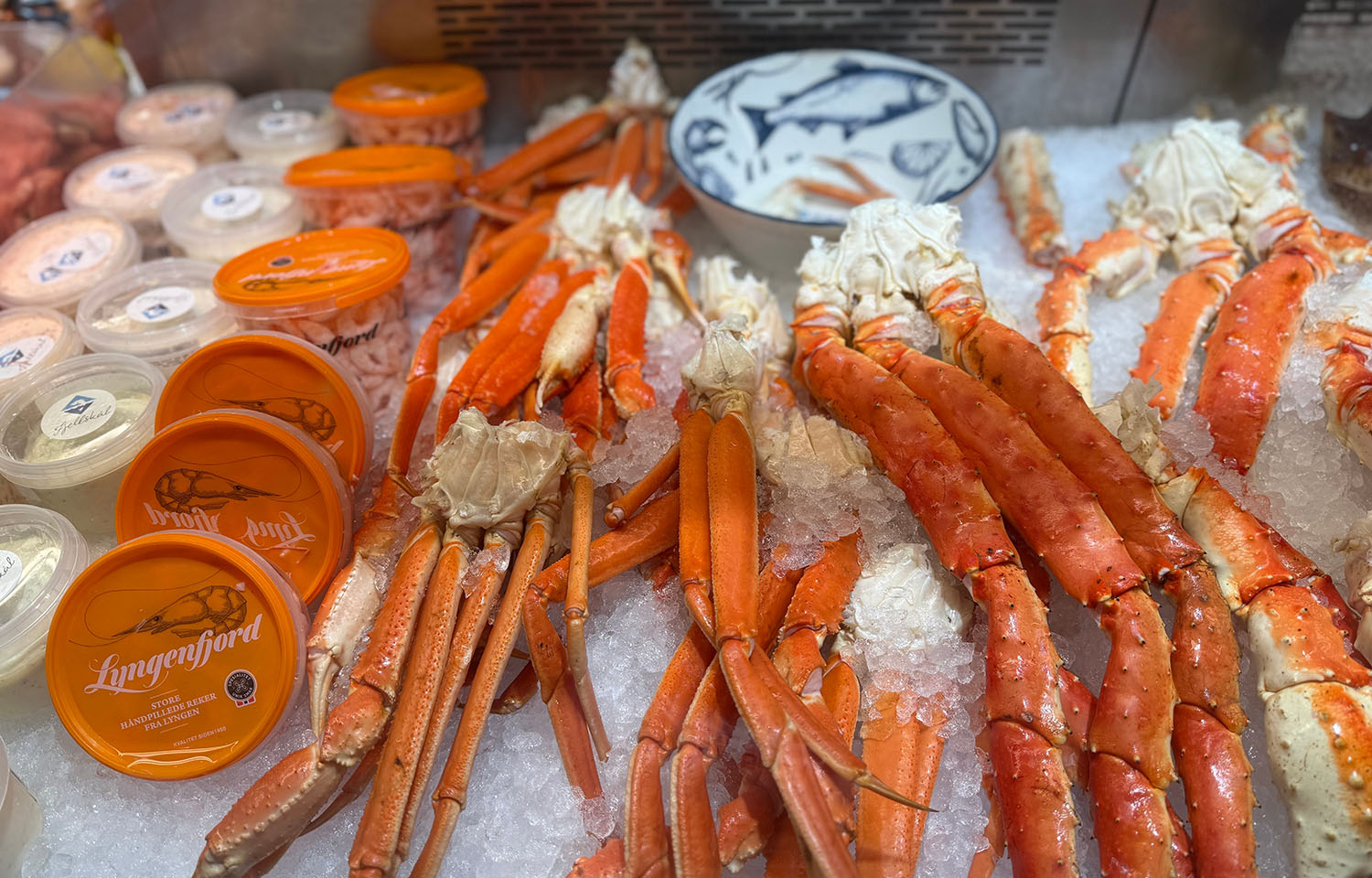
Export volumes and values for stockfish, herring, king crab, and snow crab all fell in May. Norway exported 87 MT of stockfish worth NOK 16 million (USD 1.72 million, EUR 1.48 million), 7,123 MT of herring worth NOK 161 million (USD 17.4 million, EUR 14.9 million), 59 MT of king crab worth NOK 31 million (USD 3.34 million, EUR 2.87 million), and 974 MT of snow crab worth NOK 159 million (USD 17.1 million, EUR 14.7 million) during the month.
Mackerel saw a 25 percent decline in export volume in May, but a NOK 25 million (USD 2.70 million, EUR 2.31 million), or 12 percent, increase in value during the month, for a total value of NOK 231 million (USD 24.9 million, EUR 21.4 million). NSC head of pelagic species Eirik Johnson said that the strengthening of the krone increased the price of mackerel in some markets.
He pointed out that the U.S. was the second largest market for frozen mackerel in May, after only South Korea.
"This is partly due to the US having a preference for large mackerel, of which there is now more available, growing demand among Asian consumers in the U.S., and the fact that competing products have become more expensive," he said.
Prawn also saw volume growth and strong export value, which experts achieving a value of NOK 238 million (USD 25.7 million, EUR 22.0 million) in May on 3,676 MT exported. That represented a value growth of NOK 66 million (USD 7.12 million, EUR 6.11 million), or 38 percent, year over year, and a 13 percent increase in volume.
"The growth was largely driven by raw frozen prawns, particularly to China, where demand for prawns for raw consumption is high,” NSC Head of Shellfish Josefine Voraa said. “This has led to a larger proportion of the catch going to this segment, whilst raw material prices have risen significantly."
