



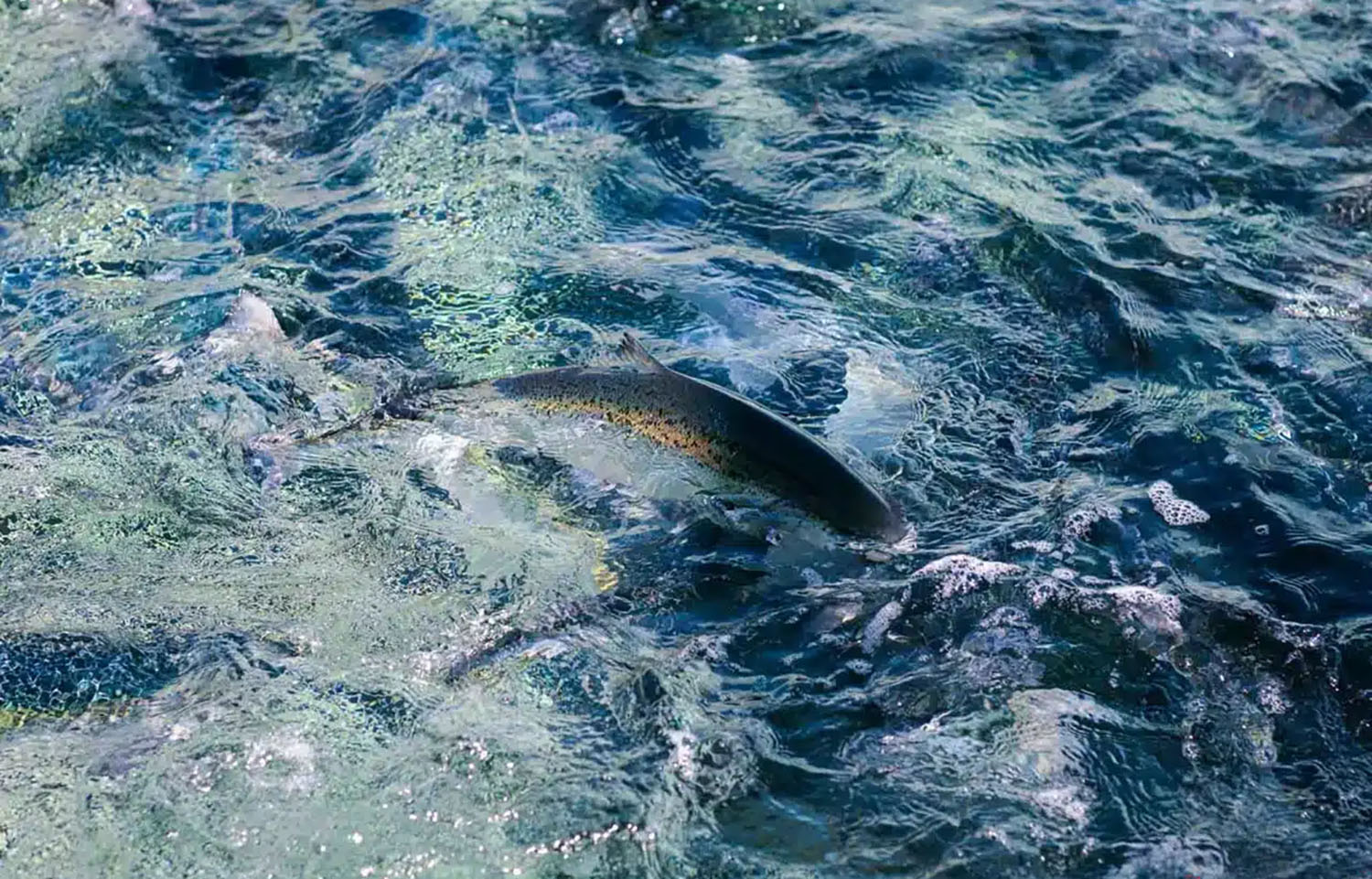
Frøya, Norway-headquartered salmon-farming firm SalMar has raised its 2026 harvest guidance by 20,000 gutted weight tons (GWT) to 350,000 GWT after reporting record second-quarter harvest volumes alongside a sharp improvement in earnings.
The firm harvested 81,800 GWT of salmon in Q2 2026, which was up from 64,500 GWT in Q2 2025. Meanwhile, the group’s EBIT more than doubled to nearly NOK 1.24 billion (USD 132.9 million, EUR 114 million) from NOK 524 million (USD 56.2 million, EUR 48.2 million) a year earlier.
Delivering the company’s Q2 results, CEO Frode Arntsen confirmed the strongest performance came from SalMar's Norwegian farming operations, where harvest volume reached a Q2 record 71,500 GWT, compared to 54,500 GWT a year earlier.
As a result, Norwegian operational EBIT rose to NOK 1.23 billion (USD 131.9 million, EUR 113 million) from NOK 696 million (USD 74.6 million, EUR 64 million).
However, the group’s Q2 performance was less positive outside Norway, with Arntsen acknowledging “weak” results from both Icelandic Salmon and its joint venture Scottish Sea Farms, attributing these to high costs throughout the value chain.
Elsewhere in the quarter, Arntsen noted the company's Sales & Industry business delivered improved profitability, citing higher capacity utilization at SalMar’s processing facilities, improved operational performance following the upgrade of its InnovaMar facility, and strong sales performance as driving factors.
Arntsen said overall positive performance has continued into Q3 and that the first seven months of 2026 for SalMar were “significantly stronger” than previous years.
“Compared with the average of the last 10 years, the mortality is 40 percent lower, the growth is 33 percent higher, and the superior share is 9 percentage points higher,” he said. “Compared with last year, the picture is equally strong. We can, therefore, confidently say that 2026 has so far been a record year biologically.”
There’s no single explanation for the improvement, Arntsen explained.
“The reality is that many factors contribute: genetics, smolt quality, vaccines, production technology and strategy, and many other elements,” he said. “They are the result of work over a long period and our constant ambition to operate on the salmon’s terms.”
The CEO also provided an update on SalMar's planned acquisition of a majority stake in Måsøval. An agreement was reached in July to purchase Heimstø's 85.7 million shares in the firm – equivalent to approximately 70 percent of the company – for NOK 39.50 (USD 4.23, EUR 3.63) per share. The transaction has a total consideration of approximately NOK 3.4 billion (USD 364.5 million, EUR 312.5 million).
Describing Måsøval as a “well-established and well-managed company,” Arntsen said the acquisition would provide an “exciting industrial opportunity that will further strengthen SalMar's position in Central Norway – one of our most important regions.”
“We also see significant potential for further development, both in terms of sustainable growth in the local communities where we operate and through the realization of synergies across the value chain,” he said. “Together, we can optimize the utilization of licenses and farming sites, improve biological performance, and reduce costs. Based on our experience from previous acquisitions, we currently estimate annual operational cost synergies of approximately NOK 300 million [USD 32.2 million, EUR 27.6 million]. Naturally, we will assess this in greater detail once the transaction has been completed, and we have full access to Måsøval's operationals and financials.”
With the transaction subject to necessary regulatory approvals and other customary closing conditions, SalMar does not expect completion before the beginning of 2027, he said.
Also in Central Norway, SalMar reported successful harvesting from its offshore farming operation Ocean Farm 1 in Q2, supported by strong biological performance. Its next production cycle will commence shortly, Arntsen said, with the expectation that approximately 5,000 GWT will be harvested in Q2 2027.
