






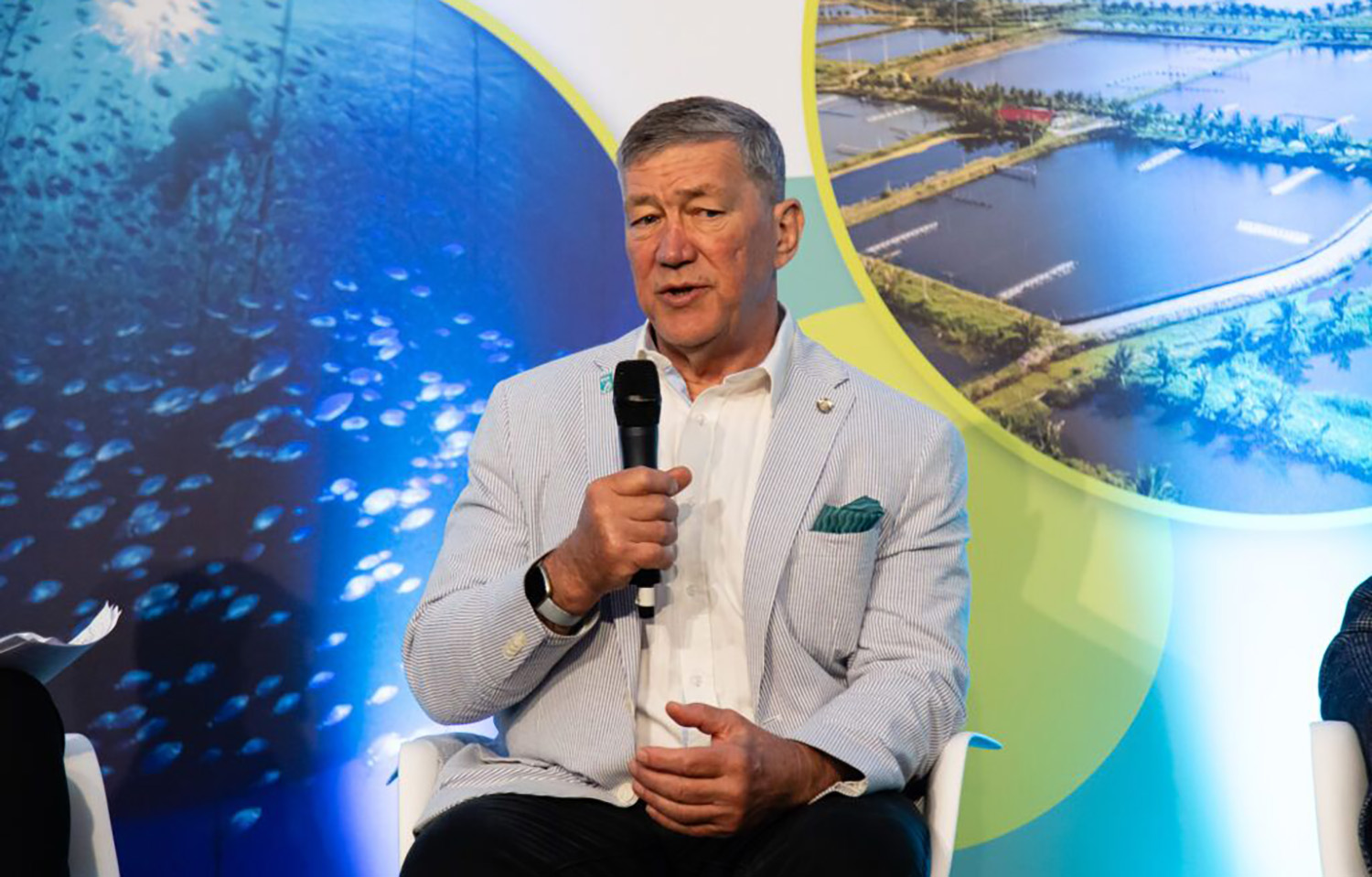
Companies, government officials, NGOs, and even some protestors all converged on London, England, to discuss what innovations are needed to maximize the potential of the blue economy.
The 2024 Blue Food Innovation Summit, which ran from 21 to 22 May in London, brought together global seafood industry stakeholders to share knowledge and brainstorm how to scale blue food production sustainably. Subjects covered at the event included financing, social licenses, feed, innovation, technology to supply chains, the introduction of new species into aquaculture operations, certifications, education, and effective collaboration.
“Innovation will be key in adapting to rapidly evolving food supply chains in a time when our oceans are under unprecedented environmental pressure,” U.K. Minister of State for Climate, Environment, and Energy Richard Benyon said at the forum.
Scaling up the production of aquaculture feed sustainably was one of the core topics discussed at the summit. It is estimated that the demand for feed will reach 100 million metric tons by 2050, and with limited supplies of sustainable raw materials available for incorporation into fish feed, manufacturers are seeking alternatives such as insects. Simultaneously, the diminishing availability of omega-3 oils from marine sources has seen algae oil and crop oils gaining traction in the space – a trend presenters said could radically alter the industry.
“Crop oils will be a game-changer as alternatives to fish oil and take the pressure off the marine environment,” Paddy Campbell, the vice president of aquafeed-maker BioMar’s salmon division, said.
Aquaculture Stewardship Council CEO Chris Ninnes said greater investments in seafood-sector technology and innovation will inevitably lead to the enhancement of its sustainability.
“At ASC, we see the future adoption of technology as pivotal to delivering increased social responsibility and environmental sustainability and to deliver increased value to our clients,” he said.
Louise Buttle, a global key account manager at Heerlen, Netherlands-based chemical manufacturing company dsm-firmenich, predicted aquaculture firms will gradually shift away from short-term feed contracts and move toward longer-term agreements, which will grant the alternative ingredients industry the ability to expand.
“In terms of investment in novel raw materials early on, new business models are needed,” she said.
More broadly, private-sector financing will be vital in helping the blue food industry progress, Buttle said. However, there needs to be more mainstream acceptance of the seafood industry innovations being formulated today, and a more consistent return on the investment in those technologies, before the funding spigot is fully opened, according to Gulf of Marine Ventures President Blaine Grimes.
“There’s a significant gap between impact investment and venture capital when companies are trying to get to Series A funding. We have a number of companies talking to us that are looking for venture capital but aren’t quite ready for prime time,” Grimes said.
Some big companies, though, have already found merit in investing in sustainable blue food projects themselves. Thai Union recently launched SeaChange 2030, a multi-pronged USD 200 million (EUR 178 million) initiative focused on investing to ensure 100 percent of the company’s seafood comes from responsible sources by 2030. Chris Shearlock, Thai Union's sustainability director for Europe, said he believes other companies will follow suit with similar initiatives.
However, Luke’s Lobster Co-Founder and Chief Innovation Officer Ben Conniff warned that a massive influx of capital into the seafood industry might result in a net benefit. Conniff outlined a hypothetical situation in which a company borrowing from venture capital investors to pursue eco-certification with the goal of edging out and eventually buying up the competition. But then it struggles to meet its defined exit solution, drops its offer to fishermen, and triggers a collapse of the fishery.
“Increasing numbers of regulations, certifications, and tech solutions can be onerous and expensive and hard to manage for fishermen and small- and medium-[sized] enterprises,” he said. “Lobstermen fear corporate consolidation of the fishery, and the [U.S. state of] Maine fishery is one of the few left where every lobsterman owns his own boat and there is a diverse range of companies competing for their catch at the dock.”
During the conference, art collective Ocean Rebellion staged a protest outside the event featuring a rotting tuna, urging people to not buy John West tuna, calling out the tuna sector's problems with bycatch and use of fish-aggregating devices, which are often abandoned, causing environmental damage.
