






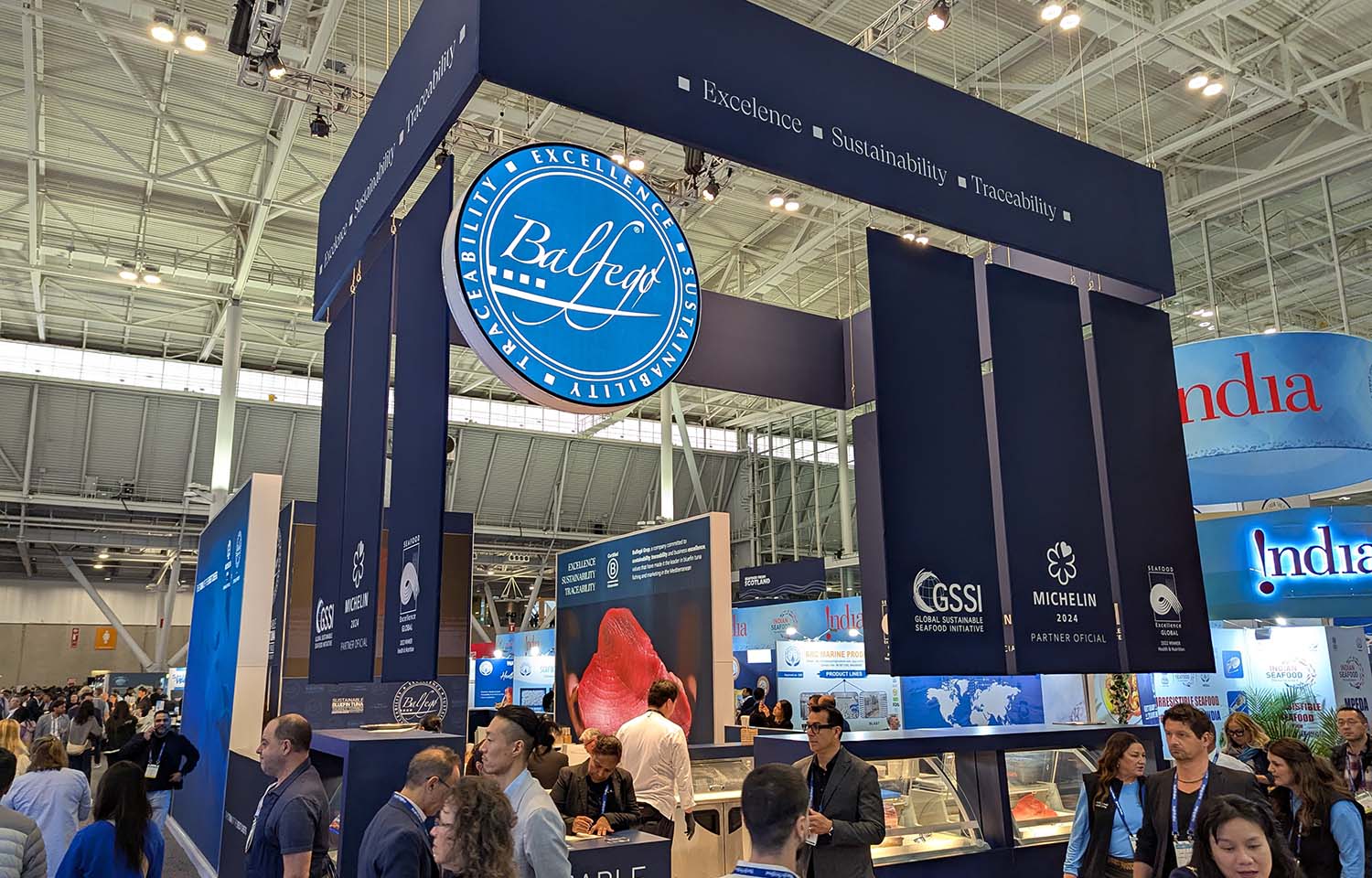
Spanish tuna company Balfegó is preparing to inaugurate a new processing and office facility in Spain in time for the 2025 Seafood Expo Global, taking place this year in Barcelona, Spain, from 6 to 8 May.
Balfegó catches bluefin tuna in May and June each year and then ranches the fish in farms off the coast of L'Ametlla, Spain. The company then feeds its fish a specific diet depending on customers’ needs and harvests them using the Japanese ikejime method to produce a high-end product.
Balfegó Marketing Manager Laia Ortiz Radua told SeafoodSource during Seafood Expo North America – which ran from 16 to 18 March in Boston, Massachusetts, U.S.A. – that the company is now poised to open a new facility in Spain that will allow it to accelerate its expansion after years of being hampered by space constraints.
“We are going to expand the brand, not just in terms of selling more tuna but in terms of creating new products. We are going to present everything on 5 May,” Radua said.
Radua said the company has been working in provisional facilities for multiple years. Its main facility was hit by a fire that destroyed the plant in 2018, and since then, it has been working to avoid investing in what was always supposed to be a provisional facility.
“We didn’t want to invest a lot of money there,” Radua said.
Not investing in that facility has been difficult as Balfegó has been growing steadily. Radua said when she first started roughly six years ago, the company was made up of roughly 80 employees. Now, it employs over 200, and in the last year alone, it has hired 40 more people.
“So, the company was growing a lot, and we haven’t had enough space to grow at the same time,” Radua said. “So, you have to have more people cutting the tuna or more people preparing the boxes, but you don’t have enough space.”
That lack of space has had other consequences for the company aside from hampering growth. It also kept it from moving into markets and product formats that it wanted to because there wasn’t any room to house the equipment that would enable it to do so.
One great example of the problems posed by the lack of space is the company’s carpaccio products, Radua said. The company has been cutting and preparing tuna carpaccio for multiple years, but because of the space constraints, it has been relegated to keeping distribution small due to lack of production capacity.
“In Spain, we have a lot of distributors asking for it. They say, ‘You have it here, but I cannot have it for my customers?’” Radua said. “But, we don’t have space for a big machine; we can create a small amount, but we cannot produce for a distributor who will buy 100 kilograms a month.”
Carpaccio is just one example. The company is also hoping to create retail products that it can sell in high-end grocery stores in Spain.
“That has been our desire for many years, but we do not have enough space in the factory to be able to prepare the cuts,” Radua said. “Now, we are starting to work on a project to bring Balfegó to retail.”
Radua said the goal is to start with the top supermarkets in Spain to gauge if the demand for its products is sufficient enough to expand from there.
“We will start in El Corte Inglés, which is one of the most important supermarkets in Spain,” Radua said. Balfegó’s products will be located in the gourmet section, she said.
“If that works, maybe we can copy that strategy and put it in Europe – Germany or France – but we are going to start in Spain,” Radua said.
In addition to bringing products to retail, Balfegó is also planning to bring new products to its HORECA customers. That will include new pre-cut products that customers can purchase, rather than Balfegó’s existing loin or belly products.
“Now, we are going to have sakus, which is a Japanese cut,” Radua said. “Japanese restaurants really like it. You give them it cut, and it’s perfect because they only have to defrost it and can prepare anything with that.”
Radua said a big motivator behind producing more processed cut products is to expand its customer base by allowing restaurants to utilize tuna of Balfegó’s quality without needing a specially trained chef.
“You don’t need to have a sushi chef in your kitchen to be able to buy bluefin tuna,” Radua said. “A lot of restaurants, if they don’t have a sushi chef, are afraid to buy a chunk of loin or belly because they will say, ‘It’s more expensive than all the other kinds of bluefin tuna, so why would I buy it if I don’t have anyone in the kitchen who is going to make the most of it?”
