


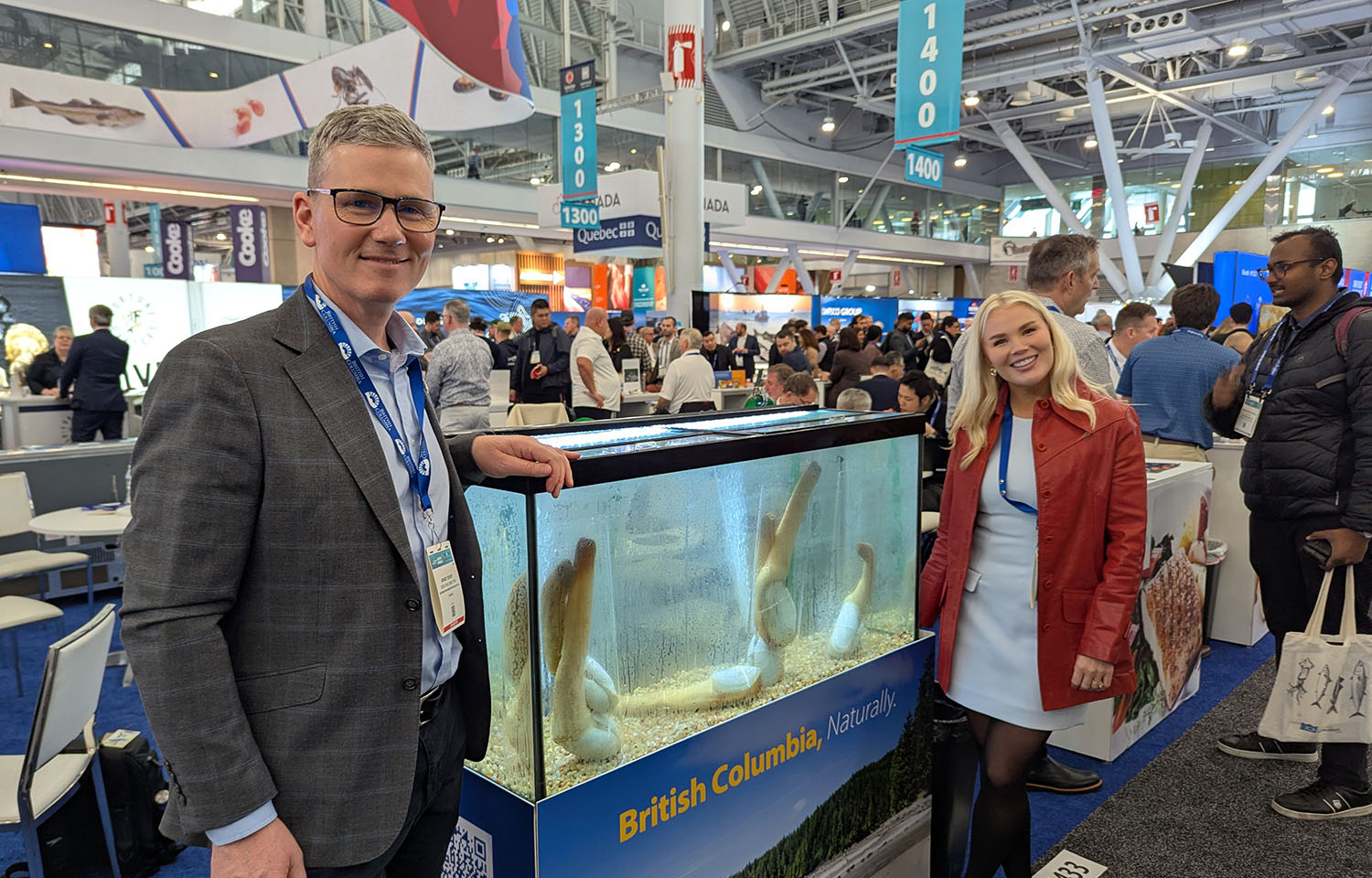
The geoduck fishery in British Columbia, Canada is bracing for the start of China’s 25 percent tariffs on shellfish on 20 March, which could completely upend the market.
China announced the tariffs on 8 March, hitting a range of Canadian goods, including Canadian shellfish. Geoduck is included in that higher tariff – and according to Underwater Harvesters Association Executive Director Grant Dovey, they came as a surprise during an already difficult year for the fishery.
“This was a surprise. Granted, they’re talking about a retaliatory tariff from the fall of 2024, but it was not on anyone’s radar,” Dovey told SeafoodSource.
Underwater Harvesters Association represents geoduck harvesters in B.C. Geoduck in the fishery are harvested individually by divers that swim to the bottom and grab members of the species by hand.
According to Katie Lindsey, marketing manager for the association, the fishery was already struggling.
“We were already struggling in our fishery this year, its been our slowest year of production juts based on the economy in China,” Lindsey said. “We spoke to our retailers in the wet market, they said that they were operating at about 25 percent of what they usually are in any given year.”
Because of the slow market in China, the fishery still wasn’t close to catching its full quota with the end of the season approaching.
“The season was supposed to end at the end of March, and we needed an extension prior to the tariffs – and then the tariffs happened and we need an extension even more,” Lindsey said.
An extension needs to come from the government, but according to Lindsey the fishery hasn’t heard anything.
“If we don’t get the extension before the end of March, it’ll be the first year that we can remember that we don’t finish our quota,” she said.
Dovey said the association spoke with officials at Canada’s Department of Fisheries and Oceans, and will hopefully hear sooner or later whether the fishery gets the extension it needs. Exporters have already stopped taking product because the tariffs are being applied at the border – so any product in the pipeline will be hit by the time it reaches China.
“Whether that shutdown is five days, 10 days, longer – we’re not sure,” Dovey said.
That shutdown will likely drive prices down, on top of what the fishery was already dealing with.
“Prices has already come down 30 percent this year, with the slow market, and there’s talk of another 20 percent reduction after 20 March, and that’s for Alaska and Washington too,” Dovey said.
The vast majority of B.C.’s geoduck production goes to China, and while Underwater Harvesters has worked to build awareness and markets, those efforts take time.
“We go to the show in Barcelona, we try to build a bit of a market in Singapore, we’ve understood the need to diversify – but because of a situation like this, where it gets pulled from underneath us and we don’t have any other option, it’s really difficult,” Lindsey said.
China’s historically high demand for the product, and the high price it has been willing to play, has worked for the fishery as a way to build its value – but has also worked against it by making it difficult to justify sending product elsewhere.
“Even if the price is similar, but it’s a 10th of the volume that they could move elsewhere, it’s hard to take that punch,” Dovey said.
The tariff problem is only adding to the fishery’s uncertainty, as it is still grappling with potential marine protected areas (MPAs) that could end up removing access to 40 percent of the fishery’s current area.
The process that began the potential MPAs was started in 2023, and according to Dovey, there is still relatively little understanding of what will happen.
“We’re still waiting for final zoning, which is going to happen over the next three years in the best fishing areas on the coast,” Dovey said. “So what we’ve seen initially is that could be devastating as well. But we’re hoping that there’s some balance there and it comes out more balanced.”
Dovey said at this point the fishery is facing multiple potential crisis, and is waiting for 20 March and the smoke to clear to see what the future could hold.
“It’s the worst possible timing for us with the fisheries,” Lindsey said. “If it was in the middle of our fishing season, and we had a couple weeks here and there to say ‘oh we’ll stop fishing and we can just work hard to finish that quota toward the end of the season,’ it could be okay. But the fact its happening right now, right at the end of the season – which has already been a hard season of plugging away just trying to finish the quota – it’s a worst case scenario for us.”
