



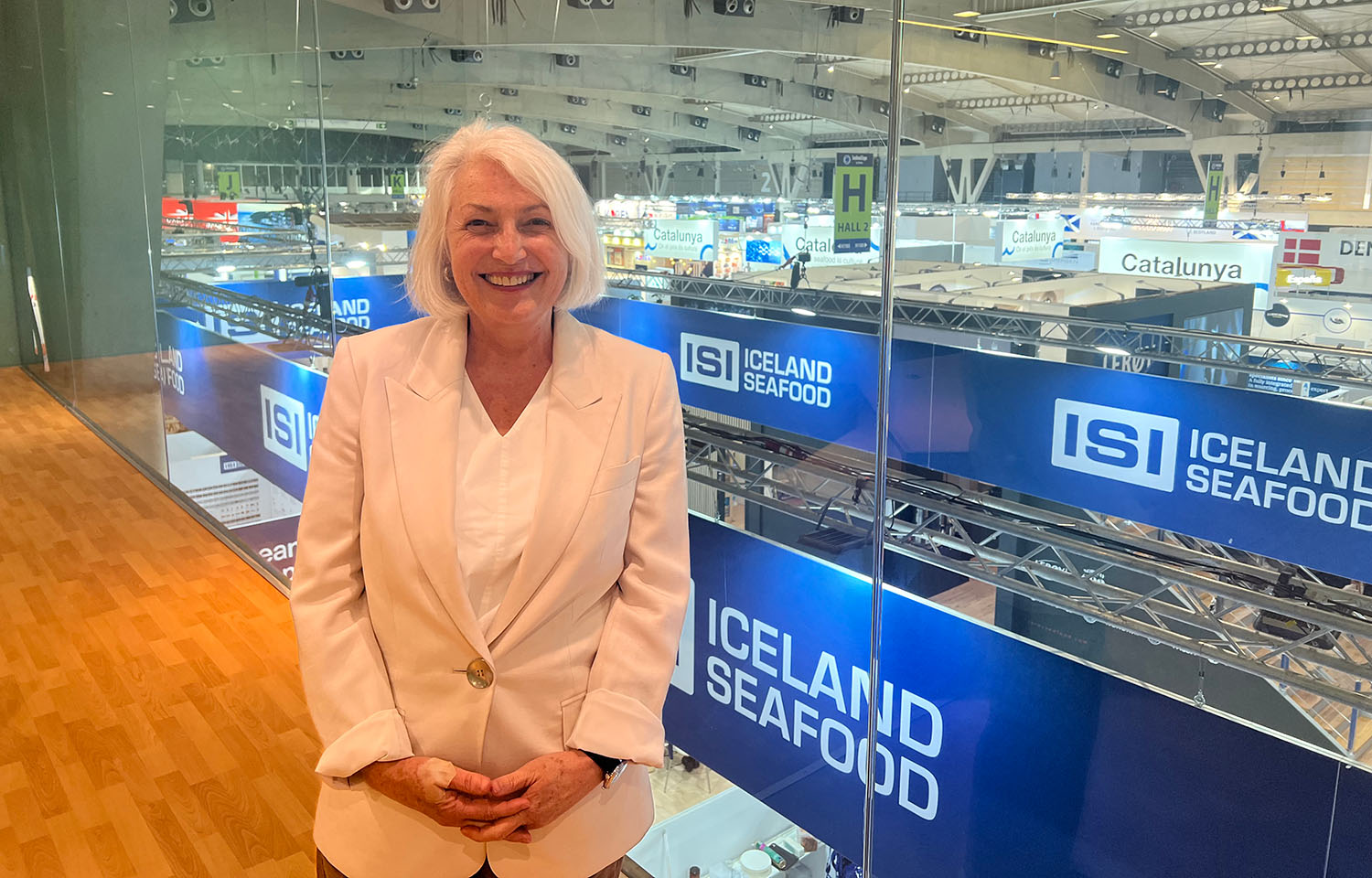
Despite ongoing trade difficulties, rising costs such as fuel, and other challenges facing seafood sectors around the globe, Canadian seafood producers remain optimistic in the long-term viability of their sector, according to Canadian Fisheries Minister Joanne Thompson.
“The world wants Canadian seafood. I saw it when I was in Boston [at the 2026 Seafood Expo North America], and I see it here. There’s huge potential to diversify and expand markets. It’s really exciting,” Thompson told SeafoodSource at the 2026 Seafood Expo Global (SEG), taking place from 21 to 23 April in Barcelona, Spain. “I don’t know, to be frank, that I have had a conversation [at SEG] that wasn’t optimistic.”
Thompson said in her role as minister, which she’s held since March 2025, she has worked to ensure the sector can maintain that sense of optimism, and has offered it her support in conjunction with Canada’s Department of Fisheries and Oceans (DFO). That support, she said, has manifested in recent concrete actions such as strengthening returns for wild Pacific salmon, negotiations to renew multiple provincial fisheries support funds, new marine protected areas and a new small craft harbor in Nunavut, and more.
She also said it has manifested in such forms as simply sustaining dialogue with the sector, via such means as attending SEG for the first time in her ministerial capacity.
“The best thing we can do in this turbulent time with this tremendous amount of uncertainty is work together to ensure the supports align with forward projections in the sector and [determine] how we can help leverage and [identify] opportunities in new markets and ensure security and diversity,” she said.
One cause for optimism that Thompson pointed to was the recent announcement that not only has Canada’s Northern cod remained healthy, but it has grown 20 percent in the last year and will enter the assessment process for Marine Stewardship Council (MSC) certification this year.
Canadian Northern cod stock plummeted in the 1990s, leading to a 32-year moratorium on fishing the species. After launching a fishery improvement project (FIP) for the stock in 2015 and then a tag-and-tracking program to gather more data on the stock in 2019, the Canadian government reopened the fishery in 2024, deeming the population sufficiently recovered to support commercial fishing and setting a total allowable catch (TAC) of 18,000 metric tons (MT).
A year later, the DFO more than doubled the TAC to 38,000 MT, and now, the FIP has been successful enough to warrant Northern cod’s entry into the MSC certification track.
“There is excitement and pride here in Barcelona today, but there is also growing excitement and pride at home in Newfoundland and Labrador, where people and communities will feel the economic benefits of a strong, healthy, Northern cod stock that is sought around the world,” Lorelei Roberts, the executive director of Newfoundland and Labrador trade group Association of Seafood Producers said in a release.
“A generation ago, lessons learned from Northern cod shaped best fishing practices of fisheries around the world. Following two successful years of a commercial fishery, the latest science on the stock points to a remarkable recovery. At High Liner Foods, we are proud to be a long-term supporter and contributor to the Northern Cod fisheries improvement project, and we are eager for Newfoundland and Labrador cod to become a larger part of our supply of responsibly harvested and managed seafood,” High Liner Foods President and CEO Paul Jewer added in the release.
Though the stock’s recovery comes at a time when cod quotas in Europe have plummeted, presenting both domestic and possible export opportunities, Thompson warned that any further decision to expand TAC would have to be led by science, following a strategy that allowed the stock to reach its current healthy status.
“Science has to lead, and then we always consult with people on the water. If there’s a disconnect in perspectives, we look at that, as well as the socioeconomic side of things,” she said. “In Newfoundland and Labrador, it’s part of the culture; it’s why the province was originally settled. I never underestimate how important these decisions are, and when you can balance that successfully with science, it’s wonderful.”
Thompson said that as both wins like cod stock recovery and losses like sporadic trade disruptions arise, the Canadian seafood industry has maintained a sense of possibility and optimism for the road ahead.
“We are here at SEG to support the industry and ensure there is a next generation for our fisheries. We all win when we do this together. There are ups and downs. That’s just the reality, but at the end of the day, we have to be good stewards of our blue economy and ocean ecosystems,” she said. “Countries want Canadian seafood, and we have that seafood, so I think we can come together in a way that works for all parties.”
