

More than 30 million cans of imported canned fish sold in Chile are misleading the public with false labeling, according to a formal complaint filed by industrial fishers association Pescadores Industriales del Biobío.
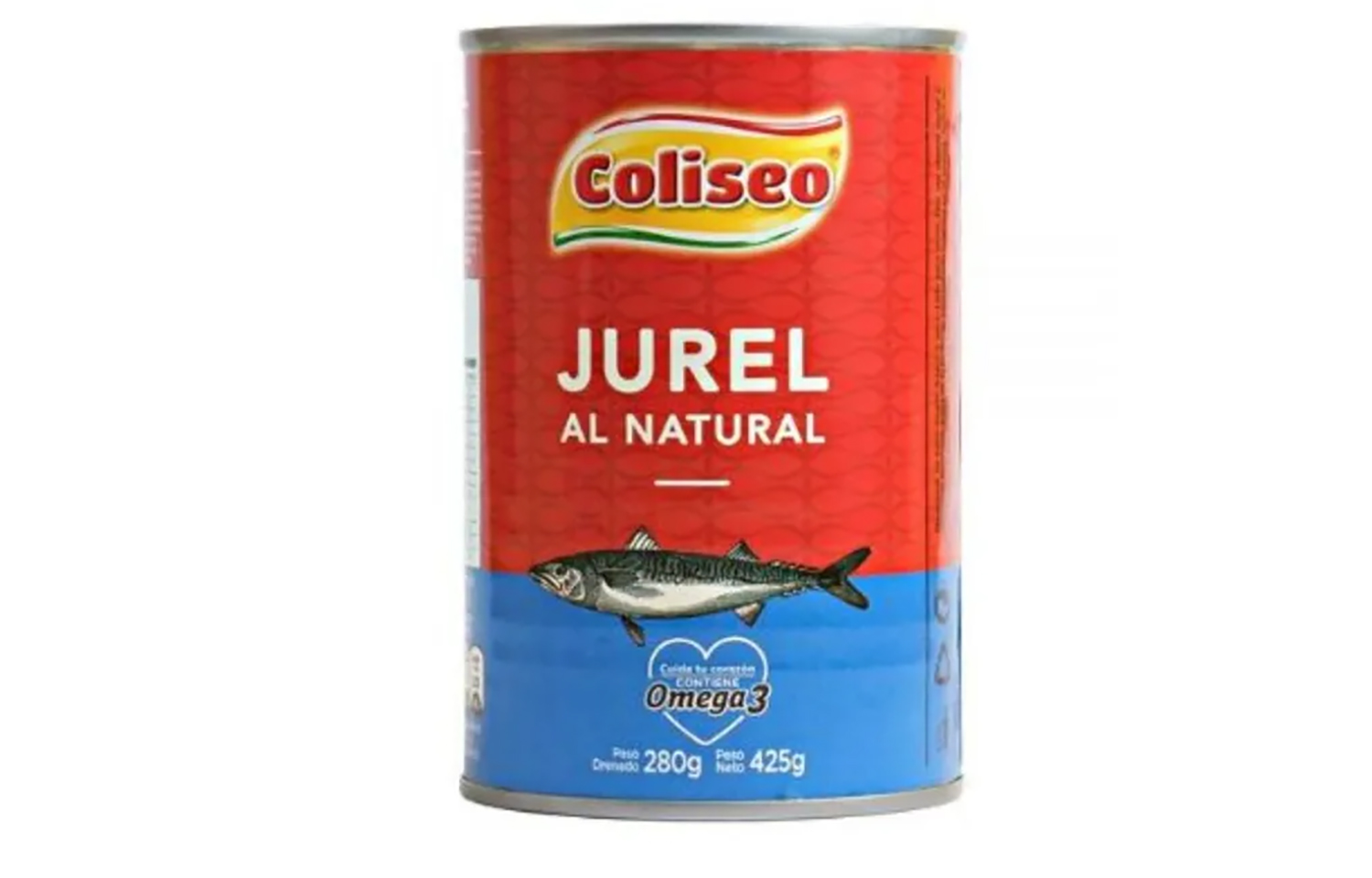
The products in question, labeled as “jurel,” or jack mackerel, are imported from China and sold under brands like Coliseo, Barquito, Novamar, and Acuenta – the latter of which is the low-cost private label of Walmart Chile. According to the association the cans have been widely distributed through supermarkets, wholesalers, neighborhood shops, and even through government-funded school meal programs.
The association asserts these products compete unfairly with locally caught Chilean jack mackerel, and that the imported canned fish, despite their labeling, are not jack mackerel at all and are made from other, lower-quality fish species such as chub mackerel, Spanish sardines, or a mix of different species in the same can.
Basing its accusation on scientific analyses of domestic and imported samples conducted by two accredited laboratories, the association said the imported products are “falsified.”
In a complaint filed with the Metropolitan Regional Health Authority, the association is seeking sanctions and requested the cans be withdrawn from the market.
“Thirty million cans currently circulating in the Chilean market are not real jack mackerel. That’s almost half of all canned mackerel consumed nationally,” Pescadores Industriales del Biobío President Macarena Cepeda said in a release. “This is unfair competition, as national companies comply with existing legislation, process Chilean raw materials captured with high sustainability standards, and generate thousands of jobs in communities like Coronel and Talcahuano.”
In one of the tested products imported from China, the association said there was an 18 percent difference in the amount of sodium when compared to domestic products, a 51.4 percent difference in fat, and 13.2 percent less protein.
If the health authority determines that there is counterfeiting occurring, companies face a fine equivalent of up to CLP 69 million (USD 71,440, EUR 61,640) in addition to possible recalls of these products or directives demanding the companies to properly label the products to comply with standing regulations, Metropolitan Regional Health Authority Head Gonzalo Soto said on national television.
If proven, companies could face significant fines and collective lawsuits, too.
Under Chilean legislation, labeling of food products must accurately reflect the true nature and nutritional content; mislabeling or selling adulterated or falsified foods is considered a serious offense.
Beyond possible health implications, legal experts, including César Eugenio Vargas, a professor of law at Universidad Andrés Bello, suggest this case could represent a major violation of Chile’s consumer rights law.
The findings of the two accredited laboratories “are not only worrying from a technical perspective, but also expose a potential flagrant violation of consumer rights,” Vargas said in an op-ed in local newspaper El Mostrador.
“If it is confirmed that the companies involved concealed or falsified information about the product's actual contents, we would be facing an act of commercial deception of enormous proportions," Vargas said.
In the meantime, Junaeb, a Chilean public institution that supports students experiencing situations of social vulnerability and which uses 38 brands of canned mackerel as part of its program to feed school children, said that as a precautionary measure it has instructed all school cafeterias in the country to make adjustments to their menus and suspend the use of products belonging to the canned fish brands under investigation. It has also contacted the health authority for formal guidance on next steps.
The companies involved in the case quickly insisted that their business has been carried out in a legal and transparent way.
Innova SPA – owner of the brands Novamar and Barquito – stressed its longevity in the space, saying that it has been importing mackerel for about 20 years.
“Our products fully comply with current health regulations and are sold through formal, established channels,” it said in a statement. “These products comply with all health and legal certifications required by Chilean legislation.”
The company argued that its imported product is Trachurus japonicus – commonly known as Japanese jack mackerel – which is a species recognized by the United Nations Food and Agriculture Organization (FAO) and is legal under Chilean law.
“There is no falsification or adulteration,” Innova’s statement said, accusing domestic producers of launching a smear campaign to limit competition. The company emphasized that any claims about nutritional inferiority are unfounded and not backed by scientific consensus.
CV Trading, which owns the Coliseo brand, echoed similar sentiments. CEO Francisco Bruzzones told local newspaper El Mercurio that “jurel” is a generic term that encompasses several subspecies and that the market has evolved from being dominated by domestic production to a 50/50 split with imports. He warned that the motivation behind the accusations is to “regain market control” by national producers.
“The purpose of these accusations is to close the market to imported mackerel so [national producers] can control the entire domestic market at their discretion. Previously, they controlled 90 percent to 100 percent of the market, but now they control 50 percent thanks to more competitive imports. Otherwise, their prices would be well above current values,” he said.
According to news television channel TVN Chile, the difference in price can run as high as 115 percent. While the questioned imported canned fish has a price ranging from CLP 998 (USD 1.03, EUR 0.89) for Barquito to CLP 1,560 (USD 1.61, EUR 1.39) for Novamar, comparable Chilean canned jack mackerel can range in price from CLP 1,990 (USD 2.07, EUR 1.78) under the Camanchaca brand to CLP 2,150 (USD 2.23, EUR 1.93) for the San José brand.
