



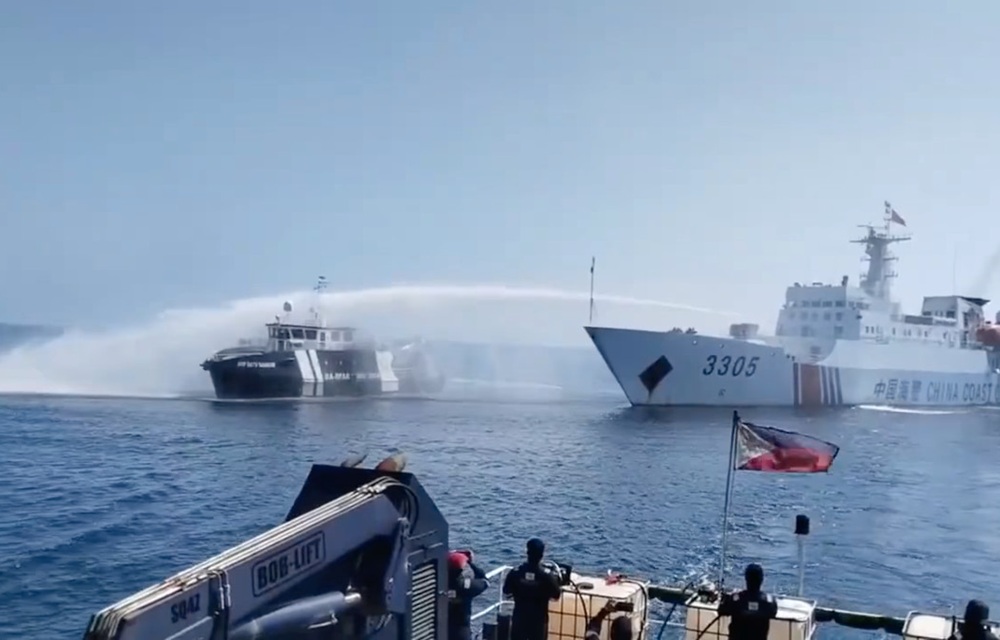
Chinese and Philippine officials are accusing each other of escalating tension over disputed territorial waters in the South China Sea.
Both nations claim exclusive territorial ownership of parts of the South China Sea. According to the Philippines, the Chinese Coast Guard and Navy have used aggressive tactics to enforce its territorial claims, using risky maneuvers to intimidate fishers and Filipino vessels and spraying Filipino fishers with water cannons. The dispute has grown increasingly tense over the last year, with reports of multiple collisions and injuries in interactions between the two countries at sea.
On 26 January, the Philippines Department of Foreign Affairs issued a statement accusing officials with the Chinese Embassy in Manila of escalating tensions in the region.
“The Department has made firm representations to the Chinese Ambassador and the Chinese Embassy conveying serious concerns with the escalation of public exchanges between the Chinese Embassy and Philippine legislators, such as Senator Risa Hontiveros, Senator Kiko Pangilinan, Senator Erwin Tulfo, and other government officials,” Philippine Coast Guard Spokesperson on West Philippine Sea Concerns Jay Tarriela stated. “The Department believes that circumspection in language and actions are necessary so that the exchanges between the two sides, especially in the public domain, do not and will not unnecessarily derail the diplomatic space needed to manage the tensions in the maritime domain and constructively collaborate in the non-sensitive areas of cooperation.”
According to the Manila Bulletin, new Chinese Ambassador Jing Quan has been more vocal in reiterating China’s assertion of territorial ownership in the South China Sea, releasing multiple statements since assuming the position in December.
The embassy responded to Tarriela’s statement by directly attacking the spokesperson, accusing him of “relentlessly attacking and smearing China and spreading false narratives.”
“China firmly opposes and strongly condemns such kind of words and actions. We have firmly responded and made serious démarches to the Philippine side in both Beijing and Manila,” Ji Lingpeng, spokesperson of the Chinese Embassy in the Philippines, said in a 2,000-word response. “Over the past several years, Tarriela has repeatedly made defamatory remarks against China, distorted facts, misled the public, and even openly lied, seriously undermining China-Philippines relations and poisoning public opinion in the Philippines toward China.”
The spokesperson took particular issue with Tarriela characterizing the Chinese Navy rescuing a Filipino fisher from the South China Sea on 25 December as “propaganda” and a “PR stunt.” The Philippines government said that the incident took place within its exclusive economic zone and questioned the presence of the Chinese Navy in that area. The government also disputed China’s official narrative of the incident.
The Chinese Embassy went on to state that China has shown restraint in its approach to the Philippines, pointing to countries that have recently been invaded – or are under threat of being invaded – by powerful neighboring nations.
“Think about it: If China were truly ‘bullying’ the Philippines or seeking to resolve disputes by force, would the situation at sea look like it does today? Would the grounded Philippine warship still be receiving resupply? China has exercised the greatest restraint and patience because we do not want to damage longstanding relations with our neighbors. Any other major country would not have been nearly as restrained,” Lingpeng said. “Look at what is happening in other countries and regions around the world. Think about Ukraine, Venezuela, Gaza, and Greenland. The Philippines should feel fortunate to have a neighbor like China.”
In turn, the Philippines National Security Council (NSC) denounced the embassy’s comments, pointing to a 2016 tribunal ruling under the United Nations Convention on the Law of the Sea that supported the Philippines claims to fishing territory in the South China Sea.
“Public messaging that intimidates, threatens, or seeks to silence Philippine officials performing their lawful duties is inconsistent with the spirit and obligations of diplomatic engagement and clearly violates the Vienna Convention on Diplomatic Relations,” NSC Spokesperson Assistant Director General Cornelio H. Valencia Jr. said in a statement. “Its illegal, coercive, aggressive, and deceptive behavior escalates tensions, threatens regional security, and infringes on the sovereign rights of coastal states, not only the Philippines.”
Last week, Tarriela said in a social media post that the Philippines’ policy is not to respond to Chinese water cannons with their own water cannons as a form of restraint.
“The moment we use our water cannons, the China Coast Guard may have a justification to increase their aggression to the next level,” Tarriela said. “Maybe their next move will be more intense, and they will blame us for their aggressive response.”
