





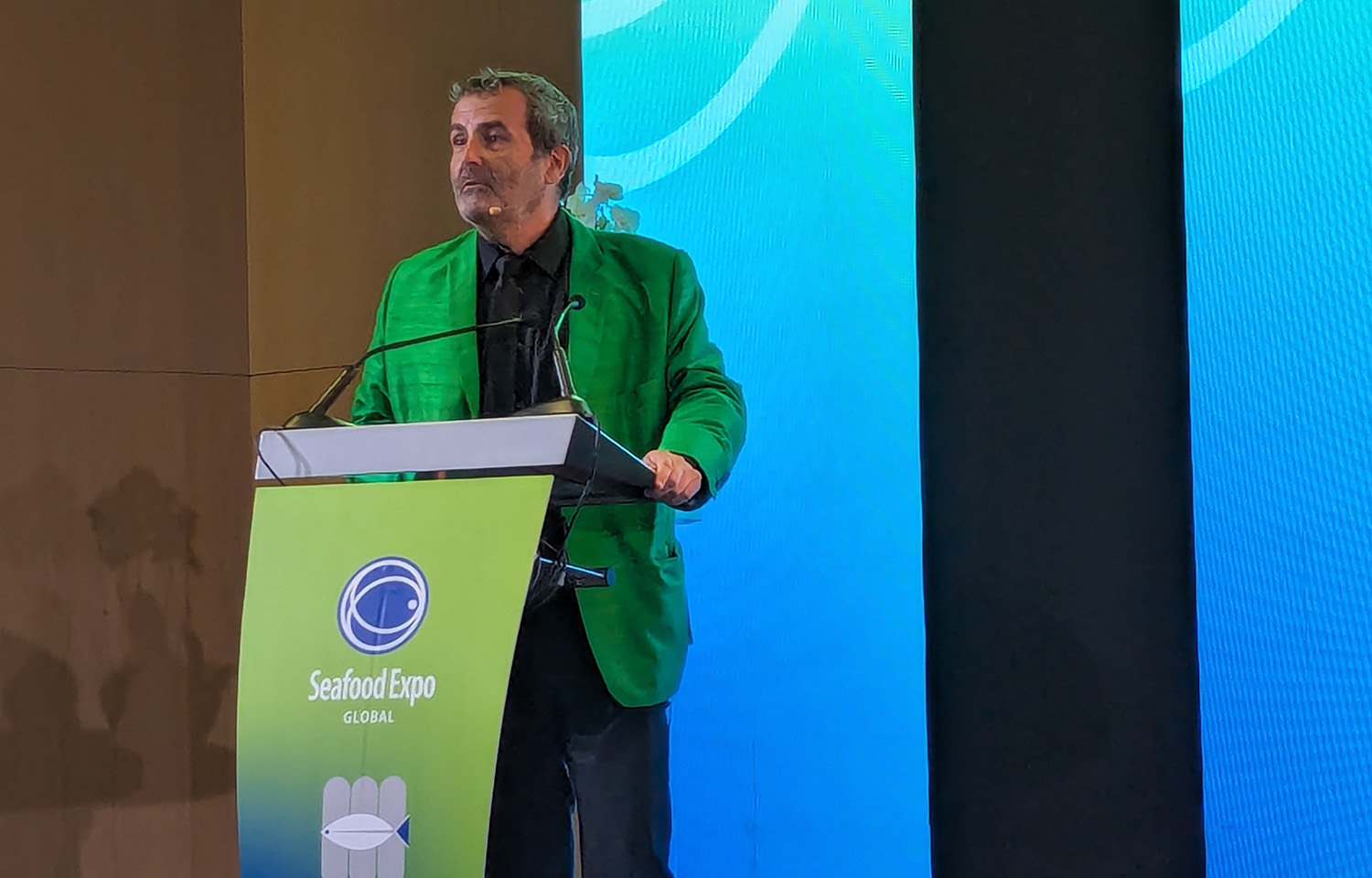
Columbia University Professor and respected economist Xavier Sala-i-Martin predicts the global economy is poised for a big shift as artificial intelligence (AI) plays a transformative role in how companies function.
Sala-i-Martin – the developer of the Global Competitiveness Index – delivered the keynote address during Seafood Expo Global, which ran from 6 to 8 May in Barcelona, Spain. Focusing on the uncertain economic climate facing global trade, Sala-i-Martin was critical of the current trade war, which has disrupted the free flow of trade between different countries.
“We are threatening this wonderful system,” Sala-i-Martin said. “The biggest story of the last three months has been that the largest richest country in the world is trying to move from this system that we created.”
Sala-i-Martin said free and open trade is good, and benefits everyone in both countries when it happens. He compared it on a micro scale to how normal commerce takes place.
“When I buy a cup of coffee from the coffee shop, I send money to them, and they send product to me. I get a coffee, you get money. And because we do it voluntarily, we both win. It’s a win-win situation, otherwise I wouldn’t buy the coffee, right?” he said.
International trade is largely the same situation, as countries that buy more product from the other are engaging in a mutually beneficial exchange of goods and money.
“If we don’t allow people to buy coffee from one another, we all lose. Trade is good, and therefore, barriers to trade [are] bad,” Sala-i-Martin said. “In the newspapers, you will hear politicians saying that deficits are bad, bilateral deficits are bad. Now if you think about it, when I go to a coffee shop and I give money in exchange for a coffee – I’m running a trade deficit.”
Any trade deficit between the U.S. and another country is similar to that relationship – there may be a monetary loss, but there’s a gain in the goods that the money was exchange for.
“Every economist will tell you that tariffs are bad, just like every economist will tell you that trade is good,” Sala-i-Martin said.
Sala-i-Martin said another key failing in the trade war is the response other countries have made to the U.S.’s push to impose tariffs on goods.
“The strangest thing in the world has been not that the U.S. has turned crazy, but that the rest of the world retaliates,” Sala-i-Martin said.
The U.S.’s decision to impose tariffs will hurt the U.S. and U.S. consumers the most, and the rest of the world should have reacted differently to its tariff threats.
“Now what is the reaction that Europeans and the Chinese and the Japanese and everybody else should have?” Sala-i-Martin said. “The reaction is the reaction I have when somebody shows up in my office dressed as Napoleon and says ‘I’m Napoleon.’ I’m not going to engage in discussions over Waterloo battles to prove to them that they’re not Napoleon. No, I’m going to open the door and say goodbye – and this is what everybody else should do.”
He compared the decision by China and Europe to impose tariffs in return to shooting themselves in the foot in response to the U.S. doing the same.
Those two factors combine to cause a high level of uncertainty in the current trade environment, which compounds the issues.
Companies could adapt to a more consistent tariff rate maintained at a fixed rate, but constant changing leaves many paralyzed and afraid to take any action.
“They’re waiting to see what comes out of this,” Sala-i-Martin said.
Sala-i-Martin said, outside of tariffs, there are a range of other major factors adding to the uncertainty of the future economic climate, including the unpredictable political climate, governments moving to extreme and authoritarian positions, a pull back from the U.S. dollar as a safe haven for investors, rising interest rates, and the increasing threat of stagflation – when both interest rates and unemployment increase – are all adding to a difficult economic environment.
Despite the many challenges facing the world economy, Sala-i-Martin said AI is poised to be the transformative technology that could bring the world into a new era of prosperity.
Sala-i-Martin said AI is a general purpose technology (GPT), and current criticism of it not having a massive impact yet is premature.
“Agriculture is a GPT. The steam engine electricity, the computer, any of these technologies change not only multiple sectors, they change entire societies,” Sala-i-Martin. “The curious thing about GPTs is that initially they appear to be bad, to be counterproductive.”
Agriculture initially resulted in people who were shorter and malnourished; electricity and the industrial revolution was initially seen as making workers lives worse than the lives of the more artisanal workers they replaced.
“A few years after going backwards, the economy shot through the roof,” Sala-i-Martin said.
He said that AI is currently in that initial stage of not appearing to be productive, but with the right amount of innovation, it will be another transformative technology like electricity or the steam engine.
“Some people claim that this is going to lead to huge increases in inequality,” Sala-i-Martin said. “The opposite will happen. What we see already is that instead AI is benefitting mediocre people. It’s bringing mediocre lawyers to the level of super lawyer; it’s bringing mediocre consultants to the level of super consultant.”
AI will make intelligence easier to access and more abundant, which will in turn add to the ability to cause other transformative changes, he said.
“Despite all the negative things I said today, we should look forward with extreme optimism,” Sala-i-Martin said. “Because the engine of growth, the engine of progress, all of a sudden has become way, way, way cheaper and way, way, way more abundant.”
