





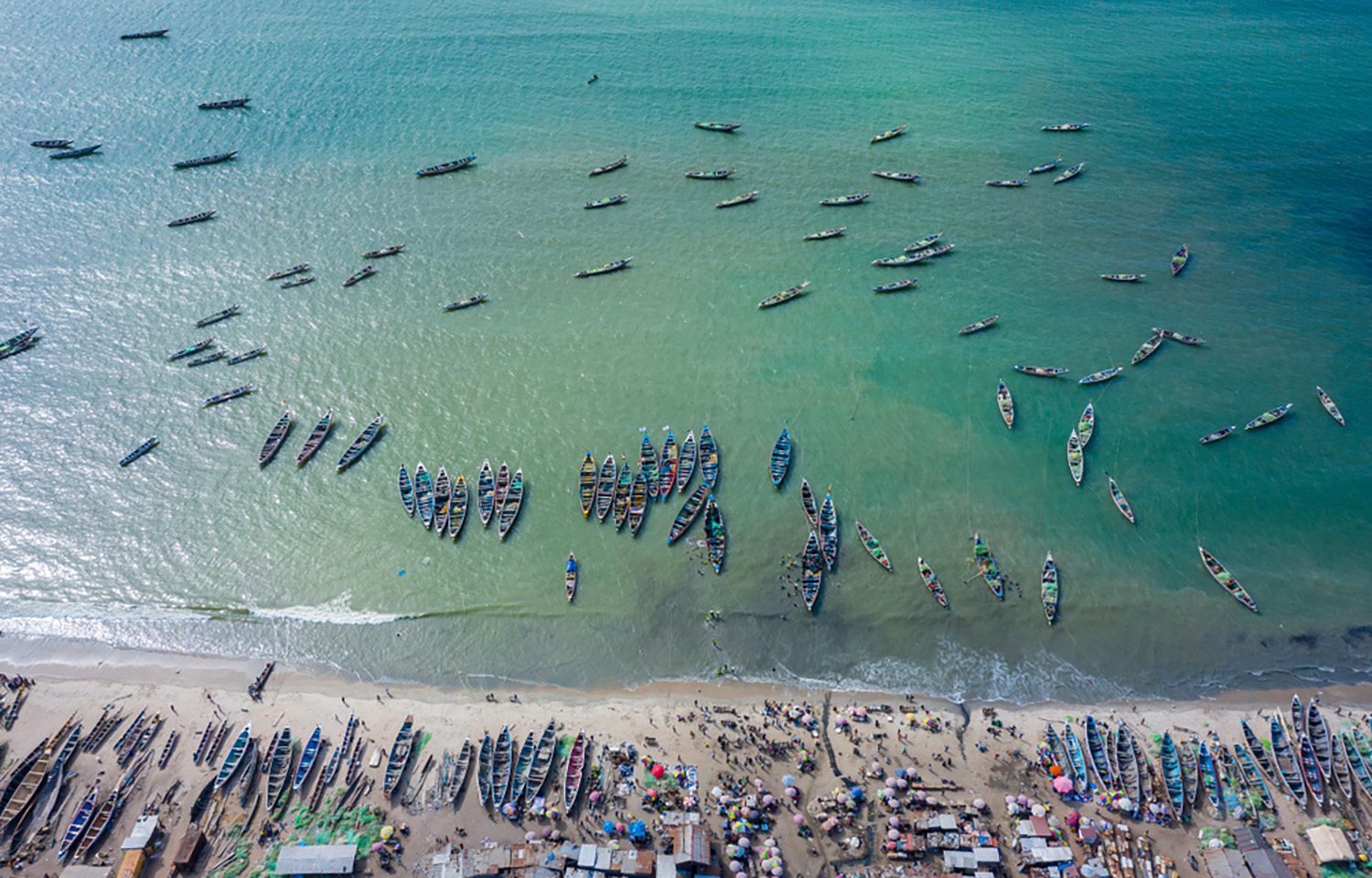
The sustainable fisheries partnership agreement (SFPA) between the European Union and the West African nation of Senegal is set to expire in November, and if the two parties can not strike a deal before then it also poses a challenge to the planned renegotiation for a similar deal the bloc has with neighboring Gambia, which lapses in June 2025.
Renewal of the E.U.’s deal with Senegal hit a speed bump in May 2024 when the European Commission issued a yellow card to the country, urging Senegalese authorities to improve its efforts to fight illegal, unreported, and unregulated (IUU) fishing off its shores.
A yellow card is the first step that the European Union takes when it identifies a country as not fully handling international obligations to fight against IUU fishing activities. It serves as a warning and initiates a formal dialogue between the Commission and the country. If that dialogue doesn’t produce any changes, the Commission then may issue a red card, resulting in a ban on the country's seafood products from being imported into the E.U.
This development has complicated negotiations for renewing the Senegal-E.U. SFPA and has, as a result, complicated the E.U.’s deal with Gambia, too.
Gambia is a small West African country that is just about 50 kilometers at its widest point. It is completely surrounded by Senegal and has an exclusive economic zone (EEZ) that is just 80 kilometers long.
So, if E.U. fishing vessels are not allowed to fish off of Senegal, they’re unlikely to see much success just fishing off Gambia’s small EEZ, according to Joelle Philippe, the communications and advocacy officer at Coalition for Fair Fisheries Agreements (CFFA), a Brussels, Belgium-based organization aimed at raising awareness on the impacts E.U.-Africa fisheries deals have on African communities.
“The question we have raised with the European Commission, and we will ask it again, is what relevance is there of having such a huge number of tuna vessels fishing in an 80-kilometer-long coastline EEZ?” Philippe said. “It would be interesting to see how the E.U. can have an agreement with Gambia when there is no fishing agreement with Senegal."
Even if the E.U. is able to secure a deal with Gambia before next summer, Philippe said she is also concerned that artisanal Gambian fishing communities lack information and a voice at the negotiating table.
“There have been concerns about the lack of information and details of where the funds [from the E.U.’s] sectoral support would go,” Philippe said. “The funds under the sectoral support component [of the SFPA] should be going toward development of the local sector, which for Gambia is mostly artisanal.”
Under the current SFPA, the E.U. contributes EUR 550,000 (USD 595,000) annually to Gambia, out of which EUR 275,000 (USD 298,000) is dedicated to the support of Gambian fisheries policy.
In turn, E.U. vessels from Spain, Greece, and France have the ability to fish in Gambian waters and are part of a patchwork of tuna network fisheries agreements in West Africa.
“For [CFFA], a fair fisheries agreement is one that allows for the development of the local fisheries sector in line with a country's national growth goals, ensures there is transparency and no competition between local fishers and foreign fishing vessels, and is transparent,” Philippe said.
If the E.U. and Gambia are able to find a way to renew their deal, Philippe said both parties should agree on what “should be given priority under the E.U.’s sectoral support, such as scientific research on fishing, monitoring and control of the waters of Gambia, training of observers, or funding fishing communities to develop infrastructure.”
“There might be other priorities for the country in ensuring fishing is sustainable and beneficial for everybody, such as good fisheries management and control and effective research on fish stocks, as managing fisheries goes beyond just giving money to the communities,” she said. “This sometimes is not explained well [to local communities], but it also depends on how well-informed [a nation’s] fishing organizations are and how well-organized they are.”
