



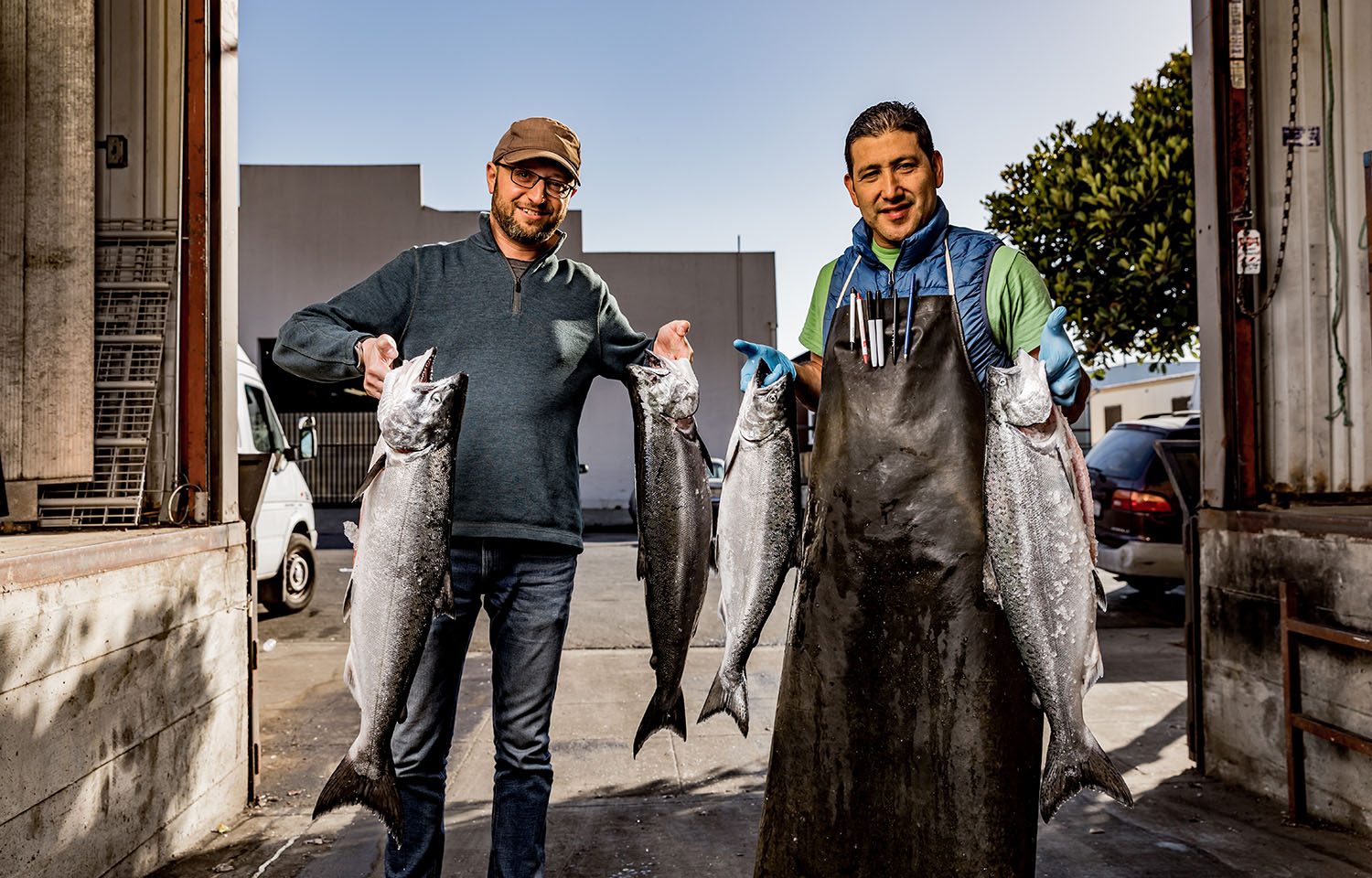
Just over a decade ago, Adrian Hoffman ate a seafood meal that set him on the path to creating what would become Four Star Seafood, a successful seafood distribution business that recently expanded on the West Coast of the U.S.
Originally a chef by trade, Hoffman and his business partner Ismael Macias met working together at high-end restaurants in San Francisco, California. After becoming friends, they both left the company they worked for in 2014 and set out on new journeys – with Hoffman doing consulting and Macias working at restaurants across the world.
“He came back from his sojourn, and we were talking; I wasn’t really digging consulting very much,” Hoffman told SeafoodSource. “I had always had this idea about getting into the seafood business.”
The catalyst for that idea was a seafood meal in Portugal, which set a new high bar for freshness in Hoffman’s mind.
“It was like the best seafood I’d ever had in my life. I came back, and I could spend whatever I wanted on seafood, but I couldn’t get anything close to the quality of what I got when I was there,” Hoffman said. “It didn’t make sense to me because here I am in San Fransisco and there’s commercial fishing ports and plenty of great seafood right off the coast, and nobody is bringing me anything that, no matter what I spend for it, that’s of the quality that I had there.”
Hoffman and Macias talked about that discrepancy and began doing some homework.
“We went down to Pillar Point at Half Moon Bay and started walking the piers and talking to fishermen, shaking hands, and we saw them with this amazing fish that they just brought in,” Hoffman said.
Hoffman said that was the point they learned more about the seafood supply chain and about how there may be several links on the chain between the fisherman and the final customer – which sparked the idea to create Four Star Seafood in 2015.
“So the idea was, very simply, we establish these relationships with fishermen, we buy their fish directly, and we sell it to restaurants literally hours later,” Hoffman said. “When we started, we would drive down to Half Moon Bay, buy lingcod off the boat, drive it up, and deliver it to a restaurant.”
Delivering fresh whole fish made an impression and started to generate buzz that drove further business among chefs. The multiple connections Hoffman and Macias had with high-end chefs in the area thanks to their history in the industry also helped, as they had an established market for their products.
However, it didn’t take long for Four Star Seafood to run into its first big obstacle: Fishing seasons change.
“We weren’t going to have very much to sell after October, and salmon season was shut down in California back then,” Hoffman said.
Hoffman – who is originally from Boston, Massachusetts, U.S.A. – said he began calling people he knew back home to find new species.
“I got hooked up with Red’s Best among a bunch of others, and we started flying fish out from Boston daily. We realized that the seafood business is very much about your resources; we’ve put a tremendous amount of effort into being as resourceful as we can,” Hoffman said.
He also began to attend Seafood Expo North America early on in the business’s lifetime to continue to meet people and gather new resources, he said.
Through that work, the company has gained high-profile customers like Californios, a two-Michelin-star restaurant in San Francisco’s SoMa district.
“At Californios, we prefer working with farmers and purveyors who understand our commitment to excellence," Californios Chef and Co-Owner Val Cantu said. "Four Star Seafood has matched or exceeded our expectations for quality seafood and has helped us craft a better experience for our guests.”
The company also managed to successfully navigate the Covid-19 pandemic, which had huge impacts on the foodservice customers it had built up. Hoffman said the company pivoted over a weekend to do a direct-to-consumer program, which it launched on 12 March 2020. Through that, the company also helped other chefs, farmers, and ranchers distribute their products, as many of them were dealing with the same downturns.
“We had already been doing some, but not a huge amount, prior to Covid, but we just went all in,” Hoffman said. “We brought in everything from every local farmer, rancher, and dairy producer that we could think of that we thought had a really good product.”
Post-pandemic, the company has continued to maintain its direct-to-consumer business, though at a slightly lower level.
Hoffman said it has also grown as a way of selling seafood to private chefs.
“Private chefs love to be able to get the same fish that they were buying for their Michelin-starred restaurants before taking private chef gigs, and we’ll deliver it right to the houses that they cook for,” Hoffman said.
The company’s continued growth led it to explore expanding its footprint in a new location.
“We started thinking about it a couple years before, and we were thinking either to go up to the Pacific Northwest or down to Los Angeles – both having a bunch of logistical advantages,” Hoffman said.
The company ultimately settled on Los Angeles and established a 12,000-square-foot warehouse in El Segundo, roughly five minutes from LAX airport. The company runs six trucks out of the region, adding to the 16 it runs in the San Fransisco Bay area.
“That’ll just continue to grow,” Hoffman said.
Though the recent fires in the Los Angeles area have affected the firm's business in the short term, establishing a logistics hub in Los Angeles has still given the company access both to new markets in the area and to new species that the company couldn’t before like spiny lobsters, California king crab, and more. The company has also hired new sales staff to expand throughout the Los Angeles region to tap into more of restaurant industry.
The move to Los Angeles is also, in part, a litmus test for Four Star Seafood, Hoffman said.
“I think part of our goal now is to prove that we’ve built something that’s scalable,” Hoffman said. “We have the systems, we know where to get everything, we understand how the seafood distribution business works, and if we can really successfully prove that we’ve built this scalable model, then who knows what’s next?”
