



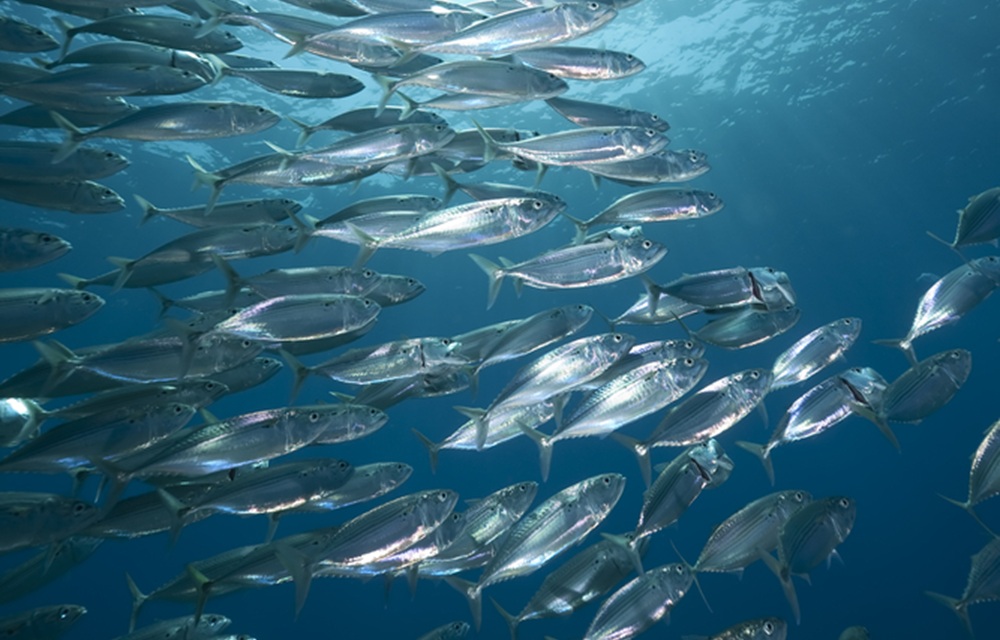
The Mid-Atlantic Fishery Management Council (MAFMC) voted to revise its mackerel rebuilding plan, allowing commercial fishers in the U.S. to harvest more in the near term while aiming to rebuild the stock by 2032.
Atlantic mackerel were declared overfished in 2018, triggering a regulatory requirement for MAFMC to take action to rebuild the stock within 10 years. However, rosy projections about the population’s recovery allowed overfishing to continue, further damaging the stock. In 2024, NOAA Fisheries set a commercial quota of 868 metric tons (MT) for the 2024 and 2025 seasons – a 76 percent reduction from the 2023 quota.
The revised rebuilding plan adopted at MAFMC’s December meeting would raise the commercial quota from 868 metric tons to 11,237 MT in 2026, an increase of 1,295 percent. That quota would increase further to 13,210 MT for the 2027 season.
“Once approved and implemented by NOAA Fisheries, the new commercial quotas will allow substantially higher initial Atlantic mackerel trip limits, including a 200,000-pound trip limit for Tier 1 permitted vessels,” MAFMC said in a release. “While the higher quota may be implemented relatively quickly, associated trip limit changes may take longer to clear various NOAA regulatory processes.”
According to the council, the decision to allow commercial fishing to expand “where stock conditions allow” aligns with U.S. President Donald Trump’s executive order titled “Restoring American Seafood Competitiveness.”
The revised plan builds on a 2025 assessment by NOAA Fisheries, which reported positive developments for the stock as it continues to recover.
“While overfishing is still not occurring, the stock is no longer considered to be overfished, though it is not yet rebuilt. This change in overfished status is likely due to the closure of the Canadian directed commercial fishery and low U.S. removals in recent years, as well as recent recruitment estimates (2022-2024) above the time-series median,” the agency reported.
The assessment also showed a massive spike in mackerel recruitment in 2025; however, council staff were quick to point out that that number was uncertain, and in past years, the recruitment number has had to be revised downward substantially as more data came in.
“We appear to have had a recruitment spike right at the end, and if you project it forward one more year, the projections would suggest because of that recruitment, right now the stock is fully rebuilt,” Council Staff Member Jason Didden said at the 16 December meeting. “We’ve seen 20, 30, 60 percent reductions as a range for those other highlighted terminal years. Because of that, there's a lot of uncertainty on that terminal year assessment.”
Multiple groups and governments wrote to the council ahead of the December meeting to express concern that “overly optimistic” projections about the mackerel stocks could lead to overfishing happening again. Fisheries and Ocean Canada (DFO) – which collaborates with U.S. regulators in managing the stock – also suggested the most recent assessment could overestimate the stock’s recovery.
“DFO understands that the update indicates a notable increase in spawning stock biomass, largely due to high 2024 recruitment estimates. Although we are still reviewing some of the information and data discussed during the meeting, I wanted to note that we have heard that both Canadian and U.S. scientists have concerns about the reliability of this estimate, given a recurring pattern of overestimating recruitment and biomass. If these concerns are valid, we would also be concerned that such overestimation could lead to overly optimistic catch limits, which would hinder efforts to rebuild the stock.” DFO Fisheries Resource Management Director General Mark Waddell said in comments submitted to the council.
Canada is set to update its assessment of the Atlantic mackerel stock in the spring of 2026.
