






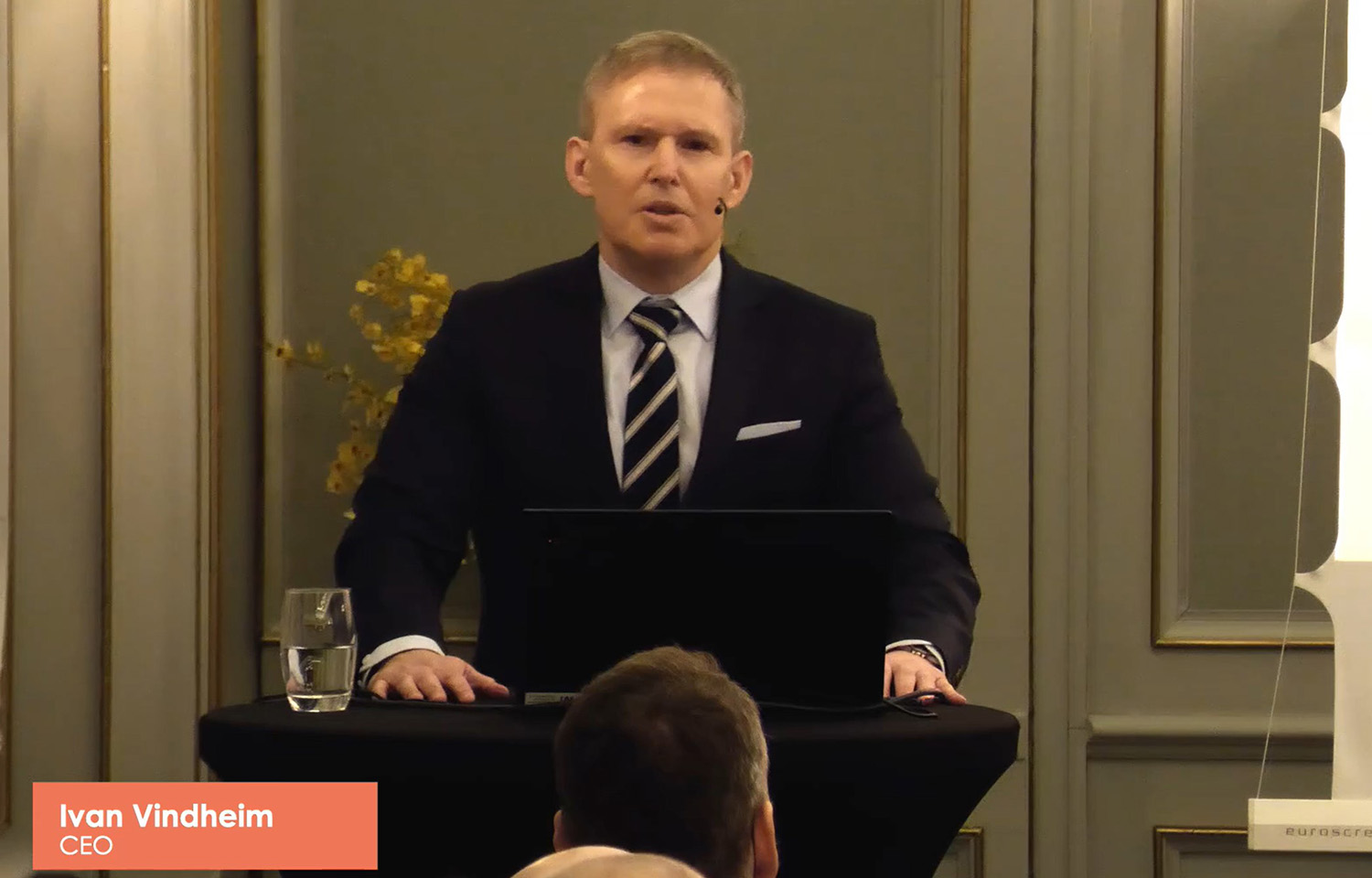
Both the salmon-farming industry and the market would be negatively affected if the administration of U.S. President Donald Trump proceeds with its planned introduction of additional 25 percent tariffs on imports from Canada into the United States, according to Mowi CEO Ivan Vindheim.
From Mowi’s perspective, if the tariffs announced by The White House on 1 February 2025 are imposed, the Bergen, Norway-headquartered salmon farming company may look to shift some of its Canadian operations to alternative regions, Vindheim said.
“Tariffs are not good for anyone – neither for the imposer nor the addressee,” he said.
Sharing details of Mowi’s results for 2024 – a year in which it set a number of new records, including a best-ever harvest total of 501,530 gutted weight tons (GWT) – Vindheim remarked that with the postponement of the tariffs on goods imported from Canada, the hope now is that the situation doesn’t escalate.
“It looks like we didn’t get tariffs on our Canadian salmon going into the U.S. in the first round after all because it was postponed by one month. Let’s hope that postponement can become permanent,” Vindheim said. “We don’t like tariffs. Salmon is an extremely international product, so open markets, zero tariffs, zero friction – that’s what we want.”
Despite the deferral of the tariffs, the situation has become “unstable,” and Mowi must be prepared to redistribute its volumes in accordance with new trade policies, Vindheim said.
“We will continue to monitor it closely and take necessary actions, including shuffling around with our seven regions for the best of our customers and our shareholders – whatever that might be and at any given time,” he said.
Vindheim’s plan to closely monitor and be prepared to react was proven prescient in just days as Trump signed an executive order on 13 February ordering his advisors to calculate new tariff levels for U.S. trading partners. That order calls on advisors to target countries with tariffs on imports, with the New York Times reporting Japan, The European Union, and India as areas in the crosshairs.
Despite the looming threat of tariffs, the first quarter of 2025 has seen a continuation of positive market trends seen by the salmon industry at the end of 2024 when a lower supply, coupled with good Christmas demand, saw prices increase, Vindheim said. He also advised that while the U.S. market has been lagging somewhat behind Europe and parts of Asia in its recovery from the cost-of-living crisis, the situation is nevertheless improving year over year.
In particular, retail channels in U.S. experienced volume growth in Q4 2024, largely driven by fresh, pre-packed salmon sales. There has also been a small uplift in foodservice, notably in the e-commerce and home delivery segments.
Mowi Canada is also experiencing something of a turnaround, according to Vindheim. Having reported a EUR 4.9 million (USD 5.1 million) loss in the fourth quarter of 2023, the Q4 2024 report confirms operational EBIT of EUR 2.4 million (USD 2.5 million).
Harvest volumes stayed relatively stable in the region at 5,239 GWT for the quarter and 30,426 GWT for the full year, which was achieved off the back of lower costs and better prices, Vindheim said.
The biology was also good in the last quarter, both for Mowi’s Canada West and Canada East operations, and this has continued into the start of 2025, he said.
For the time being, and in line with Mowi increasing its overall salmon harvest guidance for 2025 by 10,000 GWT to 530,000 GWT, it is anticipating 33,000 GWT of that toal to come from its Canadian operations.
