



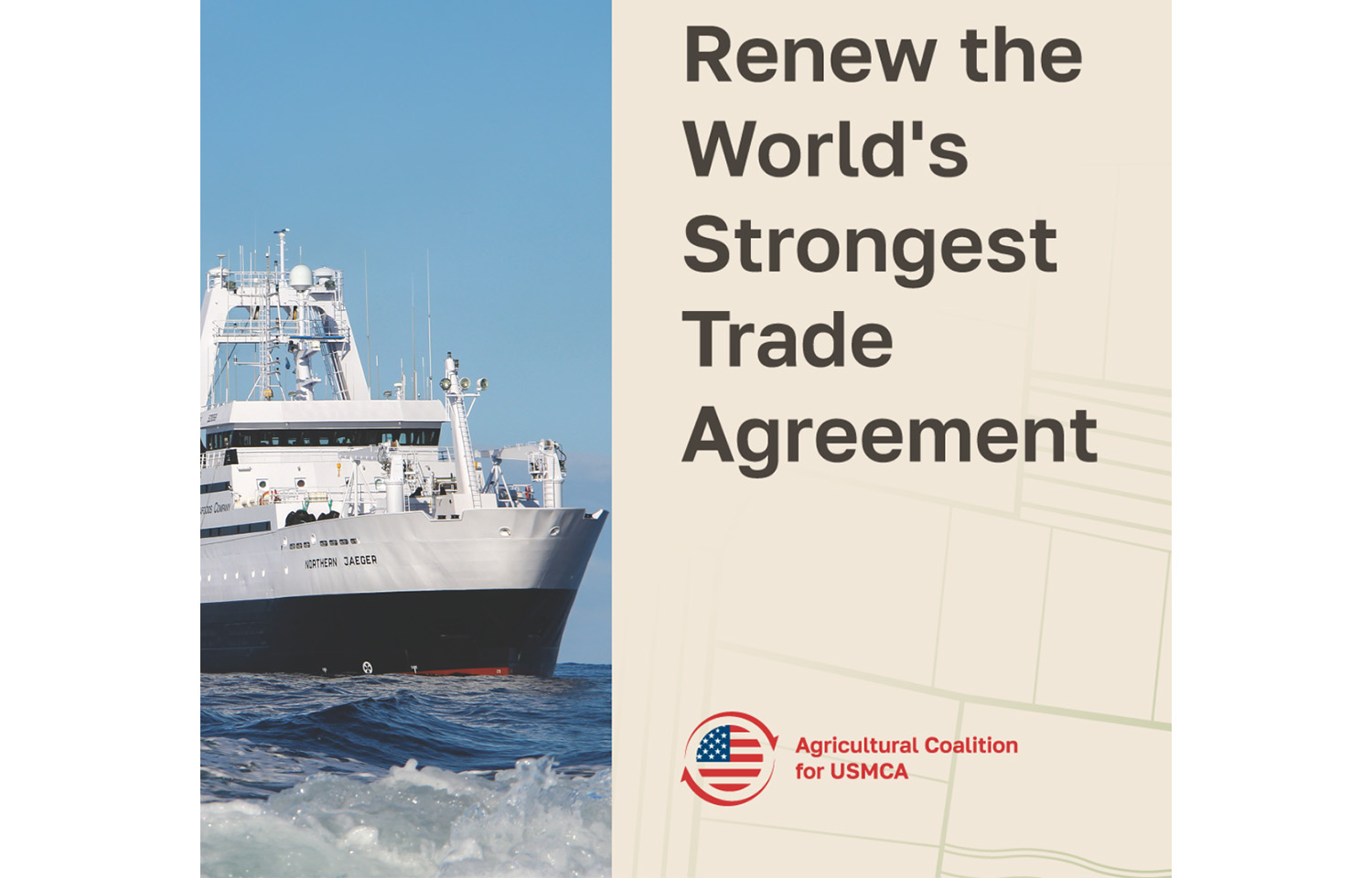
The National Fisheries Institute (NFI) is participating in a new coalition that aims to keep the United States-Mexico-Canada Agreement (USCMA) in place as the trade deal approaches its first major joint review in July 2026.
The new coalition, titled the Agricultural Coalition for USMCA, is working to advocate for maintaining the trade agreement – with some targeted adjustments to benefit agricultural industries. NFI is joined on the coalition by several other major agricultural and trade organizations including the Global Cold Chain Alliance, National Corn Growers Association, National Pork Producers Council, National Turkey Federation, and more.
“USMCA is one of President Trump’s signature achievements and one that has significantly propelled the ag economy,” Bryan Goodman, a spokesperson for the newly formed coalition, said in a release. “We are not saying it’s perfect, as some changes are warranted, but we are saying it is of paramount importance to farmers that all three countries renew the agreement.”
The USMCA trade pact was set into motion in 2018 after the U.S., Mexico, and Canada reached a tentative agreement on a new trade deal that replaced the North American Free Trade Agreement (NAFTA). NAFTA, put in place in 1994 as a means to lower trade barriers between the three countries, was revised under the prior administration of U.S. President Donald Trump and was officially replaced when the USMCA was signed into law on 29 January 2020 and entered into force on 1 July 2020.
As part of that agreement, a joint review was scheduled for 2026 – though at the time of its creation certain members of the U.S. House Committee on Ways and Means opposed the review out of fears it would discourage investment due to uncertainties regarding a potential renegotiation of the deal. Despite the concerns, the review period was set for July 2026, and the USCMA is due to be renegotiated amid trade tensions between the U.S. and its neighbors – including a trade deal with Canada that was terminated by Trump in October 2025 in response to a television advertisement.
If the agreement is renewed, it would remain in effect for an additional 16 years before another review in 2032, but if countries fail to agree on a deal and decide to terminate it, the deal will expire in 2036.
The coalition said the USMCA has been a boon for U.S. industry, significantly increased agriculture exports to both Canada and Mexico, and also created a mechanism to resolve any trade disputes. Goodman said it also provides needed certainty to an industry that has to think far ahead.
“Our farmers make decisions a year or more in advance,” Goodman said. “They need the certainty of knowing USMCA is here to stay.”
NFI has also defended the trade agreement, and NFI Director of Public Policy Morgan Bell testified before the United States Trade Representative (USTR) defending USMCA and touting the benefits it has had for the U.S. seafood industry.
“Under this agreement, tri-national seafood trade has thrived, benefiting U.S. seafood suppliers, their employees, and the millions of consumers they serve,” Bell said. “Since its entry into force, seafood trade among the three countries has increased significantly. American seafood exports to Mexico have increased by 65 percent, and exports to Canada have increased by 17 percent. A predictable, tariff-free framework gives our members confidence to innovate, plan, and compete.”
