



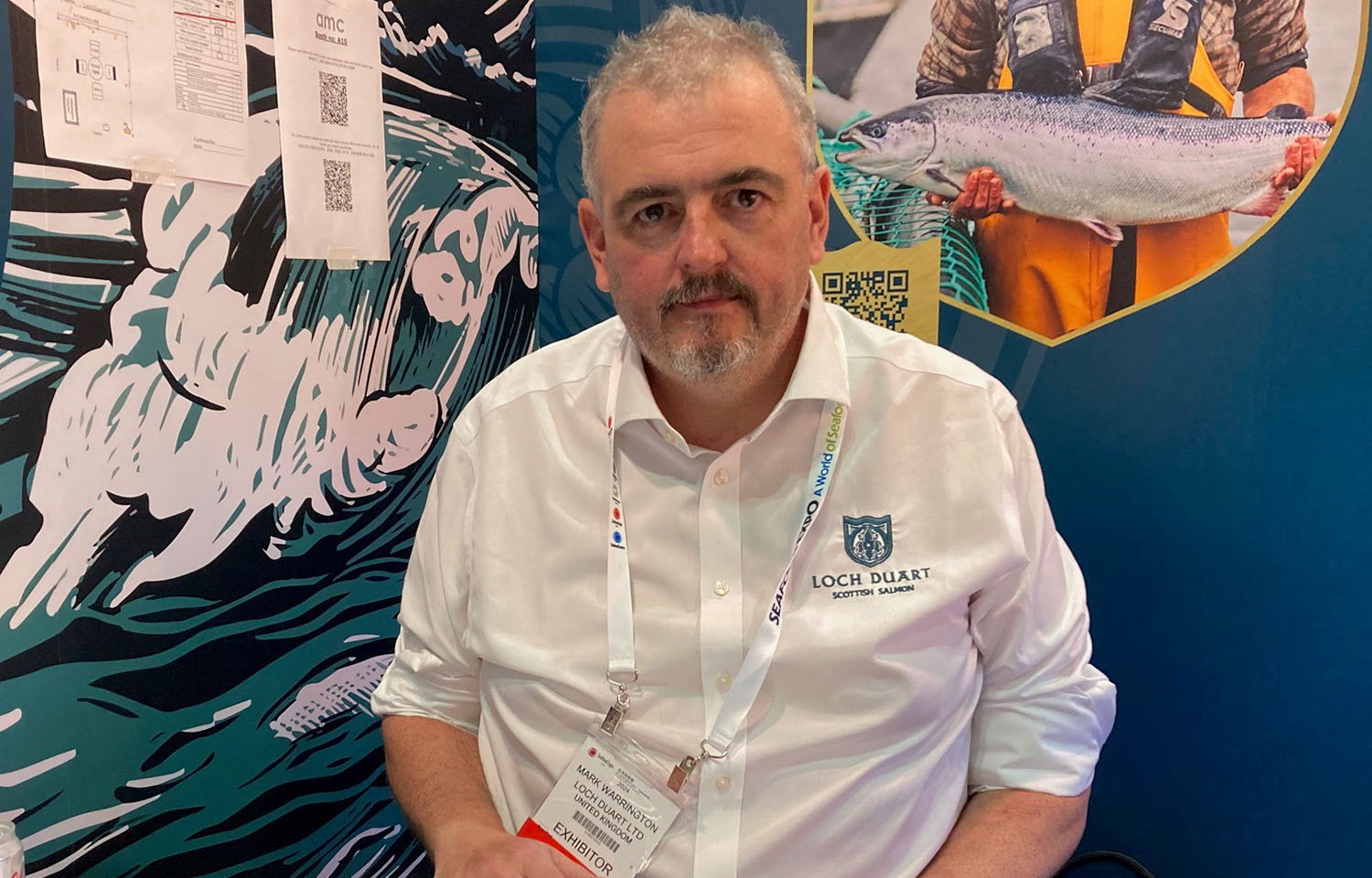
Loch Duart prides itself on being one of the last remaining independent, non-multinational Scottish fish-farming companies.
That independence gives the company a freedom that its larger, often publicly traded competitors don’t have, such as the ability to specialize on operating small-scale, low-impact farms and focus on certain products and markets, according to Loch Duart Managing Director Mark Warrington. The company’s salmon are raised in low-density, low-energy, sheltered sites that use a bespoke fish feed and feature minimal fish handling.
Speaking at the 2024 Seafood Expo Asia, which took place 4 to 6 September in Singapore, where Loch Duart was exhibiting for the first time, Warrington said Asia will be a target market for the company as it seeks to double production in coming years.
“We’re going to have a gradual increase in available tonnage; we’re doing it the long-term way, which is part of our DNA and has been for the 25 years the company has been in existence. But, it will potentially at least double our output over the next three to five years. That’s going to allow us to both react to market demand and see where some of the key areas for growth are, and Asia is definitely going to be a key region for us.”
Loch Duart purchased five sites around Scotland’s Isle of Skye in 2022 from Scottish Sea Farms, with a combined production limit of more than 9,600 metric tons (MT). The GBP 11.7 million (USD 15.3 million, EUR 13.9 million) purchase price, as well as the investment in bringing the sites into production, has been fueled by the company’s 2020 acquisition by the SAF II Master Fund, operated by Vision Ridge Partners, a U.S. sustainability-focused investment firm.
Two of the five sites now have fish in them, and Loch Duart is making alterations at the other three sites “so we can farm them in the Loch Duart way in the future,” according to Warrington.
Loch Duart currently produces 6,000 MT of salmon annually at eight sea sites and two hatcheries in Sutherland and the Outer Hebrides, with the bulk sold to France and the U.S. The expansion will take the company to between 12,000 MT and 16,000 MT of annual production.
“Because we're doing such small volumes right now, we actually struggle to supply the demand that's out there in the market. But as we create more volume over the coming years, it will be good to break into new markets,” Warrington said. “Even with that, we will be a very small-volume producer, representing about 3 percent or 4 percent of Scottish production, so we don't really need to break into anything in a large scale. It doesn't take a lot of customers or a lot of volume to make a huge difference to our business.”
The Asian market has enormous potential for growth in coming years as the regional economy continues to strengthen and consumers are introduced to salmon, Warrington said.
“I think that Asia is going to probably replicate what happened with salmon growth in Europe over the years. Speaking to some of the retailers, the percentage of salmon that makes up their sales has already grown to huge numbers. I've heard of retailers that were traditionally other seafood products that Asians were familiar with that are now selling 40 to 50 percent salmon,” he said. “I’ve been visiting Asia for 15 or 20 years, and when you visit cities [in Southeast Asia] today, places like Singapore or Bangkok are developing so fast, and there’s so much free cash that consumers seem to have in Asia. And, there’s a clear fondness for luxury brands. There's definitely a lot of potential for a small business like ours.”
The key to growing the Asian market will be familiarizing consumers with salmon, according to Warrington.
“Being able to educate consumers in the future is going to be really, really important,” he said. “I’m confident Scotland has a good place as a worldwide brand, so we will win out as more consumers continue to buy salmon.”
The Scourie, Scotland-based salmon-farming firm experienced lower turnover and operating profit in its most recent fiscal year ending March 2024 but said it was largely the result of developing plans for long-term, sustainable growth that includes goals to increase production through new sites and optimizing the potential of existing ones. Part of that plan is an exploration of the potential for reopening its Canadian operations. The company had, at one point, planned to expand in Nova Scotia via its Snow Island subsidiary, with the goal of producing 6,000 MT of fish annually, but those plans have not yet materialized.
“There's always potential with Canada, but that's certainly not a main part of business focus at the moment,” Warrington said. “We've got quite a lot to achieve with rolling the opening of the sites in Skye over the next few years. A focus on our Scottish operations is going to be key particularly following the well-publicized difficulties that we've had with the changes in the marine environment in Scotland over the last 10 to 15 years. We're seeing issues with gill amoeba, jellyfish, and other problems related to changing environmental conditions that have impacted the Scottish industry quite dramatically. We need to focus on all of these things and focus on the core business and not be distracted by things like Canada for the time being.”
Loch Duart is also dealing with a growing controversy regarding the RSPCA Assured certification scheme, which has faced mounting criticism for certifying farms that have had problems with sea lice infestations and other animal welfare issues. In response, RSPCA has introduced major changes to its salmon eco-labeling standard.
However, even though the company operated the first salmon farm to attain RSPCA Assured accreditation in 2004, the changes weren’t enough for Loch Duart, as it decided to withdraw from the scheme in August.
“This was a discussion that we undertook as a management team probably about a year and a half ago, where we felt that the certification scheme had lost its way a little and we should run out the accreditation at the end of each cycle. There were a lot of changes within the personnel within RSPCA and a lot of changes within the expertise that was within RSPCA, and we felt that was the right thing for our business to move away from it,” Warrington said. “We've got a really good reputation. Our business is built on a reputation for welfare standards and focus on low stocking densities and high farming standards. And, we really felt that that trust within the customer base that we’re doing it the Loch Duart way was more important than an accreditation scheme that was relevant to the rest of the industry, particularly larger companies. It was an unfortunate route to take, having been the first company to join the scheme all those all these years ago, but things change, and you've got to move with the times.”
The certification recently ran into a fresh round of problems after video taken by Animal Equality UK showed violations of RSPCA Assured standards at Mowi, Bakkafrost, and Scottish Sea Farms farms in Scotland.
“We have launched an immediate investigation into these allegations and suspended membership of the three farms from the RSPCA Assured scheme, pending further investigation. This means they cannot currently market or sell any products under the RSPCA Assured label," an RSPCA spokesperson told SeafoodSource on 11 September. "Animal welfare is our absolute priority and we always take any complaints of poor welfare extremely seriously."
Despite the increasing scrutiny that RSPCA Assured and other seafood certifications have encountered recently, Warrington said he still believes they play an important role for the industry.
“I think there's a place for all these accreditation schemes, but it's up to the individual companies and their customer base how important they deem these different certifications,” he said. “But, I don't think there's many industries or food producers that are so highly regulated as salmon production is. The lengths that we go to is absolutely incredible, and the lengths that we go to in Scotland specifically is pretty incredible, to ensure that the salmon we produce are of the highest quality and are treated with respect and care throughout their lives.”
In 2019, Loch Duart agreed to a request from the U.K. Advertising Standards Authority to cease using the world “sustainable” in its marketing. Warrington said the company has increasingly focus on crafting a brand that is associated with high standards as a matter not of appearances, but of survival.
“That's the real struggle for us. For a small independent company as we are that’s got really low volume, you need to be really fantastic at farming to make sure you've got a viable and sustainable business,” he said. “I've had a career in fish farming for most of my adult life, and what we do at Loch Duart is more difficult than anything I encountered at some of the larger companies I’ve worked for, where the sheer volume that we produced just made life so much easier. As a small business, we need to be excellent at so many different elements on a daily basis. That's character-building, it's interesting, and that's why we do what we do.”
