






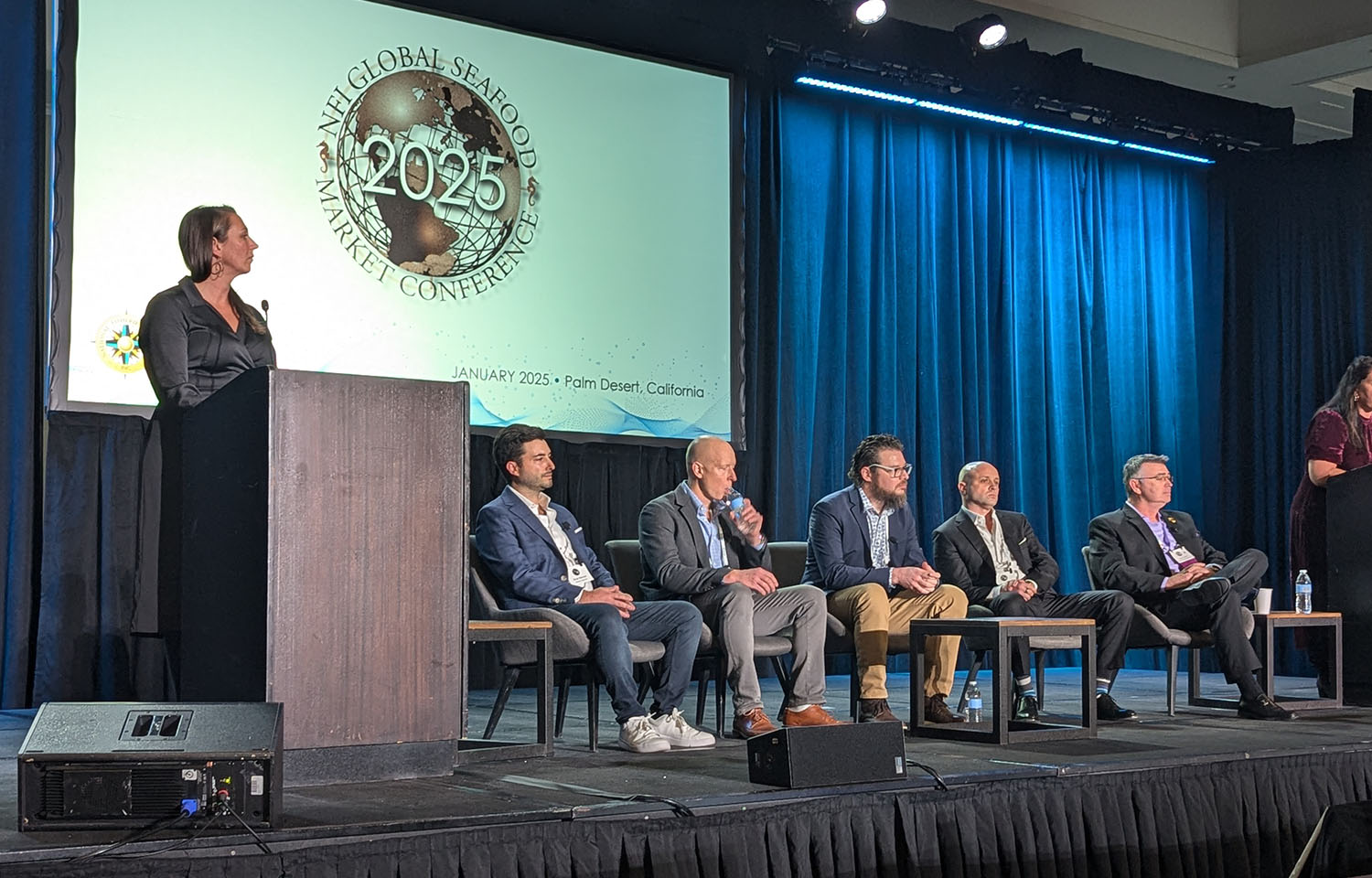
The word of the day for scallops at the 2025 Global Seafood Market Conference (GSMC) was “optionality.”
A panel of experts at the conference – which ran from 21 to 23 January in Palm Desert, California, U.S.A. – said the scallop industry in the U.S. will be heavily influenced by a small quota for scallops in the U.S. Northeast fishery. The New England Fishery Management Council projected landings of 19.75 million pounds for the year, a nearly 28 percent drop from an already down year in 2024.
The supply in Canada is also projected to be down by 39 percent, and the Japanese scallop fisheries are likely to see a lower harvest, according to Marder Seafood Vice President of Sales Brad Marder.
“Just looking ahead into 2025, the two key narratives are flexibility and optionality,” Marder said.
The U.S. also sources scallops from Argentina, Peru, and China – and the timing of the fishing seasons, and the types of products, vary across the six fisheries. Those shifts require the market to adapt to what's available at the time even during years with robust supplies.
The U.S. scallop fishing season typically opens in April, but was delayed this year until 15 May “to improve scallop yield and reduce impacts on Georges Bank yellowtail flounder and northern windowpane flounder," according to the New England Fishery Management Council.
“Supply historically has been most abundant over spring and summer months – so when it comes to the frozen segment, this typically has been a good time for frozen commitments and frozen bid processes,” Marder said. “This can vary year to year.”
Domestic U.S. landings, according to NOAA data, start to taper off in September and October. According to U.S. Census data, in 2024 that drop off in domestic supply coincided with an uptick in imports form Japan, China, Canada, Argentina, and Peru.
“There’s quite a jump in imports, and that really correlates with the latter part of 2024 which is when U.S. supply really started to become more limited,” Marder said. “The import of Japanese scallops really helped to fill the void in sea scallop supply.”
That shift from landings to imports is where “optionality” comes in, with businesses looking for U.S. scallops looking to find alternative sources for the product.
Giant Eagle Director of Seafood Andrew Cline said the need for a shift was obvious on the retail front as the price of domestic scallops started to increase in the fall of 2024.
“Domestic scallop prices really started to jump – not that it was panic mode, but it was ‘what are we going to do?’” Cline said. “That’s when everybody started to change over to Japanese scallops to be able to provide something extra. The supply was still there domestically, however the pricing was pretty high.”
That once again tied back to “optionality” and giving customers choices between a domestic product at a higher price and an imported product at a lower one.
“Being able to have those different price ranges for the consumers to go after was key, especially going into the holidays,” Cline said.
The gap in price between domestic and Japanese scallops may not last throughout the year, however.
“There’s a tremendous demand on Japanese scallops, and it’s not just here in the U.S., it’s really global,” Marder said. “So as we look further ahead into 2025, I think we’re going to start to see that gap continue to trend closer together.”
Regardless of the sourcing, Marder said another big thing to keep in mind in 2025 will be the sizing on scallops. In 2024, scallop landings in the U.S. trended smaller, with lower supplies of 10/20s, U/12s, and U/10s. However, the amount of 20/30s available increased compared to 2023.
At the same time, demand for larger sized scallops remains robust – which has driven up pricing on U/10s and U/12s.
“You can see really quite a significant jump from last year on these larger scallops, and a significant part of this move up happened in the latter part of 2024 once availability started to become more limited,” Marder said.
Cline said from a business standpoint, that jump in prices on larger sizes once again ties back to “optionality.”
“The question you have to ask yourself is, do we want to be able to offer that product to our customer? You’re going to be able to, but you may have to drop down a size and add an extra scallop to a plate,” Cline said. “That’s a question you have to answer for yourself as a restaurant, or as someone behind a seafood counter.”
