



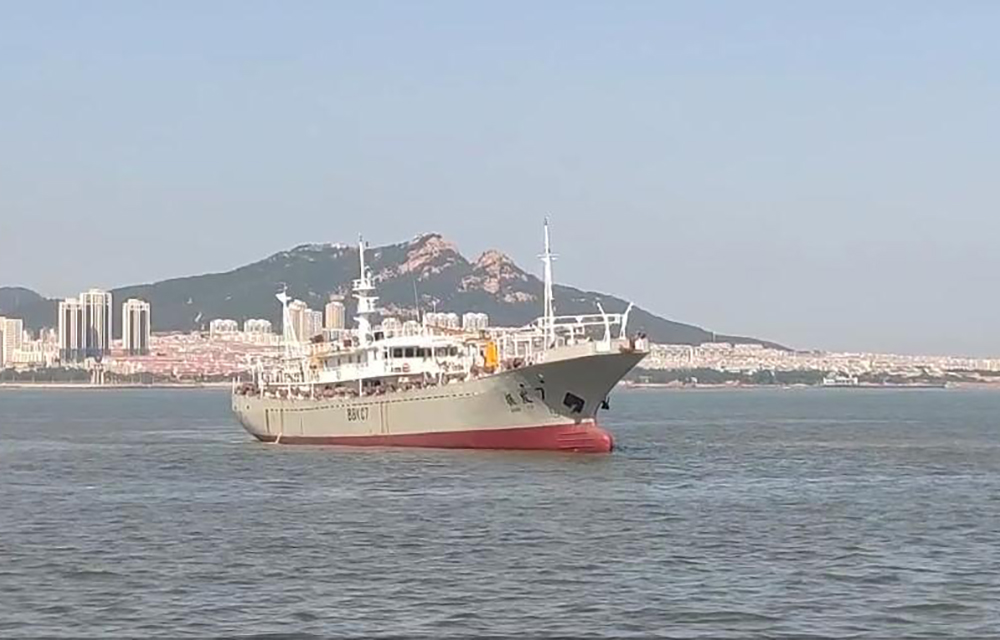
U.S. Customs and Border Protection (CBP) has ordered its officers to immediately seize all seafood from Chinese commercial fishing vessel Zhen Fa 7 should it enter a U.S. port.
On 28 May, CBP issued a withhold release order (WRO) for the vessel, claiming that it has a reasonable suspicion that the vessel’s operators have used forced labor to harvest squid and other seafood.
“Stopping forced labor and protecting law-abiding businesses are key priorities for CBP,” CBP Office of Trade Acting Executive Assistant Commissioner Susan Thomas said in a statement. “We’re working on all fronts to prevent goods made with these unfair labor and trade practices from entering U.S. commerce.”
Zhen Fa 7 was one of the Chinese-flagged vessels documented in a 2023 Outlaw Ocean Project report published by the New Yorker detailing evidence of forced labor in China’s distant water squid fishing fleet. The report highlighted the alleged abuses suffered by Daniel Aritonang, a worker who died aboard Zhen Fa 7 in 2021.
“Through testimony provided by these deckhands, the Outlaw Ocean Project identified multiple indicators of forced labor onboard the Zhen Fa 7, including deceptive recruitment, isolation, physical violence, wage withholding, and more,” Outlaw Ocean Project Founder Ian Urbina in an October 2023 blogpost reporting multiple WRO petitions filed in relation to his expose.
The Ocean Outlaw Project has published a series of reports alleging forced labor and abuse in the global seafood industry, including the systematic abuse of the Uyghur minority group in Chinese seafood processing plants, the use of North Korean forced labor by Chinese seafood suppliers, and labor abuses and health concerns in India’s shrimp sector. The reporting led many seafood companies to cut ties with companies and sectors mentioned by the Outlaw Ocean Project, and U.S. lawmakers called on the federal government to block imports from named companies.
Following the publication of the Outlaw Ocean Project’s reporting, the Human Trafficking Legal Center filed a petition asking CBP to issue a WRO on Zhen Fa 7 in October 2023.
Although CBP’s announcement of a WRO on Zhen Fa 7 doesn’t make note of the petition, the agency said the measure aligned with U.S. President Donald Trump’s directive to address unfair trade practices.
“Combatting forced labor is central to CBP’s mission to protect the economic security of the United States,” CBP Acting Commissioner Pete Flore said in a statement. “The President recently charged us to restore American seafood competitiveness by combatting unfair trade practices, and issuing this order is one way we are contributing to that goal.”
According to CBP, the government identified several indicators of forced labor aboard Zhen Fa 7, including abuse of vulnerability, isolation, retention of identity documents, abusive working and living conditions, physical and sexual violence, and debt bondage. Those practices lowered the vessel's labor costs, undercutting American businesses, CBP claimed in its announcement.
According to CBP, the agency has now issued six WROs on fishing vessels since 2020, but this is the first such order issued since August 2021.
Following Ocean Outlaw Project reporting, the U.S. government has increased its scrutiny of China’s seafood sector. In 2024, the U.S. Department of Homeland Security (DHS) added the Shandong Meijia Group – one of the companies named in an expose – to the Uyghur Forced Labor Prevention Act (UFLPA) Entity List, effectively banning imports from the company.
“We have shown again through today’s enforcement actions that the United States is taking concrete steps to keep goods made with forced labor out of U.S. supply chains,” DHS Undersecretary for Policy Robert Silvers said at the time. “It is imperative for companies to conduct due diligence and know where their products are coming from.”
Shortly after that, DHS added seafood to its list of high-priority sectors for enforcement of the UFLPA.
