

Though Western Australia-based Abrolhos Octopus started just eight years ago, the firm has quickly grown to becoming the only large-scale, vertically integrated octopus supplier in Australia and is now primed to expand its export presence internationally.
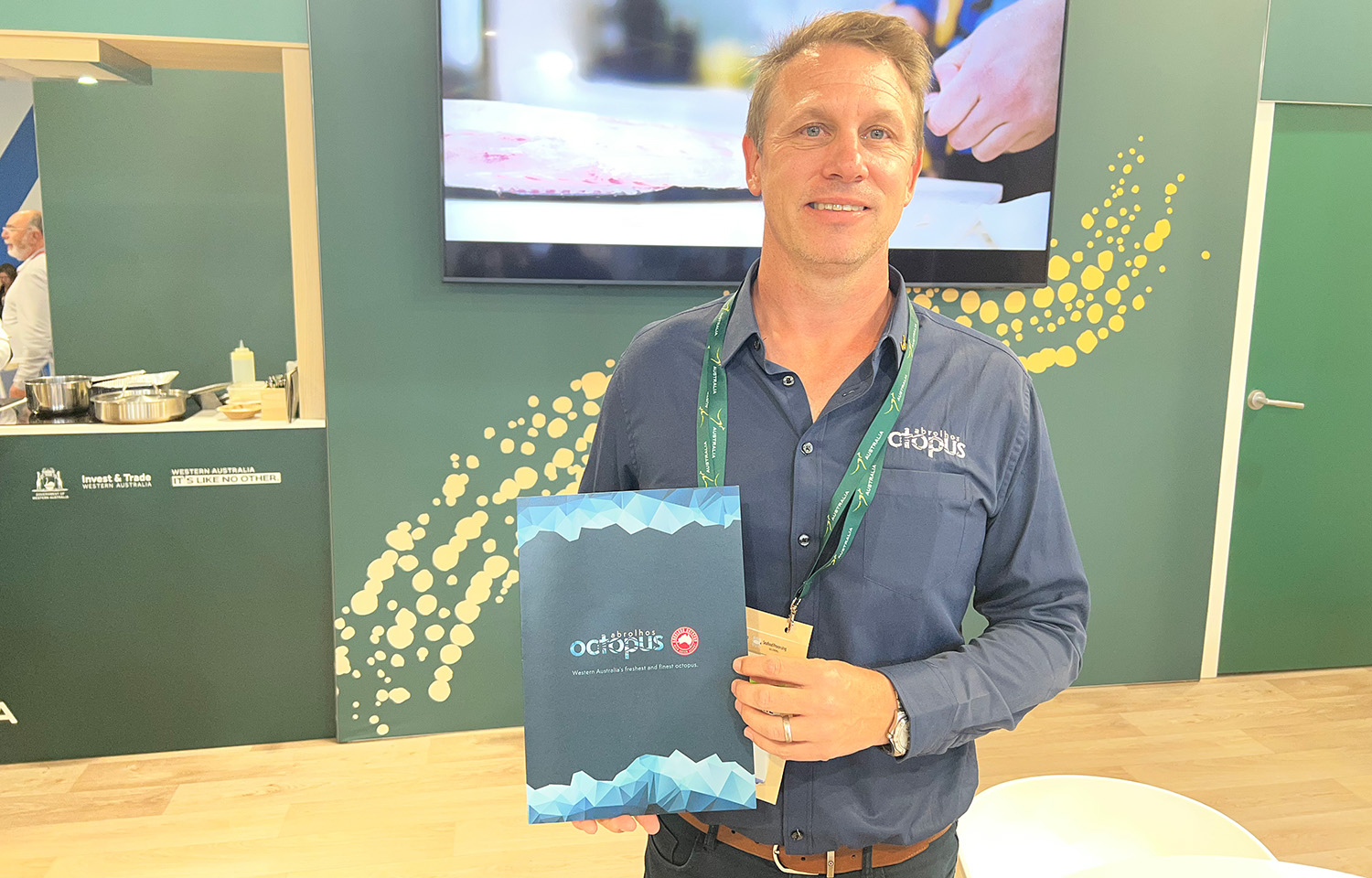
According to Dion van der Merwe, the managing director of Abrolhos, no matter how big the company has gotten, the core focus has always remained on the quality of its products.
The octopus Abrolhos sources comes from the Turquoise Coast of Western Australia, ranging from Green Head about 150 miles north of Perth up to Geraldton, which is another 100 miles north.
Van der Merwe told SeafoodSource at the 2026 Seafood Expo Global (SEG) that the fishery along the Turquoise Coast is one of only three octopus fisheries in the world certified to the Marine Stewardship Council (MSC) standard, a credential it earned mainly through the use of an Abrolhos-patented trap employed by the region’s fishermen that only catches one octopus per trap.
Longlines then haul up the traps, which results in far less rope in the water than other methods, according to van der Merwe.
“It’s not the most efficient means of fishing, but what it means is we are not trawling. We get no bycatch and do no damage to the seafloor. We target octopus; we get octopus,” he said.
The fishery produces around 600 to 700 tons of octopus annually, and van der Merwe said scientific estimates have indicated the stock could remain healthy with upward of 1,000 tons of catch annually, leaving some room for future growth.
“The fishery is very well-managed by the scientists and by us the fishermen. For Abrolhos, we are vertically integrated, so we can scale as the market grows,” he said.
The specific octopus species Abrolhos catches is Octopus djinda, which is found only in Western Australia and largely feeds on rock lobster.
“This gives its meat a sweet, succulent flavor not too dissimilar to the rock lobster itself. Our octopus lives a good life, and we are fortunate enough to harvest it in a very beautiful part of the world,” van der Merwe said.
Once caught, Abrolhos processes its octopus into several different formats, primarily for buyers in the HoReCa space, including offerings like whole octopus with the head off and 1-kilogram raw octopus tentacles that it sells domestically and into high-end dining buyers in Asian markets like Singapore and Thailand.
Value-added offerings, which are mostly available domestically in Australia, include an octopus sauce, a Greek-style marinade, and a terrine that launched a few days before this year’s SEG.
Besides foodservice, Abrolhos is also trying to make a bigger retail push, including through a partnership with a factory in Spain that van der Merwe said should soon lead to a push into Dutch, Swedish, and Danish grocery stores, among others.
“We are trying new things, new products, and new ideas,” van der Merwe said. “We want to give customers a taste of Australia and of this unique octopus but also showcase the versatility of what you can do with octopus. You can have it cooked, raw, in a terrine, in a marinade, in a sauce, etc.”
In terms of market opportunities in the near future, Abrolhos is keeping its eye on the free trade agreement soon to launch between Australia and the E.U.
“Europe consumes vast quantities of octopus and understands the uniqueness of the product and the benefit of our MSC certification. For me, Europe has been a big focus. We have gotten increased interest from markets like Germany, which is wonderful. We want people to want our sustainable products and buy in to our story,” van der Merwe said.
