




Ecuador’s government has signed an agreement with South Korea to ease restrictions on trade, and also inked a memorandum of understanding (MoU) with Japan to promote bilateral commerce, Ecuador’s Ministry of Production, Foreign Trade, and Investments announced in separate releases.
Ecuador signed a strategic economic cooperation agreement (SECA) with South Korea on 2 September, under which 98.8 percent of Ecuador's exportable products will enter tariff-free to the Asian country of more than 51 million consumers. With the agreement, non-oil exports to South Korea are expected to grow 27 percent, according to government estimates.
“Ecuador and South Korea have complementary economies. While the Asian country depends on the import of agricultural and fishery products, Ecuador stands out for its biodiversity and productive capacity,” Ecuador’s Ministry of Production, Foreign Trade, and Investments said in a release announcing the agreement. “At the same time, South Korea's technological and industrial experience represents an opportunity to modernize Ecuador's productive sectors and increase its competitiveness on the global stage.”
The Ecuadorian Corporation of Export Trade Associations (Cordex) applauded the signing of the SECA, but said further steps needed to be taken in order to ensure safe and productive trade.
“Although reducing tariffs constitutes an advance in access to a key market for exports, Cordex proposes as a next strategic step to update and standardize health protocols for export products such as shrimp, as this will guarantee that national products meet the standards required by that market and will allow exporters to increase their sales to that destination,” it said in a LinkedIn post.
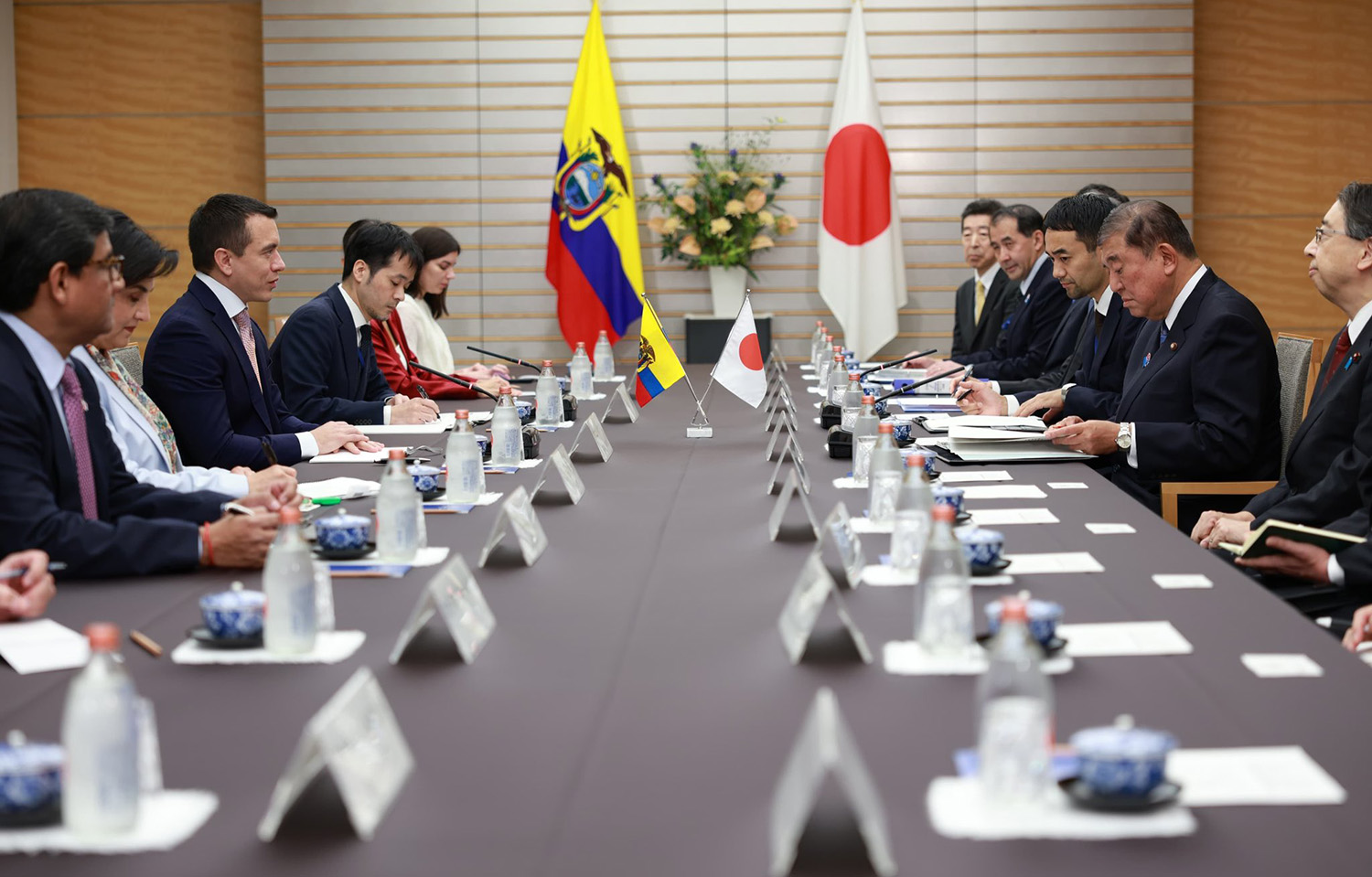
Meanwhile, the Ecuadorian government’s MoU signed with the Japan Foreign Trade Organization (Jetro) is aimed at strengthening bilateral trade and attracting investment.
The MoU includes joint promotion of Ecuadorian products in Japanese platforms and fairs; attracting Japanese investment in renewable energy, agribusiness, innovation, and infrastructure; cooperation on quality, sustainability, and decarbonization standards; and access to market intelligence and business networks in Japan for Ecuadorian exporters.
Ecuadorian Production, Foreign Trade, and Investment Minister Luis Jaramillo touted the MoU as a sign of Japan’s trust in Ecuadorian trade.
“With the signing of this agreement, Ecuador consolidates a strategic step toward Asia. Japan recognizes the quality and competitiveness of our exportable offer, and the country is looking forward to greater cooperation in investment, technology, and sustainability,” he said.
From 2020 to 2024, Ecuador’s average yearly non-oil exports to Japan reached USD 245 million (EUR 209 million), Jaramillo’s ministry reported, with those exports to Japan growing 46 percent in 2024 year over year and enjoying a similar performance during the first half of 2025, mainly driven by increased shipments of shrimp, canned agricultural products, and cocoa.
“The alliance with Jetro is a commitment to the future. It allows us to directly connect our exporters and associations with one of the most sophisticated markets in the world,” Carolina Maldonado, the executive director of export promotion agency Pro Ecuador, said. “Japan knows that Ecuador is a partner that is committed to sustainability, innovation, and added value.”
Regarding shrimp exports, Ecuador has room to grow with both South Korea and Japan.
During the first seven months of 2025, buyers of Ecuadorian shrimp continued to be dominated by China, Europe, and the United States, which took up 49.9 percent, 22.3 percent, and 18.3 percent of the share in volume terms, respectively. During that time, Ecuador exported 1.82 billion pounds of shrimp, bringing in a total USD 4.36 billion (EUR 3.71 billion), according to figures from Ecuador’s National Aquaculture Chamber (CNA).
The “Rest of Asia” category represented 5.84 percent of total volume exports, reaching 106 million pounds and USD 278 million (EUR 237 million) from January to July.
Japan specifically imported 24.9 million pounds worth USD 74.2 million (EUR 63.2 million) during the first seven months of 2025, marking increases of 47.6 percent and 65.4 percent year over year, respectively, but still making up just 1.37 percent of Ecuador’s total shrimp exports in terms of volume.
South Korea imported 5.5 million pounds of Ecuadorian shrimp for a total value of USD 13.2 million (EUR 11.2 million), representing decreases of 42.1 percent and 36.7 percent when compared to the same seven months of 2024 and representing just 0.3 percent of Ecuador’s total shrimp exports.
“That drop in exports is precisely why we have requested that the health protocols be reviewed. South Korea requires many procedures for importing products to ensure their quality and safety,” CNA told SeafoodSource.
