



Charoen Pokphand Foods has opened a new prototype indoor shrimp farm in Thailand with the aim of honing its shrimp farming practices to make them more efficient and environmentally sustainable.
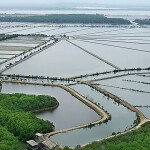
The 960,000-square-meter vannamei farm in Bangsrakao, Chantaburi, Thailand is a closed-operation indoor facility equipped with state-of-the-art biosecurity technology including measures that will qualify the farm as organic, according to Premsak Wanuchsoontorn, the executive vice president of CP Foods’ aquaculture division.
With lessons learned from the prototype, Wanuchsoontorn said CP Foods expects to increase the percentage of its shrimp farms that are indoor, closed-containment operations from 20 percent to 100 percent within the next five years.
“To achieve a sustainable level, the company must mitigate the risk factors from external environments such as disease. This farming technique will response to new consumer trend[s],” the company said in a press release. “[CP Foods] is shifting towards organic shrimp farming with high biosecurity technologies and eco-friendly [practices] to serve new consumer trend[s] as well as ensure low risk and even more productive farm[s] that will be a role model for CPF’s shrimp business through small-scale farmers in [the] very near future.”
The Bangsrakao prototype farms is equipped with CP Foods’ highest-ever level of automation, designed both to save on labor and to prevent contamination caused by human interaction with the farming system. The water used at the farm is all recycled and is filtered by an Ultra Filtration (UF) system, designed to filter out contaminants as small as 0.02 microns in size – smaller than most viruses.
“The method can massively reduce water consumption from external source[s] and, at the same time, reduce risk of contamination from intake water,” the company said.
CP Foods is also using Biofloc Technology, which introduces probiotic microorganisms into the farm’s water to treat diseases and clean pond residues. As they do their jobs, the microorganisms become nutritious feed source for the shrimp they are helping to keep alive, according to the company.
As a result of the advanced technology used in the farm, CP Foods has been able to reduce water usage from five to seven cubic meters to 1.5 cubic-meters-per-kilogram of shrimp produced, while also increasing yields from three metric tons of shrimp per 1,600 square meters to eight metric tons.
“Shrimp farmers are reluctant to invest in the closed-indoor farming due to high investment,” Wanuchsoontom said. “Bangsrakao’s farm is working on the technique to lower the cost. We believe that, eventually, all shrimp farms will be indoor farm to mitigate the risk of diseases.”
