




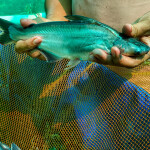

The Fisheries Laboratory of Kinki University, in Wakayama, Japan, in a joint research project with Kyoto University, has produced a line of genetically-modified sea bream that has more muscle — and thus, more edible meat — than wild sea bream.
The researchers’ work, in which they used the CRISPR genome editing tool to knock out the myostatin gene in sea bream, is detailed in the scientific paper in the journal Aquaculture. The function of the myostatin gene is to limit muscle growth, so removing it results in heavier muscling. Over a period of two years, they grew these to maturity and bred them to establish a new breed of myostatin-disabled red sea bream.
In addition to having 16 percent more edible meat, the new breed (nicknamed “muscle madai”) has a shorter centrum – the central part of the body along the backbone, excluding head, and tail – and overall body length. There were no skeletal deformities in the edited fish, so the shorter length does not appear harmful to the fish.
CRISPR gene editing, together with DNA sequencing, allowed quick development of the new breed, the researchers said. As the first step in the project, the CRISPR technique was performed on fertilized eggs soon after fertilization to try to change the DNA before it replicated. When the gene-edited fish were about six months old, they sequenced DNA from the caudal fin to determine and classify the level of mutation in each fish. Next, they bred the fish with a high mutation level with wild red sea bream. Then, they mated together the more highly mutated offspring from this F1 cross. The offspring that inherited the edited genes from both parents were then mated together to create an F2 generation of fish that had no myostatin.
The new breed is GMO, but not transgenic, as a gene has been removed but nothing added from another species. Introduction of potential allergenic genes is one of the major concerns with GMO foods. Professor Keitaro Kato of Kinki University, one of the authors, told SeafoodSource he doesn’t know if the lack of introduced genes will lead to better acceptance from consumers, but he will try to promote its safety.
The project’s aim is to make sea bream – often served grilled whole at celebrations, and as sashimi and sushi – less expensive and more popular. But as “muscle madai” is a GMO breed, its creators are taking precautions to prevent its release to the ocean, where it might interbreed with wild fish and affect the population’s gene pool. For now, it can only be raised in land-based tanks.
But the research team is already attempting to solve that problem. Kato said they are working on producing a triploid version and expect it to be ready in about a year. Triploid fish have three sets of chromosomes and are sterile, unlike a fertile, diploid fish that has two sets of chromosomes. Triploid fish are created by forcing the egg to retain a chromosome that is normally ejected during egg development. This is typically done by subjecting newly fertilized eggs to pressure inside a pressure vessel.
The decision on whether or not to approve farming of triploid fish in ocean net pens would be up to Japan’s Environment Agency. Discussion and approval would probably take two to three years, so commercialization of the new breed is possible in three to four years’ time, Kato said.
Sea bream, a popular white fish with a festive red body color, is farmed mainly in the Seto Inland Sea and around Kyushu. According to Ministry of Agriculture, Forestry and Fisheries statistics, the annual wild catch is about 15,000 metric tons and aquaculture produces about 60,000 MT.
