



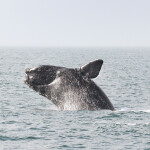
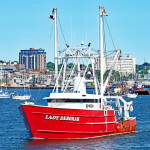

Critically endangered North Atlantic right whales have begun a summer return to the Gulf of Saint Lawrence, and their travel can be tracked by the fishery closures and seafood processing plant layoffs they’re leaving in their wake.
Fewer than 500 North Atlantic right whales exist on the planet. In 2017, at least a dozen of them were found dead in Canadian waters, many with signs they had been entangled in fishing gear or struck by ships. In March 2018, Canadian Fisheries Minister Dominique LeBlanc announced a response plan that included restrictions on Canada’s fishing industry.
Thus far in the season, the Canadian government has acted quickly to close any fishing zones close to the endangered whales, forcing all fishing activity to stop for 15-days periods and requiring that all gear be removed from the area. As a result, large swathes of Eastern Canada’s snow crab, toad crab, rock crab, lobster, winter flounder, Atlantic halibut, and whelk fisheries have been closed in 15 areas known as "grids."
Perhaps the hardest-hit fishery is snow crab, where new no-fishing zones have been put in place over areas where 20 percent of the 2017 snow crab quota was caught, according to the Department of Fisheries and Oceans.
Jean Lanteigne, general manager of the Shippigan, New Brunswick-based Regional Federation of Professional Fishermen, which represents about 20 crab fishermen, told the CBC it is becoming “impossible to fish” in the Gulf of Saint Lawrence. He said two fishermen have already quit the industry as a result of the situation.
"We don't know what's going to happen today, tomorrow and for the coming days," Lanteigne said. “"We're tied up in a system where the house is burning, and we just have to watch."
According to both Lanteigne, 2018 is shaping up to be a less lucrative one for the fishery than 2017. Lanteigne said there aren't as many snow crab in some areas this year, perhaps due to of weather conditions. Data from the DFO backs that up. As of Wednesday, 30 May, the DFO estimates 2018 landings at 13,475 metric tons (MT), down from 21,081 MT in 2017, but on par with the 2016 total landing amount of 13,684 MT. Even with higher prices – DFO said the price per kilogram is averaging CAD 11.02 (USD 8.54, EUR 7.32) this year, compared to CAD 10.49 (USD 8.13, EUR 6.97) in 2017 and CAD 8.19 (USD 6.34, EUR 5.44) in 2016 – the total value of the catch is expected to shrink from CAD 221.1 million (USD 171.3 million, EUR 146.8 million) in 2017 to CAD 148.4 million (USD 114.3 million, EUR 98.6 million) in 2018.
DFO attributed the difference to a lower total allowable catch, which was at approximately 40,000 MT last year but is set at around 22,000 MT this year, similar to what it was historically, including 2016, when it was around 20,000 MT.
“The 2017 snow crab season was an exceptional year,” DFO said in a 30 May press release in which it announced static and dynamic closure areas totaling nearly 10,000 square kilometers.
With the additional closures and fewer snow crab, fishermen aren't able to fulfill their contracts, Lanteigne told the CBC.
"Everybody's being hurt, starting from the fishermen, then to the workers in the processing plant, the processing plant and the New Brunswick economy is being hurt," he said. "Everybody's losing in this game."
Marc Guignard, who manages Belle Ile Fisheries Ltd., a plant that processes snow crab in Sainte-Marie-Saint-Raphael, confirmed landings have been down so far and that he's worried about this year's season.
Those worries hit home for up to 40 employees at the Ichiboshi fish plant in Caraquet, New Brunswick. The plant, which employs around 600 workers processing snow crab for export to Japan, let go of the employees on 21 May, according to the CBC.
Jean Maurice Leclair, the union president at the plant, said the layoffs were due to a lack of crab.
“"They're losing money so they're forced to eliminate jobs," Leclair said in a French interview with Radio-Canada. "It's sad for me, there is nothing we can do, if the company doesn't get the crab it needs … the catches are minimal."
The snow crab fishing season is scheduled to close 30 June and Robert Hache, director-general of the Acadian Crabbers Association, said there have been no conversations yet about extending the season.
"We will not ask for an extension of the season," Hache told the National Observer. "That would not be reasonable."
Photo courtesy of Maxime Corneau/Radio-Canada
