





 John Susman
Owner of FishTales
Sydney Fish Markets
Sydney, Australia
Australia’s leading fish and marketing expert, and co-author of the new seafood tome “The Australian Fish and Seafood Cookbook,” John Susman has plenty of advice on how to cook seafood for meat-people.
“There is nothing like the flavor and texture of a chargrilled sirloin steak - or is there?” he challenged. “Whilst we Westerners eat way more terrestrial than marine protein and have become programmed to more regularly choose red over white meat, there are so many meaty fish options that we should really reconsider our position.”
Susman suggests looking for a fish that mimics the firm texture and the juicy fattiness of a piece of meat. His suggestion is swordfish for its moist, meaty flesh that’s sweet and delicate, yet mild yet flavorsome. Swordfish also adapts to a range of cooking styles and methods that are often applied to red meat. A grilled piece of swordfish with smoky, caramelized char-grill marks can, for all intents and purposes, be the "steak of the sea.”
Alternatively, Susman said grouper, barramundi and trevalla are worthy as other options, as they all display the deep flavor and yielding texture of a leg of lamb when properly roasted.
Susman also points out that, similar to meat, the key to the proper cooking of large cuts of fish is to ensure it is well rested after cooking. The rest period allows for the flavor-giving juices trapped in the fish to be re-absorbed into the muscle, giving it a rich, delicious and umami rendering flavor that is often mistakenly attributed exclusively to red protein.
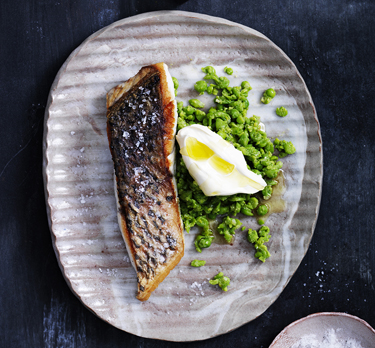
Barramundi with crushed peas and sour cream
Serves 4
- 4 × 200 g (7 oz) barramundi fillets, skin on, pin-boned
- 2 tablespoons rice flour
- 80 ml (2½ fl oz/⅓ cup) ghee (see note)
- Crushed Peas (page 459)
- 85 g (3 oz/⅓ cup) sour cream
- sea salt, to taste
- lemon oil, to serve
To prepare the barramundi fillets for pan-frying with crisp skin, lay them on a work surface and dust the skin sides with the rice flour. Place each fillet, flesh side down, on a sheet of baking paper large enough to cover the fillet.
Heat a large cast-iron or heavy-based frying pan over medium–high heat (or two smaller pans – it’s essential that the fish is not overcrowded in the pan; see note) and add the ghee. When the pan is hot and the ghee translucent, place the fillets in the pan, skin side down, leaving the paper on the flesh side. Place a 1 kg (2 lb 4 oz) weight – such as a heavy pot or another pan – on top of the fillets and cook for 4 minutes, lifting the weight once or twice then moving the fillets gently around the pan so they don’t burn. Reduce the heat to low. Remove the weight and the paper, then, using a spatula, gently flip each fillet to quickly seal the other side. (Cooking times may vary depending on the size of the fish from which the fillets were cut.)
Serve the barramundi immediately, skin side up, with the crushed peas, sour cream and a liberal pinch of sea salt on the fish skin. Add a splash of lemon oil over the sour cream.
Notes: Ghee is a type of clarified butter, made by heating the butter to separate the water, fat and milk solids. The water is discarded and the milk solids are left to caramelize with the fat to form a clear, nutty liquid. Good-quality versions are available in gourmet grocery stores and some supermarkets. Although it is used in the recipes throughout this book, feel free to use your favorite oil instead.
If you don’t have a pan large enough for all the fillets, or two smaller pans, cook the fish in two batches. Keep the first batch warm while you cook the second.
