



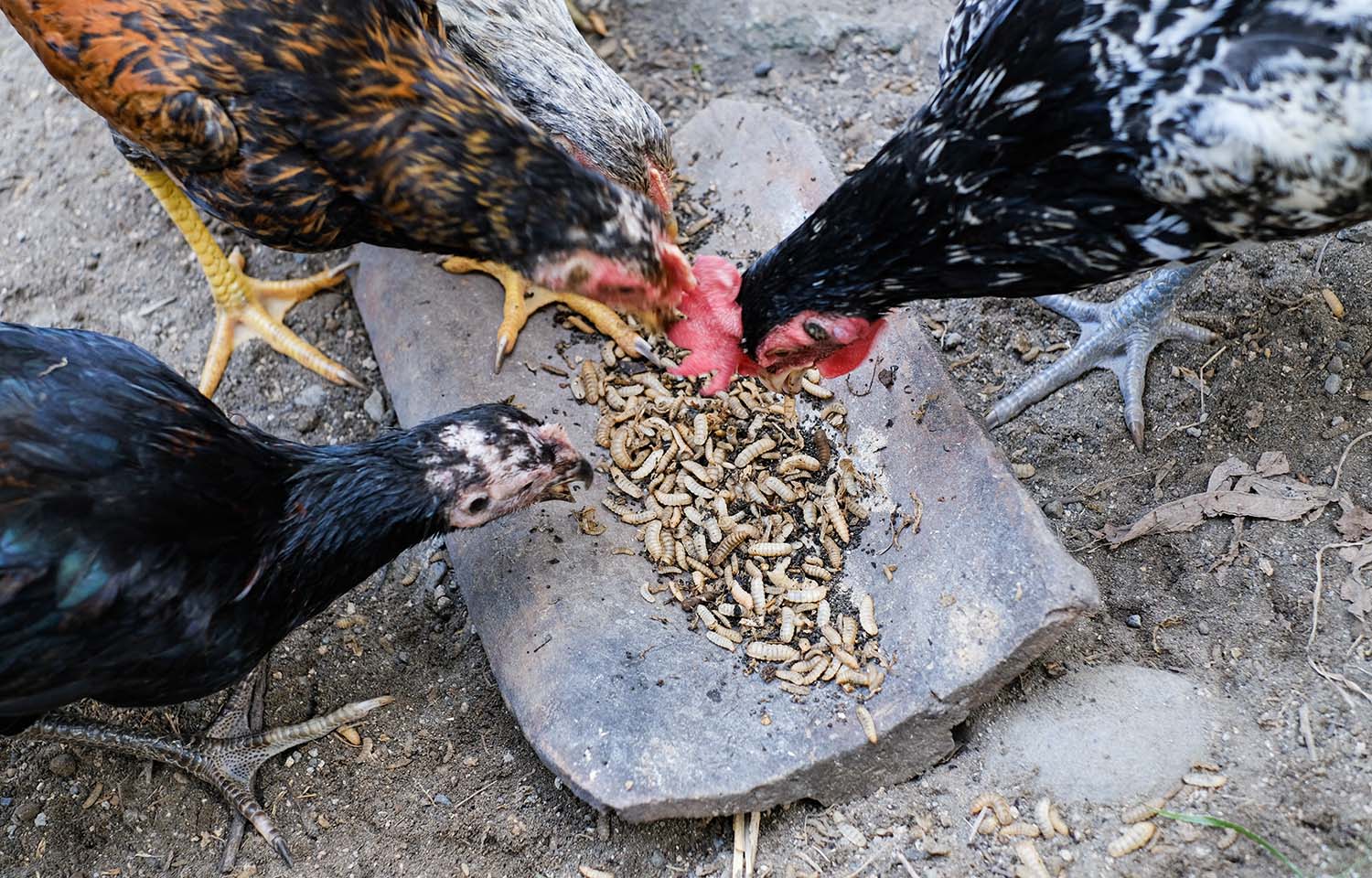
Saskatchewan, Canada-based black soldier fly (BSF) production company NRGene Canada and fish-processing and -packaging firm Ile-a-la-Crosse Fish Company recently announced a collaborative feed recipe for poultry, known as “MaxBSF.”
"Our community is proud to be at the forefront of this innovative work," Ile-a-la-Crosse Fish Company CEO Tyler Morin said. "This partnership reflects our cultural values of sustainability and way of life. Processing our byproducts locally means more of the jobs, knowledge, and value stay in Ile-a-la-Crosse."
The partnership sees byproducts previously deemed as waste from Ile-a-la-Crosse Fish processing operations used in a formulation for BSF production.
NRGene explained that fish byproducts are typically high in moisture and fat, which causes them to spoil quickly and makes them not typically conducive for use in BSF production. However, under controlled conditions and ensuring high-performing genetics in the production process, it is commercially viable.
NRGene Canada said that Saskatoon-based laboratory Prairie Tide Diversified ran an analysis on MaxBSF larvae against other forms of fish-based feed and found that the MaxBSF products contained several times more total omega-3 which did not exist in standard competitor products.
The two originally partnered in January 2025 to find ways to reduce byproduct waste and, in turn, generate “a highly nutritious feed supplement” for chickens that produce eggs with a higher omega-3 content.
Though the new feed recipe itself supports chicken-rearing operations, NRGene said the process benefits the commercial fishing industry, as well, by finding new avenues for processing jobs and repurposing waste that was once a limited economic product into a budding resource.
"We set out to demonstrate that a difficult waste stream could be converted efficiently and consistently at a commercially meaningful scale," NRGene Canada Chief Business Officer Yossi Levi said. "The run confirmed the process scales, and the economics hold up."
NRGene Canada said the company is now moving to scale production on-site in Ile-a-la-Crosse.
"These results matter because conventional BSF larvae generally contain very limited levels of EPA and DHA," NRGene Canada Director of Product Ben Gradus said. "By incorporating fish-processing byproducts into the feed, we can produce MaxBSF larvae that combine insect protein with valuable marine omega-3 fatty acids."
The next iteration of feed products planned in this partnership is a dried BSF larvae product for animal feed, called MaxBites, which could be a higher-value poultry supplement.
"This is a scalable model, not a one-time project," Levi said. "We take a local organic byproduct, develop a dedicated feed, supply high-quality neonates from a central egg facility, and establish the rearing operation close to the feedstock. Many regional byproduct streams could benefit from the same approach."
BSF larvae have been tested for use in a multitude of ways, including most recently in the U.S. state of Florida for sargassum inundation events.
