

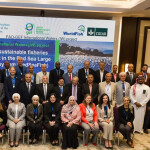


This week’s European Aquaculture Society annual meeting in Porto, Portugal, is a hive of activity, with academics, researchers, students, fish farmers, government officials and equipment manufacturers thrown together for three days to mull over the latest developments and innovations.
Now an aquaculture conference may not seem instantly applicable to wholesalers, retailers or consumers, yet without research we would not know how to farm new species nor how to improve quality, transportation and the eating experience.
With more than 1,000 visitors from numerous countries — including Kuwait, United Arab Emirates, Malaysia, the United States, Turkey, Iran, Australia, Spain, Slovenia, Sweden, Norway, the Faeroes, Germany, France, Greece, Portugal and Italy — there appears to be considerable interest in learning from others and doing things better.
Among the topics addressed at the event were food security and the importance of local food supplies. The Stockholm Project looked at fish consumption in the Stockholm area in 2009 and uncovered some surprising results, according to Ola Oberg of the Royal Institute of Technology.
“We were shocked to find that of the 31,000 [metric] tons consumed in the Stockholm area each year by 2 million people, just 0.5 percent came from [domestic] aquaculture (trout, carp) and 0.5 percent from the wild fishery; 99 percent was imported, mainly salmon from Norway and pangasius from Vietnam,” he explained. “This compares with 145,000 [metric] tons consumed in [all] of Sweden, of which 4 percent comes from [domestic] aquaculture, 16 percent from fishing and 80 percent from imports.”
In light of the findings, a consumer study was undertaken to find out what people thought of this and what they considered important when buying fish. Sustainability and local scored high on the list of priorities, but given limitations on fishing quota, increased supplies can only come from aquaculture.
Ola and his team then looked at the barriers to increased aquaculture activity, which include difficulty in obtaining permission, ambivalent government support and a lack of knowledge about the potential for fish farming in the region. “We are now working on these and believe that there is huge potential to increase locally produce fish, which will provide benefits all around,” said Oberg.
Of course, aquaculture still has a lot of room to grow worldwide. Among the “new kids on the block” are octopus, wreckfish, Senegalese sole, jack fish, cuttlefish and barnacles — all species that are in the early stages of being farmed commercially. Farmers are experimenting with mantis shrimp in the Philippines, with Shi drum, common dentrex, red porgy and sharp snout sea bream in Turkey and yellowtail kingfish in recirculation systems in the Netherlands.
One particular innovation that caught my eye during the event were fish cages made from copper alloy. The manufacturers claim that this not only prevents a build-up of fouling but also prevents all escapes — which should please environmental NGOs — and stops attacks from predatory seals.
“Seals were found to leave the cages alone completely after a couple of days, and when we tested the salmon we found far lower levels of stress hormone, with consequent better flesh quality,” said Nigel Cotton of the European Copper Institute.
The question is, will the fish farmers bite at the price? If so, this innovation may mark a turning point for aquaculture.
