




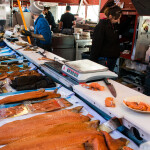

This year began with the revelation that a single 4.5kg Norwegian farmed Atlantic salmon (Salmo salar) had become worth more than a barrel of the country’s crude oil. While this phenomenon owes an awful lot to the plummeting value of oil, it’s also true that salmon prices have swelled to unprecedented levels in recent months.
Depleted supply, together with a weakened Norwegian krone against the major currencies and strong market demand have led to Norway achieving record export prices for its salmon, and there’s little sign of any let up in this trend occurring in the near future.
The average export price for the Scandinavian country’s fresh whole salmon in January was NOK 55.62 (EUR 5.80; USD 6.50) per kg, which was 26 percent or NOK 11.40 (EUR 1.19; USD 1.33) higher than a year ago and 9 percent more than the average for December 2015. It was also the highest average export price obtained for a single month since 1988.
In total, Norway’s salmon exports were worth NOK 4.3 billion (EUR 448.7 million; USD 502.4 million) last month, an increase of 18 percent or NOK 644 million (EUR 67.2 million; USD 75.3 million) year-on-year and an all-time high for the month of January.
And yet, there are areas of concern.
Measured by volume, 73,463 metric tons (MT) of salmon was exported last month, which was 4 percent or 3,300 MT less than in January 2015. And with the exception of the United States, there were volume decreases in all of Norway’s main salmon markets.
Harvests are expected to remain at lower levels than last year – at least for the first quarter – due in part to ongoing biological challenges, particularly sea lice infestations, which have also seen production/mitigation costs escalate. It’s estimated this particular parasite now costs Norway more than NOK 3 billion (EUR 313.2 million; USD 350.6 million) each year.
As well as direct losses, some farmers have also been harvesting their salmon earlier and at smaller sizes to allow contaminated production sites to be “cleaned.” This has seen much less product available to buyers and processors.
While many producers have seen their margins improve as a large proportion of these farm costs are met in krone (whereas most of their revenues are in euros or U.S. dollars), almost all of them have announced they will be scaling up their efforts to address this growing problem and to get their outputs moving in the right direction again.
Last year, Norway increased its salmon production to more than 1.2 million MT and exported over 1 million MT of that total, which was up 3.7 percent on the previous year. This year, though, analysts believe the output will be down between 3 and 5 percent to around 1.1 million MT and that it could in fact be two years before any growth is seen.
With demand running even higher than supply, it’s likely that prices will rise further, which will filter through to consumers and increasingly test their loyalty to the product.
Many end markets, particularly in the EU, have become accustomed to attractively priced salmon – made possible by the Russian trade ban that was introduced in 2014 and which increased its availability significantly. Looking ahead, a lot hinges on how high prices can go before demand wanes.
The price of salmon from other origins is also expected to rise as buyers explore alternative sources.
A year ago, the global salmon industry was forecast to produce between 2.4 and 2.5 million MT of salmon in 2016, up from 2.3 million MT last year. With Norway supposed to account for a large proportion of the increase, this year’s total should actually be expected to decline to around 2.2 million MT.
