






Finite fishmeal and fish oil supplies, increasing climate volatility, and growing competition for marine ingredients have become increasingly urgent topics of concern in the global aquaculture industry, especially as the sector’s rapid expansion has shown no signs of slowing.
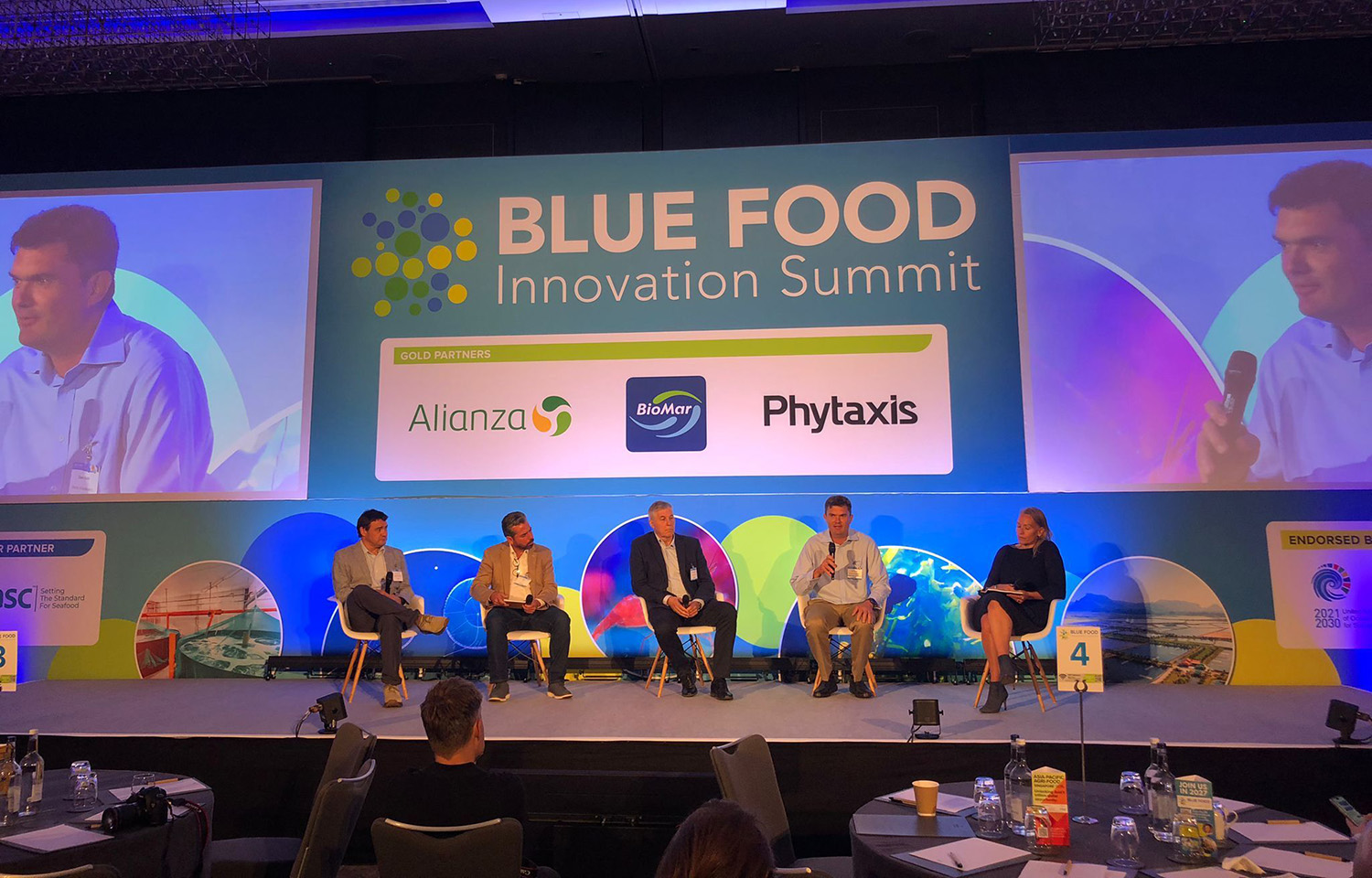
Aqua-Spark Director of Strategic Partnerships Katherine Bryar questioned at the recently held Blue Food Innovation Summit in London, U.K., whether the industry is ready for the next stage of aquaculture growth and said the issues have naturally driven innovation toward novel ingredients.
“The question is: Are we ready for the next stage? It's fantastic to talk about innovation, but if fish and shrimp aren't fed, we won't have any food to sell,” she said. “[Feed] is one of the key bottlenecks to the industry's expansion as production needs to double by 2050.”
According to IFFO data, global fishmeal production in the first quarter of 2026 fell 28 percent year over year, while fish oil production declined 12 percent, reflecting weaker supplies from key producing regions.
At the same time, demand has intensified, with China's expanding aquaculture and feed sectors, as well as global salmon producers, remaining heavily reliant on highly digestible proteins and omega-3-rich marine ingredients.
Cargill Animal Nutrition and Health Sustainability Director Dave Robb confirmed that industry growth, combined with increasing competition for fishmeal and fish oil, is generating greater pressure, while climate change is affecting fisheries productivity and extreme events such as El Niño weather patterns continue to disrupt supplies.
"We’re all going to be in a tough place for both meal and oil this year,” he said. “We're already seeing fishmeal prices go up, and I think oil is drifting up as well. We are forecasting a potentially significant El Niño event in Peru this year. We don't yet know exactly how that will affect fishmeal and fish oil availability, but it's unlikely to help.”
However, Robb said he believes the aquafeed sector is ready for the challenge, so long as it can continue meeting customer requirements.
“First, we need to deliver the nutrition fish require. Second, we need to do so at a cost that allows farmers to remain profitable and retailers to continue selling seafood at acceptable prices,” he said. “The feed industry will undoubtedly develop solutions. The question is how quickly those solutions can scale.”
Underlining the progress so far, he pointed out that in the 1990s, salmon diets consisted largely of fishmeal and fish oil, while today, a typical salmon feed contains 20 or more different ingredients.
"We've been innovating constantly over the last 25 to 30 years to get to where we are today,” he said.
That evolution, he explained, has significantly reduced the reliance on marine ingredients but hasn’t supplanted it.
According to panelists at the summit, fishmeal and fish oil have been difficult to replicate fully through alternatives, with EPA and DHA omega-3 fatty acids remaining particularly central to salmon nutrition and product quality and highly digestible marine proteins playing an important role in performance and fish health.
Nevertheless, they said commercial-scale insect meal production is expanding, while algal oils have secured a place in salmon feed formulations. All the while, single-cell proteins, microbial ingredients, precision fermentation products, and genetically modified oil crops are continuing to move along respective commercialization pathways.
"We're not simply replacing protein," Alianza Business Development Manager for Aquaculture Rodrigo Andres Lewis said. "We're replacing a highly complex nutritional matrix consisting of proteins, lipids, and numerous other nutrients."
Alianza has spent 80 years developing nutritional technologies, and it remains convinced that innovation in oils will be critical, Lewis said.
“Proteins will still play an important role but perhaps not always as the dominant volume ingredient. Increasingly, they may serve strategic and functional purposes within feed formulations,” he said. “We're convinced the technology exists; the industry still has room to evolve, but we're ready to move forward.”
Regardless, the next generation of feed development is increasingly focused on functionality, with companies investing in ingredients designed to improve gut health, nutrient absorption, immune function, and feed efficiency.
These functional ingredients can help reduce antibiotic use, improve feed conversion ratios, and lower environmental impacts by reducing nutrient waste, explained Phytaxis Director Luis Gonzalez.
Switzerland-based Phytaxis’ plant-based ingredients, for example, which derive from upcycled agricultural residues, have already demonstrated strong commercial results, including improved feed conversion, survival rates, and cost savings for farmers, Gonzalez said.
He added a caveat that despite such benefits, “collaboration is critical” to bringing new solutions to market.
“Many smaller producers cannot afford significant upfront investment, so we work collaboratively and structure agreements around demonstrated performance,” he said. “Success depends on working closely with feed companies and producers.”
Cost is one consideration but so is sustainability, as many alternative ingredients offer lower carbon footprints, reduced reliance on wild fisheries, and greater supply chain control than traditional marine ingredients.
Sustainability alone, though, will not drive adoption, BioMar Global R&D Director Simon Wadsworth insisted.
"The most important factor remains performance. Any ingredient must maintain growth rates, feed conversion ratios, and overall production performance,” he said, explaining that introducing novel ingredients to the mainstream is, therefore, an “ongoing process.”
“We've seen significant volatility before. Algal oils, for example, experienced major price swings but eventually became commercially viable and widely adopted. The same may happen with proteins,” Wadsworth said. “As traditional ingredient prices rise, the economics become increasingly attractive. Importantly, conventional ingredients such as soy protein concentrate continue to grow and remain highly competitive. The future will involve both traditional and novel ingredients working together.”
Once adopted, another challenge lies in maintaining adoption, Robb said.
“Historically, industries tend to revert to the lowest-cost option. That's why value chain collaboration is essential. We also need long-term commitments that survive beyond individual supply crises,” he said. “You cannot build a stable supply chain by reacting only when an El Niño occurs.”
