






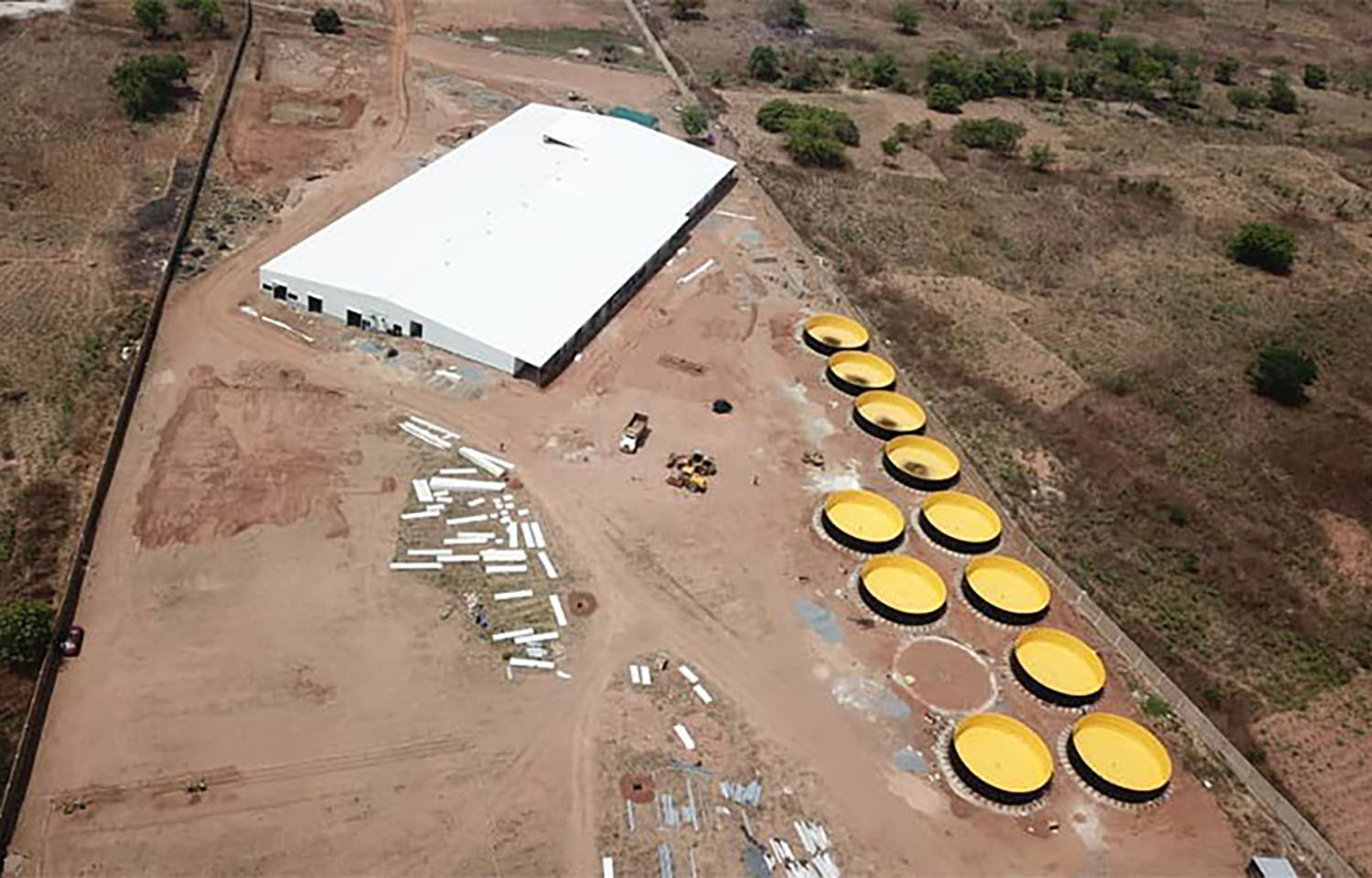
Chinese aquaculture equipment companies are securing contracts across the globe, taking advantage of consistently rising demand for such products.
One region in particular that has frequently partnered with Chinese firms for its aquaculture equipment needs has been the Middle East, according to Marcel Verbrugge, who is the director of Guangzhou, China-based Dahui Aquaculture, which supplies recirculating aquaculture systems (RAS), as well as hydroponics and aquaponics systems, to clients worldwide.
Verbrugge told SeafoodSource that the key drivers of demand for aquaculture equipment in the region include food security but also water shortages.
“They don’t have much water; therefore, governments have decided that open pond aquaculture has to be replaced with RAS,” he said.
Specifically in Saudi Arabia, Dahui has taken advantage of government policy that is supportive of aquaculture, with Verbrugge pointing to the country’s “Vision 2030,” which has pushed for a diversified economy that includes increased food security and efforts on initiatives like aquaculture production.
“Their quantities of seafood and fish are not enough to feed the population. They give subsidies to promote aquaculture,” Verbrugge said.
Dahui Aquaculture is a joint Chinese-Dutch company. Verbrugge described the firm as a “fully turnkey” supplier, providing equipment to customers but also installation and engineering advice onsite. Some of the company’s most important clients, according to Verbrugge, are in the Middle East, including in Saudi Arabia, Qatar, Oman, and Iraq.
Verbrugge said China is likely to continue dominating in the region, as it has several competitive advantages as a supplier of aquaculture equipment.
“There are many companies producing aquaculture equipment. China is leading price-wise,” he said.
Other Chinese suppliers of aquaculture equipment are having similar success in exporting their products to the Middle East, including Huizhou Beehive Aquaculture Equipment, which supplies shrimp hatcheries, as well as rooftop RAS systems for crowded urban sites.
“Extreme water scarcity means [the Middle East] needs 95 percent water recirculation,” a company salesperson told SeafoodSource.
Additionally, Guangzhou Zhonghang Environmental Technology Co. confirmed that a single Saudi Arabian customer bought 500 aquaculture ponds for installation on a single 180,000-square-meter indoor site producing tilapia, shrimp, grouper, and salmon.
Outside of the Middle East, firms like Dahui are winning contracts in Africa.
According to Verbrugge, Dahui supplies aquaculture projects in the Lake Victoria area of Kenya and is also supplying a large catfish and tilapia project in Zambia.
“The market is there, and it is increasing, corresponding to the rapid growth in African aquaculture,” World Aquaculture Society Executive Officer for Africa Blessing Mapfumo told SeafoodSource. “Lots of equipment and implements are coming from China, largely due to affordability, but also strong bilateral relations between China and Africa, which is rapidly expanding to the agro-based sector and spurring trade.”
Dahui has also found clientele in Europe, such as in Bulgaria, Romania, and Czechia, as well as strong interest coming from Portugal, according to Verbrugge.
Seafood consultant Alan Cook said that aquaculture equipment firms in Northern Europe are not taking Chinese players seriously and that Chinese firms are well-positioned to take market share from established competitors.
“I think there is an assumption that they have an unassailable advantage that took them decades to build and it will take the Chinese decades to catch up,” he said. “If the Chinese follow the same track as they have with electric vehicles, solar power, and shipbuilding, they will turn their attention to export markets in the medium term and the Scandinavian market will be in for a rude awakening. [Chinese companies] are pushing so hard on so many fronts – RAS, offshore fixed position, vessel-based systems, genetics, and broodstock – and gaining so much valuable experience and expertise that they will, in my opinion, dominate the market within a few years.”
The gains Chinese firms have made come as the global market for aquaculture equipment is growing at 7.1 percent annually, according to a report from Indian research firm Straits Research, which valued the market at USD 22.2 billion (EUR 18.85 billion) in 2025 and USD 37.1 billion (EUR 31.5 billion) by 2033.
A separate report, conducted by research firm Global Market Insights, is projecting annual growth of 5.4 percent for aquaculture technology sales in Europe, the Middle East, and Africa.
