


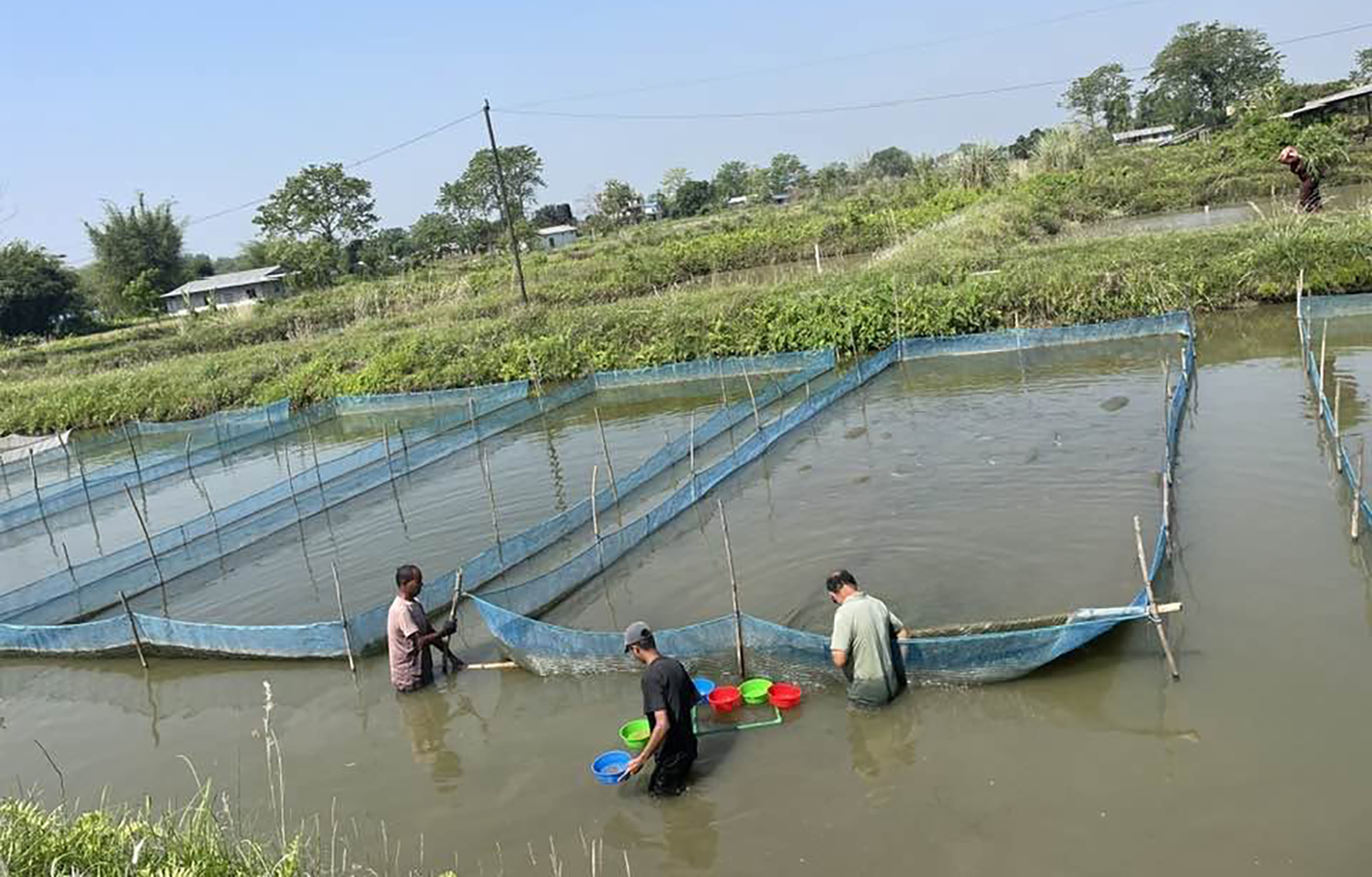
An aquaponics system developed by a Chongqing government-backed firm has been shipped to the district of Jhapa in Eastern Nepal, marking the latest piece of Chinese aquaculture technology sent abroad.
Zhai Xuliang, deputy director of the Chongqing Municipal Fisheries Technology Extension Station, told the People’s Daily that the aquaponics system would increase the output of both fish and vegetables in Jhapa by 50 percent, guaranteeing local food security.
“Fish excrement becomes nutrients for vegetables, and the purified water absorbed by the vegetables flows back into the fish pond, creating a cycle,” he said. “With better water quality, there are fewer fish diseases, and we can harvest an extra season of vegetables."
Zhai added that the equipment and training was transferred to Jhapa in alignment with the Belt and Road Initiative – China’s blueprint to building trade relationships through global infrastructure and aid projects.
Madhav Shrestha, the editor in chief of the Nepalese Journal of Aquaculture and Fisheries and the chairman of the Center for Aquaculture-Agriculture Research and Production (CAARP), which is a Nepalese fish-farming and research organization, told SeafoodSource that aquaculture is experiencing fast growth in Nepal.
“Carp has been a well-established cultured species for years now and is mostly cultured in a semi-intensive system,” Shrestha said, adding that pangasius and Nile tilapia were also recently introduced. “International partners can help to develop the aquaculture industry in Nepal in research, academia, post-harvest processing, and market development.”
Shrestha said besides China, the E.U. has supported Nepalese universities in developing aquaculture curriculum and internship programs.
Additionally, a U.S. Department of Agriculture-funded project, SAMBRIDHI, is also being implemented in partnership with local Nepalese organizations, aiming to improve local aquaculture farms’ access to “improved inputs, services, financing, and end-market linkages” while also “expanding trade of aquaculture products locally including live fingerlings, fish, and processed fish.” The project also seeks to integrate U.S. soy into local aquaculture feed.
Chongqing has also opened the Aquaculture Practical Technology Promotion and Demonstration Center in Jhapa to further local knowledge on aquaculture and grow the sector.
China has become the go-to provider of aquaculture technology for countries around the world. The Nepal shipment comes closely on the heels of exploding demand in North Africa and the Middle East for Chinese aquaculture technology.
Seafood consultant Alan Cook told SeafoodSource in March that aquaculture equipment firms in Northern Europe are not taking Chinese players seriously and that Chinese firms are well-positioned to take market share from established competitors.
“I think there is an assumption that [European providers] have an unassailable advantage that took them decades to build and it will take the Chinese decades to catch up,” he said. “If the Chinese follow the same track as they have with electric vehicles, solar power, and shipbuilding, they will turn their attention to export markets in the medium term, and the Scandinavian market will be in for a rude awakening. [Chinese companies] are pushing so hard on so many fronts – RAS, offshore fixed position, vessel-based systems, genetics, and broodstock – and gaining so much valuable experience and expertise that they will, in my opinion, dominate the market within a few years.”
