
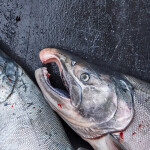


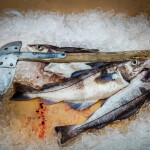



For over 40 years, dsm-firmenich has been giving farmed salmon the world over the color that customers have come to expect.
The company first launched its CAROPHYLL Pink product in 1985, and it continues to manufacture it today. The product is a type of carotenoid called astaxanthin, a molecule that is found in the wild inside crustaceans like shrimp and krill.
Dsm-firmenich is a global leader in producing a huge range of molecules, and Global Product Manager of Carotenoids Stefan Habermacher told SeafoodSource the company invented the synthetic process to create an astaxanthin molecule mirroring those found in nature.
“We had, starting in the 1950s, huge research and industrial development in these naturally occurring carotenoids” Habermacher said. “We were the first to create an industrial process for it.”
The company created the industrial process for astaxanthin in 1985. Prior to that point in time, the molecule was not available at an industrial scale, according to Habermacher.
Enter the salmon-farming industry. On a historical timeline, salmon farming is a recent development in food production. In past years, demand for salmon was more than met by wild fisheries, and the need to farm the product didn’t exist.
The first salmon farms were developed in Norway in 1970, and the industry has rapidly expanded from that time as farmers learned what it took to farm healthy salmon.
One of the pieces of that puzzle was carotenoids like astaxanthin.
“The aquaculture industry had a problem back in those days. The fish did not look natural because they did not contain astaxanthin in their diet as it would in their natural diets. They were not looking like a wild salmon would look like,” Habermacher said.
Wild salmon eat a range of different prey species, and among those are crustaceans with the naturally occurring astaxanthin molecule. That molecule carries with it the redder coloration that is seen in salmon flesh, in salmon skin, and also in salmon eggs. The term “carotenoid” is a clue to its impact on color: The word is derived from the name carotene, which was coined by a German chemist who isolated the orange color inside carrots.
Astaxanthin was a known ingredient in that salmon-coloration solution, but before 1985, it was not available in the quantities that salmon farms needed. They instead used canthaxanthin, a similar molecule, but Habermacher said the goal was always to use nature-identical ingredients in salmon farming. The creation of dsm-firemenich’s industrial process in 1985 provided the solution the industry needed.
While astaxanthin and CAROPHYLL Pink are most recognized for the coloration they give to salmon, the purpose of it in salmon feed is more than just making the salmon look the right color. Louise Buttle, who works on dsm-firmenich’s aquaculture portfolio, told SeafoodSource that astaxanthin is an essential nutrient for growing healthy salmonids and shrimp.
“A fish feed cannot leave a factory without astaxanthin. That’s how important it is in terms of a nutrient in feed and for the branding of the final product,” she said. “It has a lot of vitamin-like properties and lots of antioxidant-type properties.”
Buttle said astaxanthin protects fish in times of stress and is deployed in biological processes to protect them from oxidative stress. Salmon in the wild heavily utilize astaxanthin as they return to their spawning grounds and then use it further in the eggs that they lay, giving them the orange color.
“What they actually do is at the end of their lifespan, if you look at Pacific lifespans, they mobilize the last astaxanthin in their muscles and bring them to the eggs that they lay,” Habermacher said. “The flesh of a spawning Pacific salmon differs markedly from when it enters the river, as muscle tissue breaks down and stored astaxanthin is mobilized and redistributed.”
Salmon coloration can differ in wild salmon based on species, timing of the catch, and what the fish ate, as well as in farmed salmon based on diet and species. Salmon coloration can vary even within a single net pen, and Buttle said a cage of fish fed the same exact feed will always have some level of natural variation between them.
Salmon also aren’t the only commonly consumed animal products that include carotenoids.
“The same is true of chicken. The golden yellow in the egg yolk is, as well, coming from carotenoids that are different molecules than we see in the marine environment,” Habermacher said. “It’s a natural thing to happen.”
Habermacher said throughout the history of the company’s production of astaxanthin for salmon coloration, it has had to face debates over the product’s synthetic origin and questions over how salmon are colored. Consumer rights groups have launched lawsuits over the source of salmon coloration in the past, and currently, the U.S. Department of Agriculture is working to phase out common synthetic food dyes.
The difference with astaxanthin, according to Habermacher, is that the molecule produced by dsm-firmenich is completely identical to the ones found in nature; it’s just the production method that’s different. This is very different to some synthetic food dyes, which have no natural origins.
Animals cannot produce astaxanthin or any carotenoid directly and must get them from their diets, which is why salmon farms must include it in feed for it to be present in the fish.
“You will not find an animal producing a carotenoid directly. They will always come either from plants, or from bacteria, or from microalgae along the food chain,” Habermacher added.
Habermacher said the astaxanthin dsm-firmenich produces has been shown to be pure and is heavily regulated to ensure it remains so to meet the standards of multiple regulatory bodies, including the U.S. Food and Drug Administration and in the European Commission.
He said the company has seen debate over astaxanthin and salmon coloration multiple times in the past but pointed to dsm-firmenich even gaining approval for astaxanthin use in direct human consumption, though the company’s focus will remain on animal feed.
“Our main focus is really on aquaculture because in the end if you actually look at the industry size in terms of volumes out there, it is much bigger in animal nutrition than it is in human nutrition and dietary supplements,” he said. “We focus on the animal nutrition industry.”
Buttle said since its creation 40 years ago, CAROPHYLL Pink has continued to evolve to meet the needs of salmon farms. Formulations have been modified to make it easier to add it into salmon feeds and to tailor the product to specific factory applications.
She added that dsm-firmenich is a major, reliable source of astaxanthin and produces commercial volumes to meet the industry’s needs accordingly.
“You really need a reliable, robust source because pigment is a strategic ingredient in the aquaculture industry in terms of what you see in the final salmon or trout product,” Buttle said. “All the time, we’re innovating and, of course, in dialogue with our customers around the salmon world.”
