





An industry consultant is warning the salmon industry to consider shifting to natural sources of ingredients for carotenoids amid increased attention on food dyes and coloration.
Dominique Corlay of Aquaculture Natural Solutions told SeafoodSource he has worked with the salmon and aquafeed industries as a consultant and recently delved into consumer behavior and opinions on farmed salmon coloration and the carotenoids that give them their color. What he found was consumer attitudes toward coloration varied, but the vast majority said that knowing whether ingredients used in feed were naturally derived or synthetic was important to them to some degree.
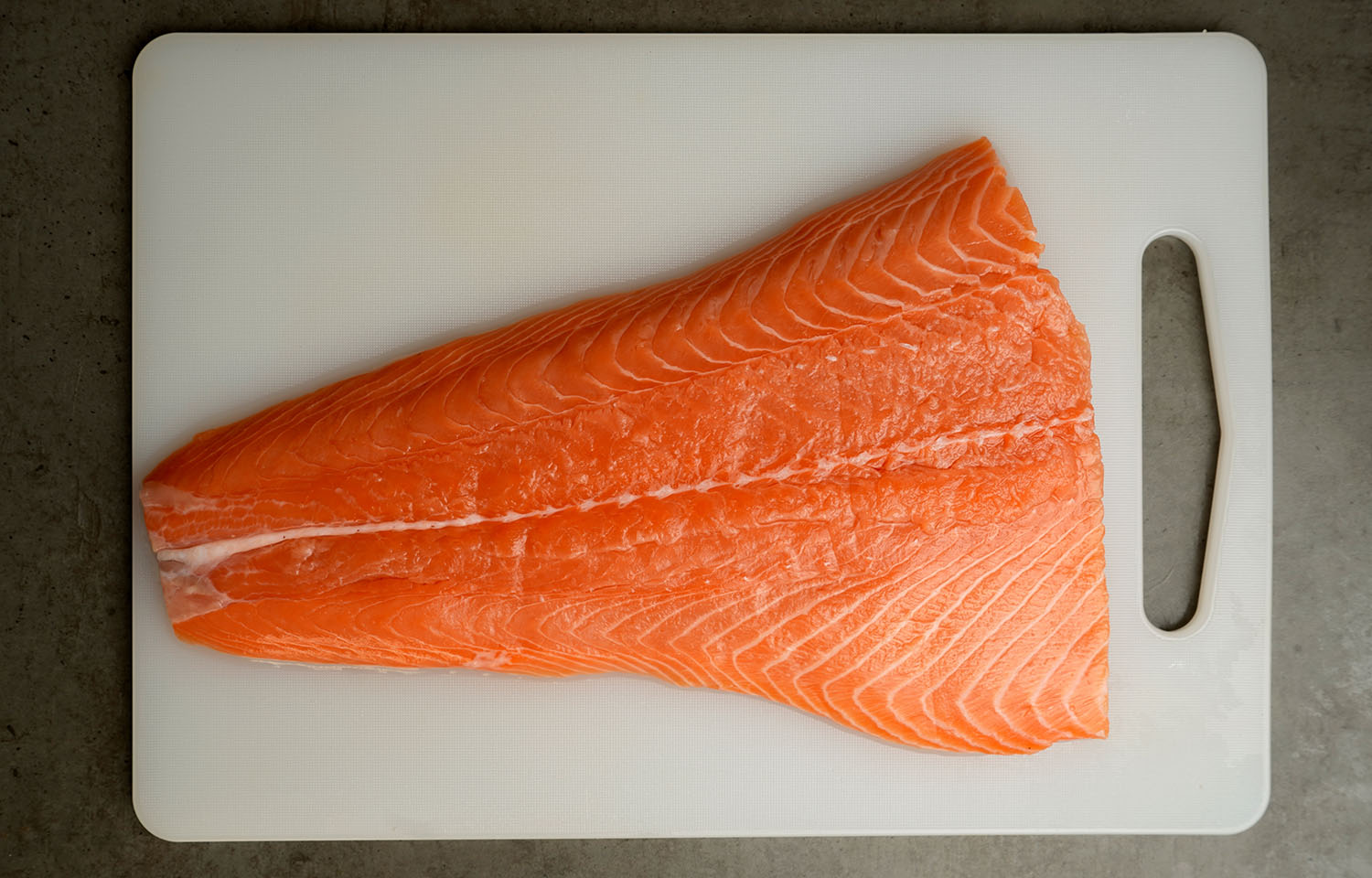
Carotenoids are what give salmon and trout the distinct red color that makes the fish stand out from other species and is a key nutrient in the diet of both species.
The nutrient does more for salmon than give it its color; it is also a key nutrient that salmon can’t metabolize on their own and must source from their diets. Without sufficient carotenoids, salmon could suffer health impacts as it is essential for metabolic, muscle, and immune function, as well as a key nutrient in the protective coating on salmon eggs, which is the source of salmon eggs’ orange color.
Corlay said in both the wild and on salmon farms, the source of carotenoids is astaxanthin, which is a naturally occurring antioxidant found in plankton and crustaceans.
While astaxanthin is a natural ingredient, not all salmon farms use natural astaxanthin in their aquafeed and, instead, may use a synthetic version of the same product, derived from petroleum.
That synthetic version of the product could be a ticking time bomb for the industry, Corlay said.
Besides public opinion, the U.S. government is taking a renewed focus on food dyes and additives under the leadership of U.S. Secretary of Health and Human Services Robert F. Kennedy Jr.
Currently, the push against food dyes is largely against ingredients used directly in food, and synthetic astaxanthin is not used in any food, only in aquafeed. However, Corlay said it is a petroleum-derived ingredient, and as both federal and state authorities in the U.S. begin to look at additives, it could present problems for the salmon industry.
Corlay said certain states have already begun to ban synthetic dyes used in foods, and the willingness to look at all petroleum-derived food dyes could pose problems if the lens begins to focus in on the salmon industry.
Corlay said there’s also little reason to continue using synthetic astaxanthin, as natural sources of the product have been developed and are relatively inexpensive. He said based on his research, using the natural ingredient instead of the synthetic ingredient would increase farming costs by as little as USD 0.05 to USD 0.10 (EUR 0.04 to EUR 0.08) per kilogram of salmon – a small enough amount it could be absorbed in prices.
A Mintel survey referenced by Corlay indicated that consumers would be willing to pay more for salmon that contained natural coloration rather than synthetic coloration, with the highest percentage of people indicating they’d pay as much as 11 percent to 20 percent more for the product, despite it costing far less than that to use.
“Part of the salmon industry has already switched, especially the premium ones … fearing the exposure risk,” Corlay said. “I can tell you some others are really checking that, and they should announce that very soon. Transparency matters; there’s no doubt.”
Corlay said his reasoning in bringing the issue to light now is that it’s only a matter of time before consumers begin to question the source of coloration in salmon, and the industry, in some instances, hasn’t been transparent enough with consumers. The issue is also a difficult one to explain thoroughly, he said, because of its complicated nature. Therefore, the industry could take a hit from people rejecting all salmon products regardless of ingredients out of an association with petroleum-derived additives.
“Before it’s too late, it’s a good time to define our positions or at least explain things. If it’s well explained, it could be understood,” Corlay said. “Right now, it’s a very secretive attitude. ‘Let’s hide the dust under the carpet’ in a way. But, it cannot last.”
Corlay said the best case would be to increase production of natural ingredients and shift the salmon-farming industry over to avoid any perception hits.
“It’s something to think about now and to define a position on it,” Corlay said.
