






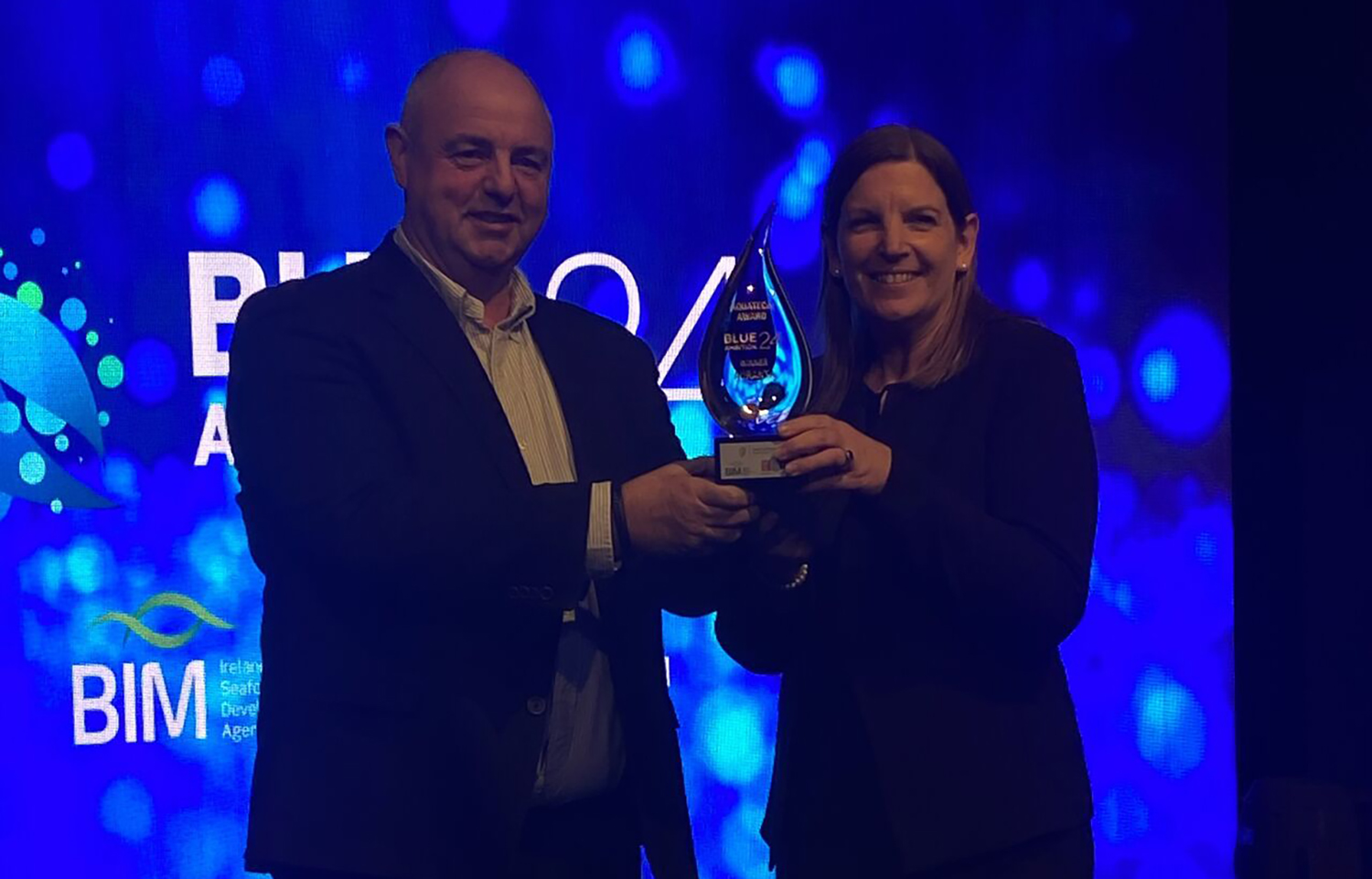
Dublin, Ireland-based Auranta, a producer of feed health supplements for the aquaculture sector, recently won the Aquatech Business of the Year competition run by Bord Iascaigh Mhara (BIM), Ireland’s state agency aimed at further developing the country’s seafood industry.
Auranta specifically won the award for its AuraAqua product, a proprietary blend of citrus-based phytogenic ingredients that boosts the immunity and gut health of shrimp, salmon, and other fish species. Southeast Asia and Ecuador are key markets for Auranta, which is also keen to grow its presence in China.
Auranta is a rising star in the Irish aquatech industry, which BIM values at over EUR 200 million (USD 218 million) annually. The company got mentoring and participated in industry networking through the BIM Innovation Studio. Ireland’s aquaculture output has remained largely flat, but BIM has put much emphasis on drawing on Ireland’s role as a pharma and tech hub to create a network of companies exporting solutions to Asia and other territories for a growing aquaculture industry.
“[Auranta is a] fantastic example of the excellence, innovation and talent that exists in Ireland’s growing aquatech sector,” BIM CEO Caroline Bocquel said of the firm after the award was handed out.
Company CEO John Cullen, who co-founded the firm in 2013, talked to SeafoodSource recently about his future plans for Auranta.
SeafoodSource: What does winning the BIM award mean to Auranta?
Cullen: We are delighted to win the BIM Aquatech Business of the Year award. This is the latest step in our journey to become the first-choice functional feed ingredient supplier in the global aquaculture industry.
Auranta has invested heavily over the last few years to build up our data set in fish and shrimp through four new peer-reviewed scientific papers. We combined this knowledge with the experience gained on the BIM Innovation Studio program last year and the access to the excellent contacts we have made in the industry to date.
This resulted in significant growth in our business this year, which has doubled compared to last year. We believe that the future of our company lies in our ability to increase the robustness of fish and shrimp being produced under challenging conditions around the world in a safe and sustainable manner.
SeafoodSource: What are the biggest challenges for a smaller Irish company entering the Southeast Asian market, where distances are vast and issues around counterfeiting and fragmented low-margin production are often inhibiting for sales of premium products?
Cullen: We have worked in Southeast Asia for many years in other species, and we have appointed local distributors in a number of countries. In terms of the aquaculture market, we are really only starting to commercialize. We have worked on shrimp and tilapia for a number of years in Thailand, mostly in a testing capacity with a small number of countries.
I would agree that the challenges of scaling are very challenging if one wants to sell at a farm level. It’s difficult to control the quality of the carrier, and the on-farm processes have a lot of variation.
Luckily, we have worked for three years with some other global feed producers, especially in South America, so the proof of our products’ efficacy has been completed independently, and we will conduct the same process in a large part of the Asian market.
SeafoodSource: To what extent have you researched the market in China, where shrimp production is expanding domestically and in contracted facilities overseas?
Cullen: We have a European partner for the Chinese market, and we are hoping to be ready to start there in Q2 2025.
We are currently selling in significant volumes for us in Ecuador, and Chinese sales are scheduled subject to registration approval for as early as possible next year. We also see Thailand, Vietnam, and India as being real opportunities in the next two years. We are registered in these countries right now and are working on Indonesia.
SeafoodSource: Are you planning to expand your headcount to expand distribution of your aquaculture product, and are you competitive price-wise with producers of similar products who are also tapping the Asian market?
Cullen: We are expanding our headcount as required, and we will fill some positions by mid-year next year. We believe that we are competitive in the market; our products are highly effective if they are used properly.
