






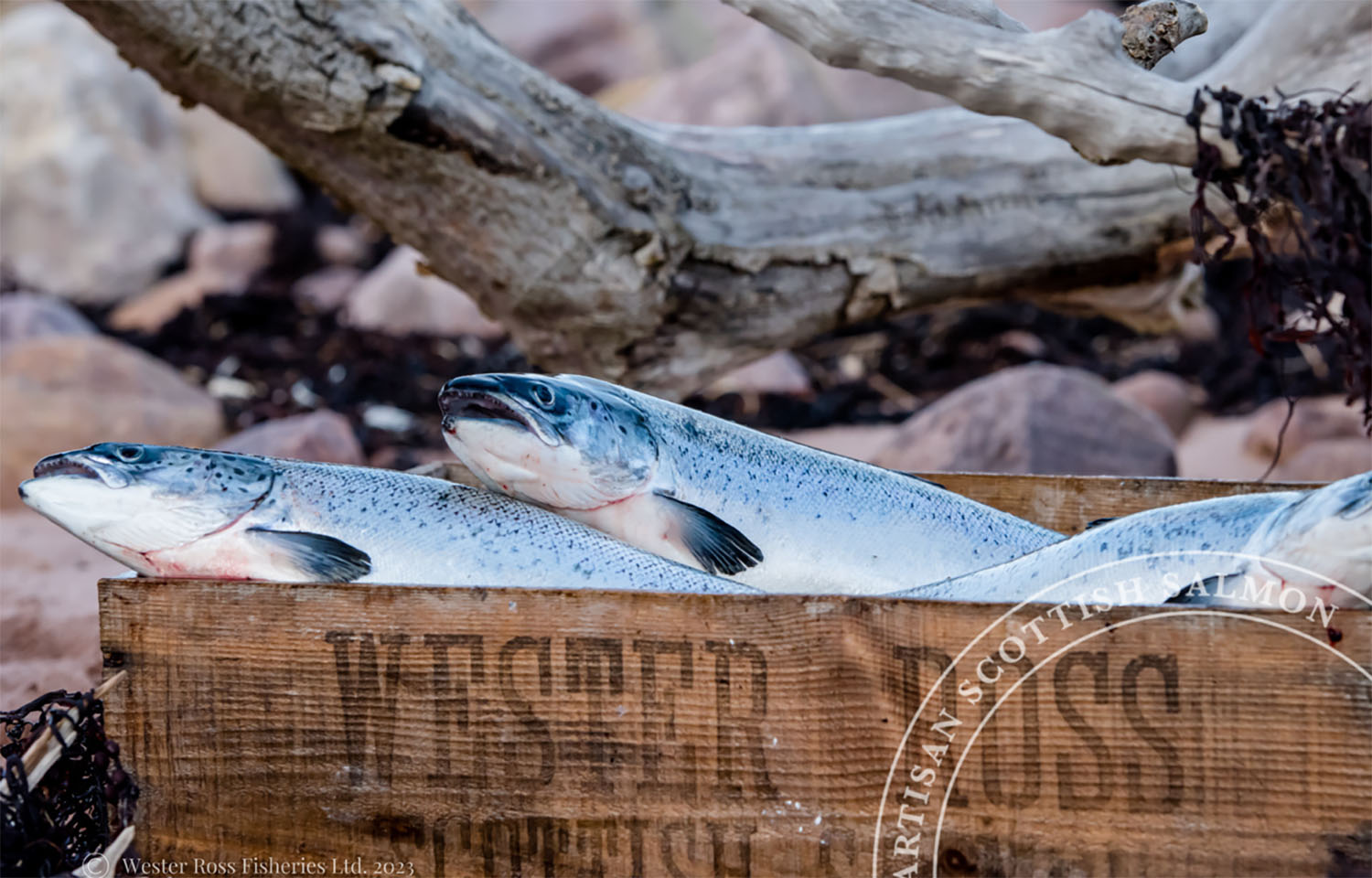
Tucked away in the northwest Scottish lochs, Wester Ross Fisheries is a company and brand that has been built on the foundation of doing things carefully and as naturally as possible, with its hand-fed fish reared slowly without medicine and with minimum handling.
Under the three-decade stewardship of recently retired Gilpin Bradley and a committed management team, the business has thrived; Wester Ross’s salmon is not only prized among chefs and consumers in the U.K., it’s also a premium-priced product that’s widely exported, notably to North American and Asian markets.
Independence and individuality are key to the company’s strategy, and though a 2006 management buyout put it in the hands of Bradley, David Robinson, Hugh Richards, and Colin Milne, followed by industry giant Mowi’s acquisition of the company in 2022, that mantra has remained true since the company’s founding in 1977, according to Wester Ross Marketing and Communications Manager Gillian Osborne.
Through it all, it remains the last independently managed Scottish salmon farm – something that will continue through the course of its future growth, Osborne said.
Osborne said that Mowi ownership helps mitigate some of the inherent risks that come with being an aquaculture business in the 21st century. Alongside the challenges posed by unpredictable feed supplies, disease and biological threats, regulatory changes, and more, there are emerging environmental, social, and governance issues to contend with, not least climate change. Those threats considered, the Mowi acquisition, nearly two years on, provides both security and a platform from which to explore further opportunities, according to Osborne.
“Having that backing and access to our new parent company’s resources is a very positive, reassuring position to be in,” Osborne told SeafoodSource.
Since the sale, the new owners have actively sought every opportunity to keep things as they were before, Osborne noted.
“Being independently managed means we’re able to maintain the Wester Ross standard," Osborne said. "Obviously, there are things we need to integrate and cooperate with, but those are not to the detriment of our brand or our way of doing things."
If anything, she said, the brand has probably been strengthened by the deal and, with it, the opportunity and financial scope to broaden the company’s horizons.
While it’s too early to outline any specific growth plans, Osborne said Wester Ross will have the ability to tap into a new Mowi broodstock facility, which is already staffed but still under construction on the site of one of Wester Ross’s former grow-out farms. Other resources include the Mowi Academy, which is an online portal providing staff training.
Most of the company's operations have stayed the same post-acquisitions, but one key change has been the closure of the company’s Dingwall fish-processing plant, with production shifted to one of Mowi’s other Scottish facilities. The process saw all 15 affected employees offered alternative positions in the company’s value chain.
“The closure of the plant was an inevitable step and something we always knew we’d have to do as the business grew. Dingwall simply didn’t have the capacity to process the amount of volume we’re now selling,” Osborne said. “We’re all impressed by the commitment from Mowi to keep Wester Ross intact.”
The company’s standard of raising salmon in a traditional, low-mechanized. but highly-skilled, hands-on way, which has honed under Bradley, will continue, Osborne said.
“Producing this way not only makes the salmon taste different; it also makes it better,” she said. “This is on trend with today’s market, where there are consumers looking for something that’s sustainable and that is produced with love. Our brand and product convey the values and care that have gone into producing our fish.”
Every Wester Ross fish leaving the factory is gill-tagged with a unique number that makes it traceable back to harvest and the farm that produced it.
“Customers can call us, quoting the number to obtain specific information about that fish,” Osborne said. “Such knowledge is becoming increasingly important as buyers and consumers take greater interest in the food they are purchasing.”
Through this added traceability and the shift to larger, more sophisticated processing facilities, she maintains that Wester Ross is further safeguarding its business, protecting its identity, and ensuring it stands by the proven production methods championed by Bradley and others as it opens new doors and starts new chapters. These efforts have been further underpinned by some recent key appointments. Connie Pattillo has Wester Ross as head of farming operations, bringing her specialized expertise in cleaner fish into the mix. Another new hire is farms manager Darren Wilson, whose aquaculture career started in processing before he became a farm technician and then assistant manager for Mowi.
