

Aure, Norway-based aquaculture company Salfjord has signed a NOK 100 million (USD 9 million, EUR 8.6 million) deal for initial construction on its first land-based Atlantic salmon farm, which will be located in the Tjeldbergodden Industrial Park in Aure.
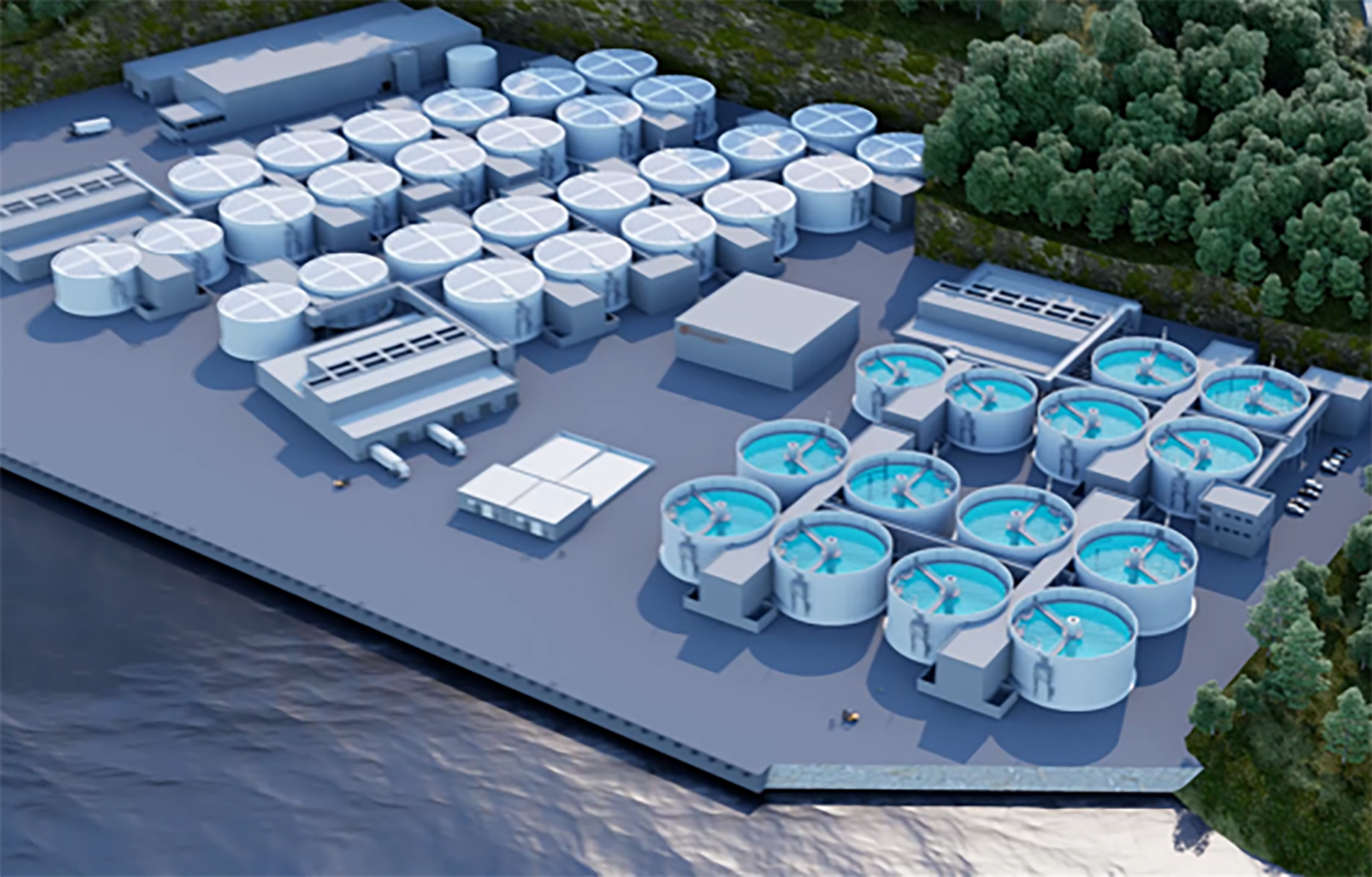
Salfjord’s initial plans for the farm include a modular grow-out operation, with the exact number and design of its tanks remaining a work in progress. The company has a permit to grow a maximum allowable biomass (MAB) of 21,000 metric tons (MT), which would give the firm an annual output of at least 36,500 MT of head-on gutted (HOG) salmon. The permit also allows for production of up to 30 million smolts per year.
“We are aiming to start the first construction phase in mid-2026 and to introduce smolts in December 2027 if all goes to plan,” Salfjord Co-Founder and CEO Hans Ramsvik told SeafoodSource. “We set up the company in 2018 and have been through six years of planning and preparation to get this far. We are now focusing on raising capital to secure the rest of the NOK 160 million [USD 14.6 million, EUR 13.8 million] that will enable us to strengthen our organization, prepare infrastructure, bring in a power supply, finish the groundworks and engineering, and become ready to start farm construction. The aim is to identify and assess a core investor base in order to secure a future ownership setup that supports the long-term strategy of developing a prosperous salmon company.”
Ramsvik said the company’s plan has evolved slightly since its conception in 2018, to capitalize on existing infrastructure.
“The grand plan was to have a fully integrated farm, including a hatchery and first feeding unit, but as there are many good smolt units in Norway, we may decide in time to concentrate more on the on-growing business,” Ramsvik said. “With efficiency, we hope to be able to increase our production output within the existing license.”
Salfjord has chosen a hybrid flowthrough system for the farm, developed by Ålesund, Norway-based Artec Aqua, which is the main technology partner for the new operation. This system, which has been tried and proven at other companies’ farms such as Salmon Evolution, recycles up to 65 percent of the water used in its operations and is designed to mitigate against biological risk.
“Biosecurity has been a top priority from the start – both to protect our own fish health and to minimize any impacts on wild salmon in the area. As a result, we will be incorporating a UV treatment plant for intake water and have designed a comprehensive risk management system with both preventive and reactive barriers to mitigate biorisks,” Ramsvik said.
Ramsvik said the decision to apply for an onshore license, instead of pursuing an operation offshore, was influenced by such factors as biology, disease control, and fish welfare – as well as the current moratorium on traditional coastal farm development in Norway and the subsequent uncertainty facing companies seeking to move further offshore.
The Tjeldbergodden farm is located close to both a methanol and an oxygen factory, which could provide opportunities for a circular economy, Ramsvik said, adding that his firm is also seeking other local partners for ways to collaborate.
“We hope to use the waste heat from [the nearby] methanol factory, which will help to cut our energy consumption and reduce pressure on electricity supplies in the area,” he said. “The proximity of an oxygen supply is also useful in terms of savings on transportation costs, as it takes 0.5 kilograms of oxygen to raise 1 kilogram of fish in a land-based system using the chosen technology.”
The company estimates the project’s development costs are likely to be in the region of NOK 7 billion to NOK 7.5 billion (USD 641 million to USD 686 million, EUR 592 million to EUR 634 million), but Ramsvik emphasized that the actual cost will depend on the farm’s final design and capacity.
The farm is expected to create more than 100 direct jobs, and contribute in excess of 300 downstream roles, as well as help the area secure valuable export revenue, according to Ramsvik.
“It’s an interesting time to be working in land-based aquaculture, as there is still so much to learn to perfect the systems,” he said. “However, I believe that by combining traditional fish-farming expertise with modern technology and risk management principles, we can produce salmon more cost-effectively on land compared with traditional sea pen farming and develop a highly successful industry. This is certainly of interest to investors, who seem to be growing in confidence in this new sector.”
In addition to the Aure farm, the company is also seeking permits for a second farm in Hyttneset, which is about 35 kilometers southwest of Aure.
