






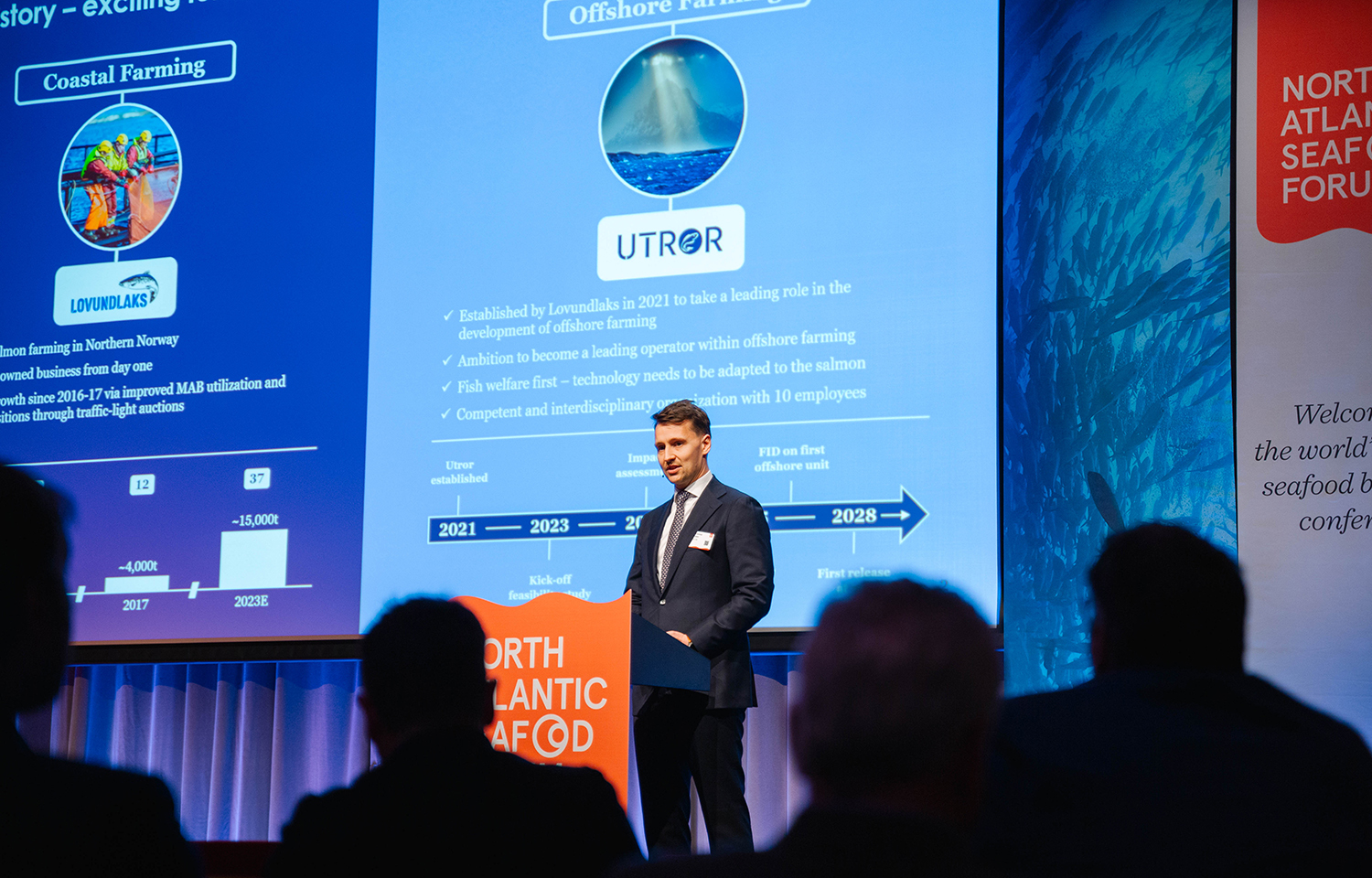
A Norwegian aquaculture startup has announced as plan to win an offshore salmon-farming license in the first licensing round Norway plans to host in 2025.
Lovund, Norway-based Utror, which is majority-owned by salmon farmer Lovundlaks, said it hoped to overcome current complications with Norway's offshore salmon-farming permit system, obtain a permit, and begin farming by 2028.
“We have spent significant time over the past year on an offshore concept that we think meets all our internal criteria and requirements. Above all, the concept and how we think about the value chain – from smolt to harvest – are centered around the biology of the fish and biosecurity,” Utror Business Development Director Lars Konrad Johnsen told SeafoodSource. “We will use our expertise in coastal farming and more exposed aquaculture projects to ensure that the offshore installation can achieve good fish welfare from day one.”
To inch closer toward making that dream a reality, the company signed a collaborative framework agreement on 5 March with Stavanger, Norway-headquartered offshore energy engineering firm Aibel.
“The two companies see great potential in leveraging each other’s expertise to establish offshore salmon farming,” Johnsen said. “We believe strongly that because a salmon’s natural habitat is in the open ocean, the growth potential for the business lies in moving farther out to sea. Joining forces with Aibel was a natural choice, as they are world leaders in offshore oil and gas, and we hope to be able to merge all the pieces to develop a successful new industry.”
The Norwegian government has designated three offshore areas for development, and Utror aims for its sites to be located in the designated area off the coast of northern Norway, more than 100 kilometers offshore.
“The timescale for development is determined in part by the government, but we are aiming to complete the pre-qualification phase by the end of 2024 in order to be ready for the licensing round in 2025. The ultimate aim is to put the first fish to sea in 2028,” Johnsen said.
Johnsen expressed frustration with that timeline, but said the company plans to work within Norway's existing permitting system to ensure it attains a license. Salmon companies have called on the Norwegian government to clarify the regulatory environment for offshore development, and Johnsen said Utror is in active discussions with Norwegian aquaculture authorities to advocate for amendments to the country's regulatory framework that better facilitates profitability, efficient utilization of marine areas, and sustainable development.
Johnsen said with proper planning, offshore farming can compete with coastal farming on both capex and opex figures, while easing problems such as biological disruptions and spatial oversaturation common to coastal salmon farming in Norway.
“We are considering the whole value chain in our production plan to make sure that the project is economically viable from egg to plate,” he said. “We are at the forefront of an exciting new salmon farming industry, and we see great possibilities for the future.”
The potential of offshore aquaculture to contribute to Norway's food security, employment, and value creation was the subject of a November 2023 report commissioned by Norway's Biomarine Forum, produced by Menon Economics and research institute SINTEF.
The report, ”Value chain analysis of offshore aquaculture,” found offshore salmon production offshore was more sustainable than coastal farming, but warned about operational, technological, and regulatory challenges the industry and regulatory authorities must overcome to achieve success with offshore farming. If managed correctly, offshore aquaculture could eventually reach one-third of the volume produced by current coastal aquaculture, generate up to NOK 13.9 billion (USD 1.65 billion, EUR 1.19 billion) per year, and support around 7,400 jobs worldwide.
