




Eight years ago, BlueTrace CEO Chip Terry was invited to tour his friend’s oyster farm in Maine.
Terry told SeafoodSource his friend was trying to tempt him into starting his own oyster operation, and wanted to give him a look at what it’s like.
“I went out there for a day and realized ‘eh, maybe not, not going to be a great oyster farmer,’” Terry said. “But in the process, I began to learn a little bit about what he was dealing with.”
That initial visit sparked the first iteration of Terry’s software forays into the seafood industry: OysterTracker.
OysterTracker was intended to be a full farm management system for oyster operations that could help keep costs lower and increase efficiency. Terry said he’s been a long time member of the tech industry and learned about the challenges oyster farmers faced.
In the end, Terry did end up creating a full farm management system, but quickly realized it wasn’t a great business proposition.
“That was a great product, but a horrible business,” he said. “We still have some clients using it, but the reality is that most farmers are either too small to need anything like a farm management tool, or their farm manager changes too often, or they often just use pencil and paper, or something else.”
The industry wasn’t ready for a full digital farm management tool, but it was ready for something to make farmers’ lives easier.
“Visiting these oyster farms and talking to all these oyster farmers, it became clear that shellfish tags are a pain,” Terry said. “So, we came up with a really simple solution.”
The company created an application that allows oyster farmers to create a shellfish tag using a portable printer. That software also creates a log of the items when they’re harvested, and it can also email buyers of the products to let them know what products have been landed and what is coming.
That product is still being used today, and currently over 600 customers are printing out 100,000 tags a week.
“Really, it all started with this little mobile printer,” Terry said.
The company has evolved since then, however, and once it hit that inflection point, it changed from OysterTracker to signify its broader purpose.
“It became obvious at that point that we were broader than oysters, so we renamed ourselves BlueTrace, and I began to think of this as a real business and not just a hobby,” Terry said.
In 2021, BlueTrace received a Small Business Innovation Research grant from NOAA to help accelerate its development, and in 2023 the company got major investments to continue growing beyond oysters into a full inventory management system for small- and medium-sized broadline/specialty distributors and producers.
The work with distributors is now the majority of the company’s revenue, Terry said.
At the start, a lot of what the company was doing was “following the paperwork” and identifying where distributors could utilize a tracking technology to enhance their business.
“I have the world’s most boring phone because I just take pictures of various paperwork,” Terry said. “Invoices, bills of lading, purchase orders, all the stuff that makes these businesses run.”
Those photos of paperwork have created what Terry calls a “tide-to-table system” to manage a seafood business. BlueTrace can show companies what they have been purchasing, what current inventory looks like, what they have been selling, and what the margins on everything is in real-time to help keep track of the day-to-day business.
For many smaller businesses, software like BlueTrace might be overkill, but many mid-sized seafood businesses rapidly approach a point where a spreadsheet and some sticky notes won’t cut it, he said. He pointed to one of the company’s clients, which manages over 100 suppliers of nearly 700 different products that the company is selling to almost 1,200 different buyers.
“Think of the complexity of that,” Terry said. “And trucks going out seven days a week, and you can’t mess up an order.”
For many of these mid-sized businesses, a larger enterprise software like an SAP system might be out of reach.
“The challenge with those is they’re expensive. They require an IT staff that the big companies can afford, [but] the smaller companies don’t have, and they’re not designed for seafood,” Terry said.
With seafood, products can often be inventoried in one value, sold in another value, and bought in a third value.
“I buy in bushels, I inventory by the pound, and I sell by the count bag,” he said. “That’s not an unusual scenario.”
If those details get lost and companies lose track of inventory and what’s being bought when at what price, it can result in not understanding where the margins are in an industry with narrow margins. Terry said he went to one company that was using tons of different spreadsheets to manage everything, with data getting lost in the shuffle. He thought they would make a good client but didn’t hear from them, until learning they filed for bankruptcy months later because they were upside down on their margins without being able to identify it.
“When margins are thin, you want to be able to keep an eye on it,” he said.
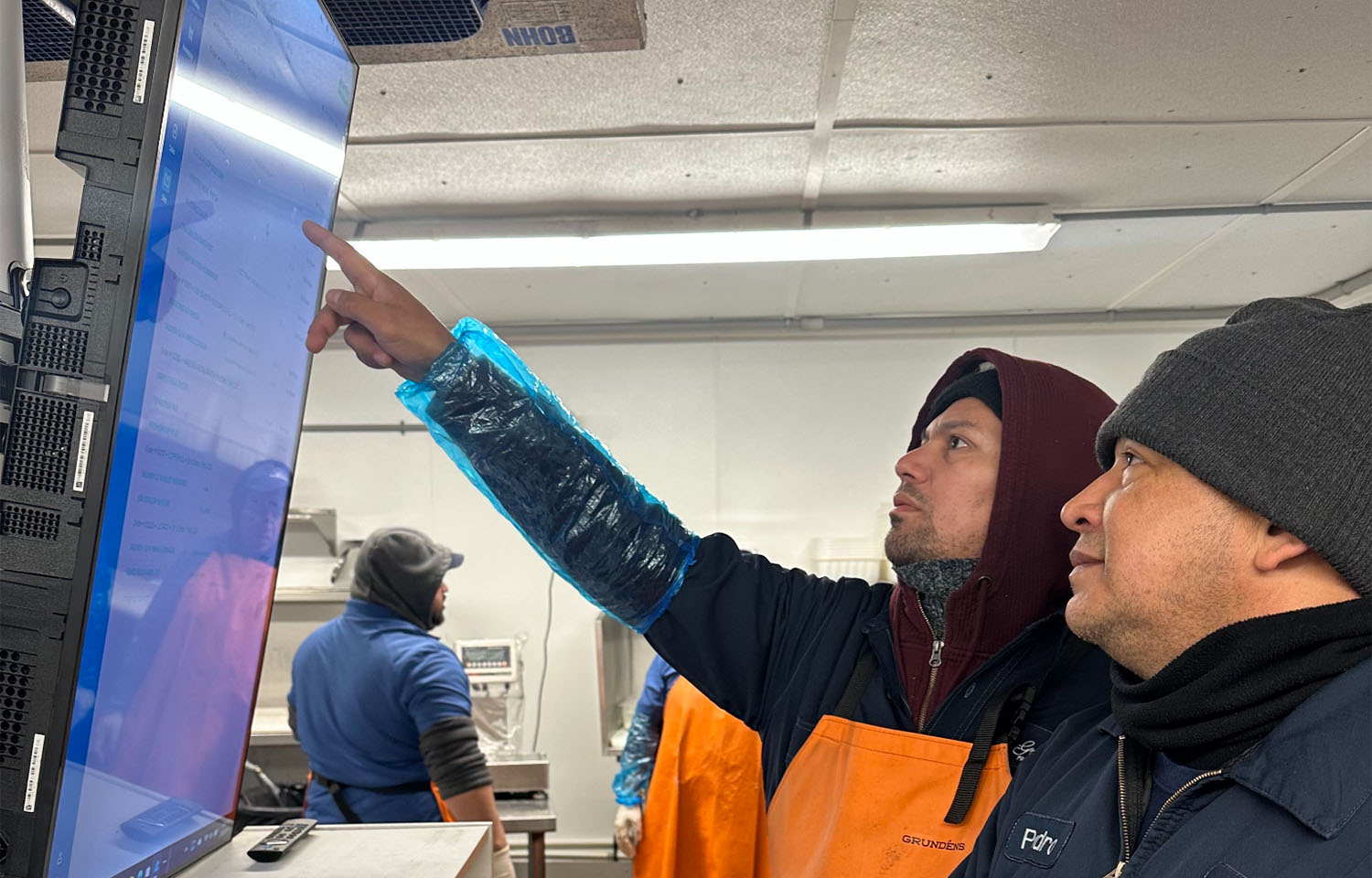
As the company grows, it is also adding new features, Terry said. It’s adopting AI to eliminate a lot of the transcribing that needs to be done to input data correctly, and in ways that help enhance sales like cross-referencing sales data with a restaurant menu to identify new opportunities.
Terry said it has rapidly expanded its customer base across North America and is now looking for companies internationally to expand. It’s currently operating in every U.S. coastal state except Hawai’i and every Canadian province except Nunavut.
Looking back, Terry said he’s still surprised to be in a position where he’s running a software company centered on seafood.
“I was not expecting to be a seafood technology company; I was expecting to do a little thing to help people print shellfish tags then move on!” he said. “But the thing about it is, these businesses are all so interesting, and it’s one of the areas where you can really help folks – they use this software and say ‘wait a second, I don’t have to show up at 4 a.m. to transcribe these orders any more?’ That’s huge.”
