



Asia-based seafood start-ups are having a moment.
The seafood industry’s newest unicorn – a start-up that has achieved a USD 1 billion (EUR 902 million) valuation – is Bandung, Indonesia-based eFishery, which offers fish and shrimp farmers an end-to-end platform to access to feed, financing, and markets. And numerous other Asia-headquartered companies, including India’s Captain Fresh, FreshToHome, and Licious have garnered hundreds of millions of dollars in financing in recent years.
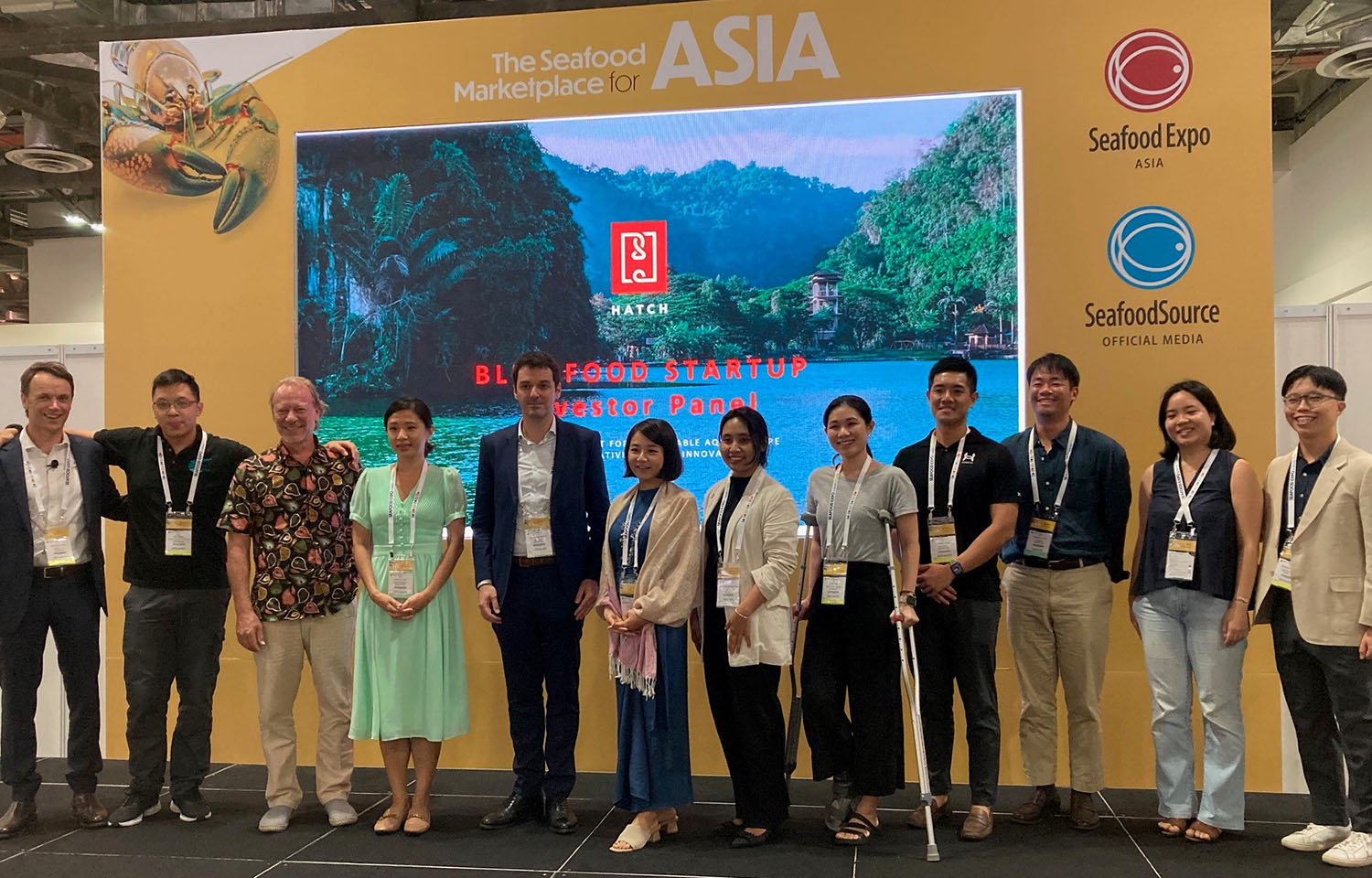
At an investor panel hosted by incubator Hatch Blue at the 2024 Seafood Expo Asia in Singapore on 4 September, six young Asian firms sought to wow an investor panel and garner the attention and funding necessary to rocket themselves to similar heights as their well-heeled compatriots.
Marrying promises of solid profit margins, healthy returns on investment, and ESG credentials, executives from Forte Biotech, The Agrata Group, Living Seas Aquafeeds, JALA, Coast 4C, and Wittaya Aqua made their pitches to AgFunder Venture Capital Investor Angela Tay, Orion Capital Asia Investment Specialist Annabelle Kong, and Natixis Business Investment Manager Antoine Sahaghian.
Agrata Co-Founder and CEO James Fan explained how his company is seeking to revolutionize the mud crab (Scylla serrata) market through recirculating aquaculture system farming and the development of specialized feed.
“We want to move the industry away from wild catch and into aquaculture and there are many benefits to that,” he said.
The Singapore-based firm currently operates one RAS hatchery on nearby Bintan Island, Indonesia, and supplies 200,000 farm-raised juveniles to local farms monthly.
“The hatchery essentially acts as an engine to the commercialization of the protein. We're able to produce the juvenile animal at scale, then provide these crabs to our partners who farm them at their sites until they are market-ready, whether that's on the soft-shell crab or hard-shell crab,” Fan said. “Once they're market size, we bring them back into our processing facilities and then do the sales, thereby enabling our farmers to focus on what they do best.”
Lombok, Indonesia-based Living Seas Aquafeeds is also developing a premium feedline for mud crab, as well as lobster feed and supplemental ingredients for shrimp feed, aiming to aid regional mariculture efforts. Tim Hromatka, the company’s founder, said the cold-extruded, moist gel feed is manufactured via a proprietary method from fishery byproducts, seaweed, and mangrove leaves. Along with fellow presenting company Coast 4C, Living Seas Aquafeeds participated in Hatch’s 2023 accelerator program.
“The next big sustainability barrier to break through in lots of aquaculture is that of feed. We need an efficient growth rate and a reasonable cost, while trying to get feed-conversion ratios down much further than where they are now,” Hromatka said. “Our FCR is at 10 kilograms of inputs per kilo of output now, and we’re aiming for 6 soon, compared to the industry average of using 25 kilos of fish to produce one kilo of crab or lobster.”
Coast 4C Co-Founder and CEO Nick Hill said his business is aiming to address a bottleneck in global seaweed supply by building out a network of growers in the Philippines. He said he hopes to sell 30,000 tons of seaweed in 2025 for USD 3 million to USD 5 million (EUR 2.7 million to EUR 4.5 million) in preparation of a Series A fundraising round that will allow the company to expand into Indonesia.
“Global growth in seaweed supply is slowing down. Smallholding producers face declining yields and fragmented value chains that drive declines in quality and sustainability issues,” Hill said. “Our solution is unique. We partner with thousands of smallholders and with marine protection agencies to help derisk and scale the supply of quality responsibly-sourced seaweed to meet global demand.”
The company, which booked USD 600,000 (EUR 541,000) in revenue in 2023 and which Hill said will break even within the next 10 months, provides seedlings, farming support, and post-harvesting process that “encourage farmers to maximize their currently underutilized farm space,” according to Hill.
“This drives a six- to 10-time multiplier of supply that gives a renewed livelihood to fishermen who are facing declining fish stocks,” he said.
Yogyakarta, Indonesia-based JALA is also aiming to stir up a revolution in aquaculture production in Asia, focusing on the shrimp sector. The company, which offers a suite of products and services to aid shrimp farmers in the cultivation process and in navigating the industrial supply chain, recently completed a USD 13.1 million (EUR 12 million) Series A fundraising round.
JALA CEO Liris Maduningtyas said through its app, JALA provides farmers with analysis built off real-time data and connected equipment, access to farming assistance, financing, supplies and equipment, and services to effectively bring their harvests to market. JALA’s farm credit scoring service, launched in 2023, gives farmers the ability to improve their creditworthiness and gain access to additional financing options.
Liris previously told SeafoodSource the company’s goal is eventually to get as large as its chief competitor, eFishery, but it also wants to keep an environmental focus front and center, with mangrove restoration a core part of its strategy. In conjunction with Conservation International, JALA recently created the Climate Smart Shrimp Fund, which provides loans to shrimp farmers in Indonesia to allow them to invest in intensification of their farming effort, increasing yields, in exchange for commitments to restore or conserve mangrove ecosystems. JALA is aiming to raise USD 10 million (EUR 9 million) for the fund.
“This is expected to not only increase profits for farmers but also offer mitigation and adaptation benefits to both the farmers and society,” Liris said.
Singapore-based Forte Biotech is also targeting Asia’s shrimp market with its PCR testing technology. Forte Biotech Founder Kit Yong said his company aims to “make PCR testing easy.”
“The current way to diagnose diseases is through land-based PCR testing, but in rural Indonesia and Vietnam, this process is so slow by the time you get the results back, it can't help you – it's a post-mortem,” Yong said. “What we do is to empower farmers to do testing by themselves … You take a sample, you test it. You know what's going on. You solve the problem, and you still sell your shrimp at the end of the day, so your cash flow doesn't die and your business doesn't die.”
Yong estimated the cost to the farmer is around USD 0.02 (EUR 0.01) per kilogram of shrimp produced. He said his company is seeking USD 500,000 (EUR 450,000) to help expand throughout Southeast Asia.
Wittaya Aqua, which is co-located in Toronto, Canada and Singapore, has built a technology platform for aquaculture producers, feed mills, and ingredient suppliers that consolidates existing data points across the seafood supply chain. It recently pulled in USD 2.8 million (EUR 2.6 million) in seed round funding that will allow it to expand across Asia and invest in research and development.
Wittaya Aqua Strategic Product Director June Wu said the firm's platform collates information on aquatic animal growth, feed intake, efficiency of feed utilization, survival rates, water temperature, and other water quality metrics. It then uses a proprietary analytical model to produce actionable recommendations for operational optimization.
“We work on feed formulation for vertically integrated farming operations, and we also do analytics on feed management on farms,” Wu said. “We have different types of analytical models, we have data tracking, we have price ingredient databases for ingredients and formulations. And we also have a partner in Vietnam who is producing farm hardware for shrimp and pangasius.”
Wittaya specializes in creation optimizing feed formulations and feeding plans for species for which there is a paucity of knowledge or data.
“Our real edge is in our scientific modeling for nutrition. We’re extremely good at modeling growth off relatively little data – we are fairly accurate doing advanced analysis and producing accurate growth models for species like striped bass, abalone, sturgeon, and perch,” Wu said.
Wu said Wittaya currently has customers in 17 countries but is looking to expand across Asia.
The panel’s moderator, Hatch Program Manager Benedict Tan, said the aquaculture start-up scene in Asia is getting more exciting every year.
“These startups focus on technology that can transform the seafood industry and create a more sustainable future,” he said.
