





Globally, seaweed production now exceeds 35 million metric tons (MT) annually, making it a significant contributor to the blue economy.
However, some in the sector have said that the industry has reached a creativity and commercialization crossroads, particularly in terms of scaling up production and integrating seaweed into a broader spectrum of uses, such as nutraceuticals, bioplastics, and food ingredients.
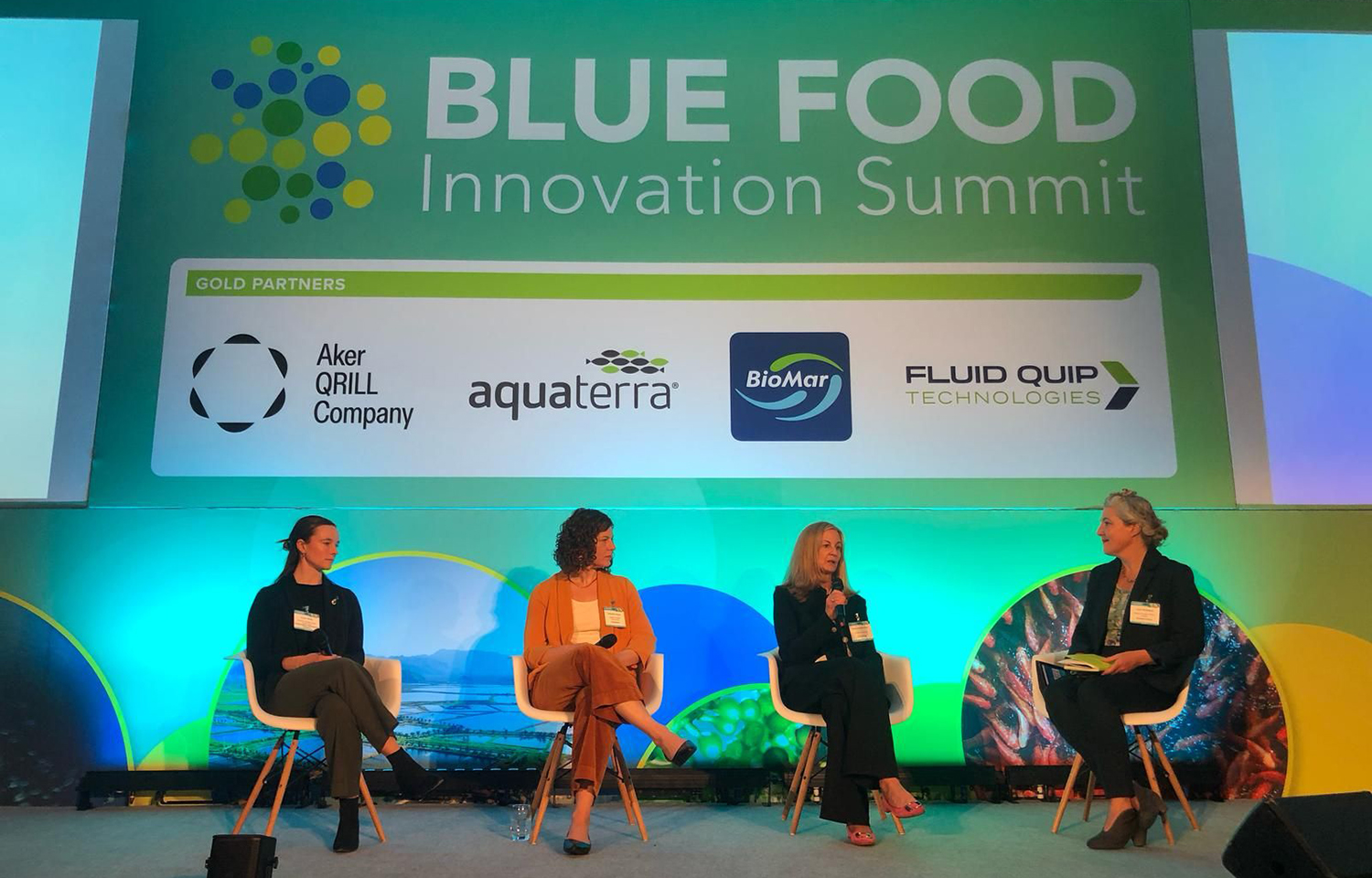
“This is a very pivotal time for this industry,” Oceanium CEO and Co-Founder Karen Scofield Seal said at the 2025 Blue Food Innovation Summit, which was held in London, U.K., from 8 to 9 April. “We really are at a crossroads, with the last few years being very exciting as farmers have scaled up their technology and improved their harvesting and seeding.”
Scottish biotech company Oceanium, which manufactures functional seaweed ingredients for food and nutraceuticals, expects to have a new processing facility up and running in the next two years.
“We've had our heads down, working really hard on scaling up technology, product development, patents, and trials, and now we're ready to go,” Scofield Seal said.
A lot of players in the seaweed industry have reached the same stage of development as Oceanium and are seeking another wave of investment that has yet to come, Scofield Seal said.
“We need a new group of investors to come in and support the industry,” she said. “This is not just me with a refinery here in Europe or [someone] doing farms in North America; it's investors looking at the wider industry that is going to feed the planet and clean the oceans for future generations. It is really important to get this industry going.”
Over the past 10 to 15 years, seaweed has evolved to the point that it’s now a universally recognized sector, with leading international banks investing in its potential, Sea6 Energy Co-Founder Sowmya Balendiran said at the conference.
Over the past decade, Bangalore, India-headquartered Sea6 has developed patented seaweed products for the agriculture, aquaculture, bioplastic, and food industries. Over the next two or three years, the company wants to look at making a “sustainable and a quantifiable impact” in the biomaterials space, too, Balendiran said.
Similar to Oceanium, Sea6 has been fortunate to have had investors on its side, but Balendiran said the wider seaweed industry now needs access to multiple forms of financing, particularly growth capital.
While there’s plenty of funding opportunities at the USD 1 million to USD 5 million (EUR 886,000 to EUR 4.4 million) level, when it comes to checks of USD 10 million, USD 20 million, or USD 30 million (EUR 8.9 million, EUR 17.7 million, or EUR 26.6 million), there are “very few [opportunities] in this ecosystem,” she said.
“That's the gap we have at this point in time, but I think every industry goes through that. You have to get some critical mass of companies for a critical mass of investors to come through,” she said.
This is “slowly building up,” she said, but building widespread support for the seaweed sector will be key to attracting fresh investment.
“We're also still at a very early stage on all of these products, whether it's food ingredients, bioplastics, cosmetics, or chemicals – all of these are possible, but we have yet to reach scale,” she said. “To drive that not only requires innovation by the [seaweed] companies, it also needs the acceptance from large [buying] companies, which have the big distribution systems and access to customers, and for them to look at this as a potential solution.”
One organization brainstorming innovative ways to scale up seaweed production is North American nonprofit GreenWave, which is focused on the development of regenerative farming techniques. Its particular focus within seaweed is on kelp, with Director of Market Development Samantha Garwin saying that it presents the opportunity to build an entirely new agricultural sector from the ground up “and to do it right.”
“It’s about how to get a little into a lot. How do we get kelp and seaweed into everything? Because it is such a sustainable crop, it is where we need to turn for sources of micronutrients as the soils become depleted on land,” Garwin said. “So, GreenWave is focusing on supporting the companies that are, [for instance], doing biorefining and figuring out how to turn kelp into functional ingredients that go into human food, pet food, biostimulants, and personal care products. The possibilities really are endless.”
According to Garwin, a lot of benefits can stem from companies downstream in the supply chain collaborating with stakeholders who are producing seaweed.
“You have the ability to influence these supply chains as they're being built. That’s a huge competitive advantage – to build it to be what you need. You also have the preferred access to ingredients that comes with having those established relationships with suppliers,” she said.
To support seaweed in the current financial climate, the aim should be to build value chains that can operate independently within three to five years, Garwin added.
“These things are inefficient when you're first starting up. There are a lot of things to learn,” she said. “We've got to be looking to get folks to a place where the whole value chain makes sense financially as well as environmentally and socially. I think that that is only going to be possible through really deep collaborations across the value chain.”
Besides analyzing how best to use seaweed, investors are also looking at where best to produce it.
The Conservation International (CI) Ventures investment fund provides loans to small- and medium-sized enterprises and views Southeast Asia as a “massive area of priority” for its flexible capital, partly because seaweed is already being farmed in the region at scale, according to CI Director of Global Ocean Investments Gracie White.
“There’s a lot of opportunity for innovation, improved access to market, and support for smallholder farmers,” she said at the conference. "From an investment standpoint, I look for companies that have some flexibility built into their model. I think a major challenge that the seaweed sector globally has faced in recent years has been a ‘chicken and egg’ problem, with supply and demand continually leapfrogging each other.
In addition to Southeast Asia, White believes East Africa is going to be an interesting area for the sector going forward. Additionally, in Latin America, she highlighted that there's been more activity in Brazil recently.
Moving forward, White believes the industry could benefit from global best practices – an infrastructure that the young sector has yet to develop like other forms of aquaculture have.
“Industry-wide, we need to have some collective discussions on, what the definition of sustainable or responsible seaweed is,” she said. “Not all seaweed is created equally, and I think that the industry as a whole would really benefit from some consensus around what are the best practices for growing it.”
