






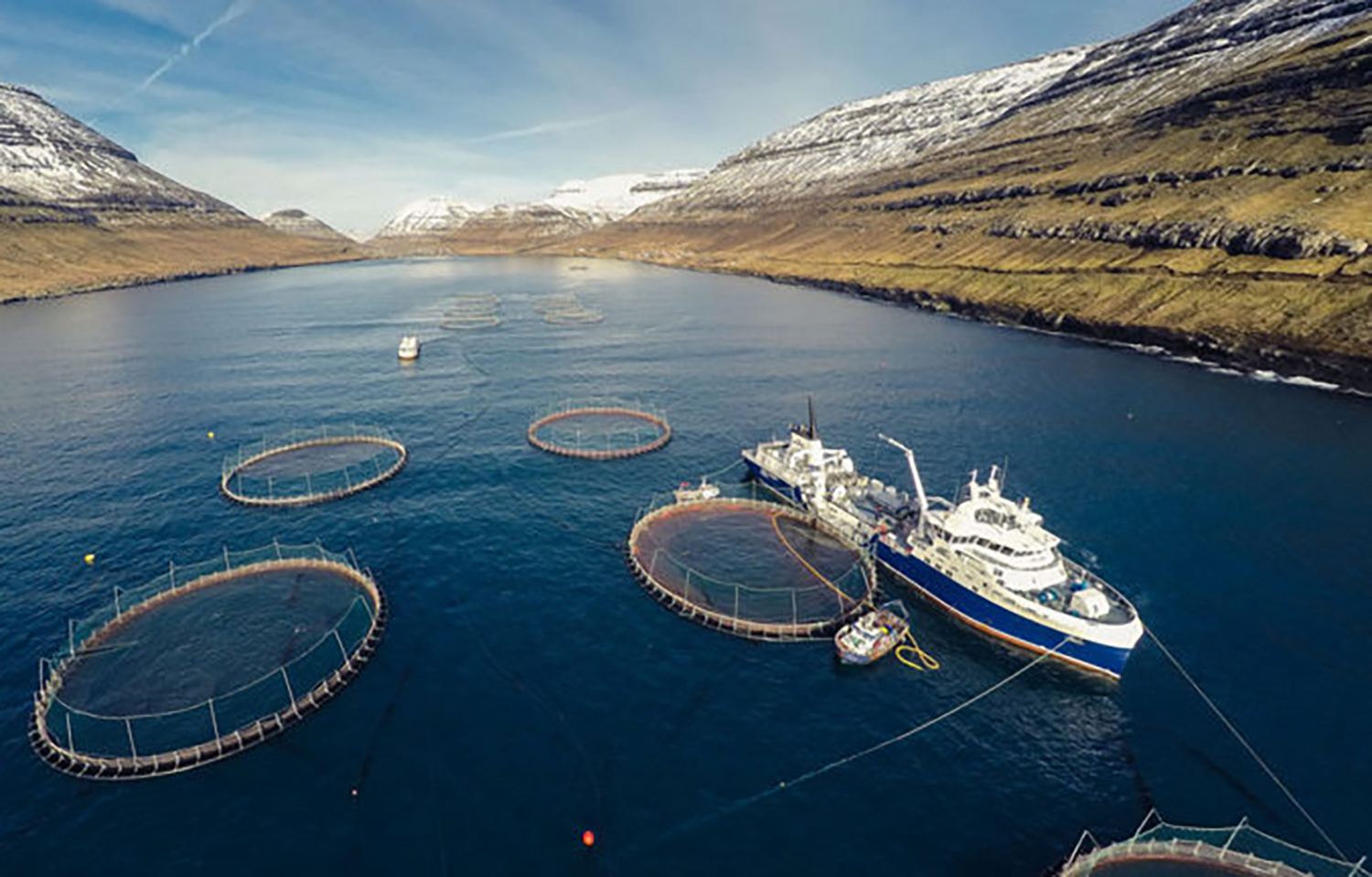
High global salmon supply in the first quarter of 2025 created heavy competition and dropped sales prices, leading Faroese salmon-farming firm Bakkafrost to report lower revenues and EBIT in the period.
Despite strong biological performance in the Faroe Islands and the production of higher-quality smolt in Scotland, Bakkafrost’s Q1 2025 revenues decreased by around DKK 300 million (USD 45.2 million, EUR 40.2 million) year over year to less than DKK 1.9 billion (USD 286.4 million, EUR 254.7 million).
At the same time, it posted lower operational EBIT of DKK 505 million (USD 76.1 million, EUR 67.7 million) and a loss of DKK 6 million (USD 904,510, EUR 804,327). In the corresponding period of 2024, these totals were DKK 710 million (USD 107 million, EUR 95.2 million) and a profit of DKK 401 million (USD 60.4 million, EUR 53.8 million), respectively.
Delivering the group’s results, Bakkafrost CEO Regin Jacobsen noted that a main reason for the year-over-year decreases was a dramatic drop in salmon prices in the period. Prices started the new year at around NOK 130 (USD 12.61, EUR 11.22) per kilogram, but ended Q1 at NOK 85 (USD 8.25, EUR 7.33) – a fall of NOK 45 (USD 4.37, EUR 3.88) per kilogram.
“That's not been seen in a first quarter ever and in a quarter where we expected high prices,” he said.
Bakkafrost CFO Høgni Dahl Jakobsen confirmed the Q1 average price for 4- to 5-kilogram superior Atlantic salmon was NOK 92.73 (USD 8.99, EUR 8.00) per kilogram, which represented a 16 percent decrease on the corresponding period of 2024.
“Prices were high around Christmas [2024] and also continuing into the beginning of this year but dropped quite dramatically in early January and have been following a downward trend since then,” Jakobsen said. “The prices were affected by the increased overall global supply but also by the improved biology in Norway, [which resulted in] less downgraded fish and more large fish coming to market. In fact, the Norwegian supply of whole fish increased by 38 percent in this quarter, and as a result, overall prices were suppressed; the price premium for large fish also reduced.”
The drop in revenue came even as the firm’s total combined harvest in Q1 2025 totaled 25,200 gutted weight tons (GWT), which was up from 21,557 GWT in Q1 2024. Its Faroe Island operations contributed 18,914 GWT – up from 14,294 GWT – and its Scottish operations produced 6,286 GWT – down from 7,263 GWT.
Bakkafrost’s harvest guidance for the full year of 2025 is 97,000 GWT, with 77,000 GWT coming from the Faroe Islands and 20,000 GWT from Scotland. Its longer-term goal is to build its growth capacity to 200,000 GWT and its production to 165,000 GWT by 2028.
According to Bakkafrost’s Q1 2025 report, its Faroese operations delivered quarterly revenues of almost DKK 1.21 billion (USD 182.3 million, EUR 162.2 million) and an operational EBIT of DKK 286.5 million (USD 43.2 million, EUR 38.4 million), versus DKK 1.17 billion (USD 176.3 million, EUR 156.8 million) and DKK 472.1 million (USD 71.1 million, EUR 63.3 million) in Q1 2024, respectively.
Referencing the positive biological performance, Bakkafrost said harvest weights have been high and sea lice levels under control, while feeding, growth, and survivability rates have also all been high.
Revenues for Bakkafrost’s Scottish operations fell by 21 percent in the period to DKK 424.2 million (USD 63.9 million, EUR 56.9 million), and its operational EBIT tumbled 35 percent to DKK 15.9 million (USD 2.4 million, EUR 2.1 million).
Its Fishmeal, Oil, and Feed (FOF) segment achieved revenues of almost DKK 487 million (USD 73.4 million, EUR 65.3 million), and an operational EBIT of DKK 64.6 million (USD 9.7 million, EUR 8.7 million), down 34 percent and 63 percent, respectively.
Bakkafrost’s Services and its Sales and Other segments achieved revenues of DKK 219.1 million (USD 33 million, EUR 29.4 million) and DKK 2.96 billion (USD 445.9 million, EUR 396.8 million) in the quarter, respectively.
