






Weaker salmon and trout prices, increased sea lice treatments, and lower earnings from its wild-catch segment due to diminished quotas negatively impacted Lerøy Seafood Group’s (LSG) earnings in the third quarter of this year.
Lerøy CEO Henning Beltestad, presenting the Bergen, Norway-headquartered seafood corporation’s Q3 2024 results on 14 November, reported revenues of just under NOK 7.9 billion (USD 706.5 million, EUR 672.3 million) for the firm in the period – down 1 percent year over year. The firm’s EBIT also fell 35 percent to NOK 412 million (USD 36.8 million, EUR 35.1 million).
Beltestad said that the company’s Farming segment has seen significant biological improvement in 2024 overall, but Q3 was a particularly challenging quarter, with lower growth than expected mainly due to sea lice.
“On the positive side, we’ve had increased harvest weights – to 4.2 kilos from 3.7 kilos [year over year] – but on the negative side, we’ve had a quarter with a high number of treatments, which has impacted costs, especially in the Midt region,” he said.
Comprising the three Norwegian regions of Lerøy Aurora in Troms and Finnmark, Lerøy Midt in Nordmøre and Trøndelag, and Lerøy Sjøtroll located in Vestland, LSG’s Farming segment reported operating Q3 EBIT of NOK 310 million (USD 27.7 million, EUR 26.4 million), compared with NOK 566 million (USD 50.6 million, EUR 48.2 million) a year previously.
The segment’s slaughter volumes of salmon and trout decreased by 3,000 gutted weight tons (GWT) to 51,000 GWT, while its EBIT per kilogram decreased from NOK 13.50 (USD 1.21, EUR 1.14) to NOK 10.30 (USD 0.92, EUR 0.88).
Salmon’s average spot price in the three-month period was NOK 70.50 (USD 6.30, EUR 6) per kilo, which was NOK 31 (USD 2.77, EUR 2.64) lower than Q2 2024 and NOK 7 (USD 0.63, EUR 0.60) less than Q3 2023.
LSG’s 2024 salmonid harvest volume is expected to be 190,000 GWT, down from its previous guidance of 193,500 GWT. Of the total, 20,000 GWT is expected to come from its 50 percent share of Stirling, Scotland-based salmon-farming firm Scottish Seafarms.
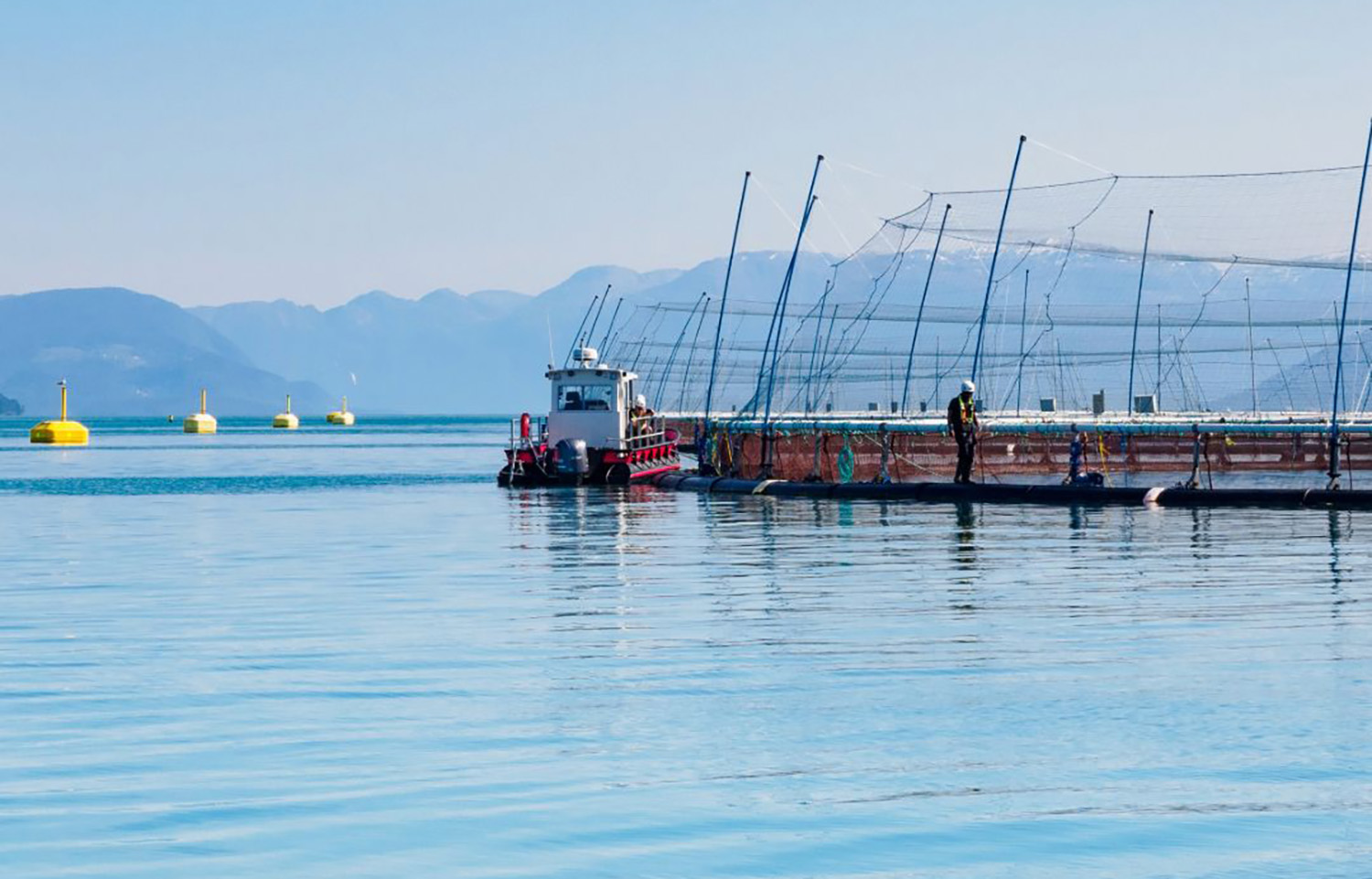
Beltestad said the group is optimistic about further advancements in biological performance in 2025, with data continuously reinforcing its strategy that shielding, particularly through submerged cages, leads to a reduced need for treating fish against sea lice.
Compared to traditional farming methods, this approach has reduced lice treatment frequency by nearly 90 percent and positively impacted survival rates, the share of superior-quality fish, and overall fish welfare, he said. LSG plans to invest an additional NOK 350 million (USD 31.2 million, EUR 29.8 million) in submerged cages in H1 2025, with the aim to shield up to 45 percent of its salmon population by the mid-year point.
Within the firm’s Wild Catch segment, Lerøy Havfisk's total catch volume for the quarter totaled 13,266 metric tons (MT), compared with 14,433 MT in Q3 2023. Its main catch species were cod (1,512 MT), haddock (69 MT), redfish (2,517 MT), saithe (2,935 MT), and shrimp (5,131 MT). Compared with Q3 2023, the average price for cod and haddock increased by 27 percent and 52 percent, respectively, and saithe, which only experienced a 6 percent quota reduction, experienced a 5 percent higher price.
Wild Catch reported an operating loss of NOK 58 million (USD 5.2 million, EUR 4.9 million) for Q3 2024, compared with a loss of NOK 38 million (USD 3.4 million, EUR 3.2 million) in the same period last year.
Beltestad noted the outlook for Wild Catch remains challenging due to the significant quota reductions Norway has implemented over the past few years. This, he said, has created strong headwinds for the firm’s trawling fleet, while its processing facilities along the Norwegian coast are heavily under-utilized and impacted by high raw material costs.
“The quota for 2025 is down a further 32 percent – 25 percent of which stems from an overall industry quota reduction and 7 percent due to the reallocation from the trawler fleet to the coastal fleet under the new regulations,” he said. “So, it’s still a challenging outlook next year for the segment, but the quota is going up and down, and we believe that in the long term, this has good potential and value for Lerøy.”
Profit contribution from associates and joint ventures before fair value adjustment was NOK 15 million (USD 1.3 million, EUR 1.3 million) in Q3 2024, compared to a loss of NOK 67 million (USD 6 million, EUR 5.7 million) a year previously.
The Q3 2024 report also said LSG’s downstream operations – comprising its VAP, Sales, and Distribution division – continued to develop positively. It recorded Q3 revenues of NOK 7.7 billion (USD 689.1 million, EUR 655.5 million), which was on par with a year previously. The division’s operating EBIT climbed NOK 57 million (USD 5.1 million, EUR 4.9 million) to NOK 220 million (USD 19.7 million, EUR 18.7 million), mainly driven by an improved utilization of processing capacity in end markets.
Current expectations are that the segment’s earnings for full-year 2024 will be significantly higher than in 2023, while for 2025, it is projected to reach NOK 1.2 billion (USD 107.4 million, EUR 102.1 million).
