






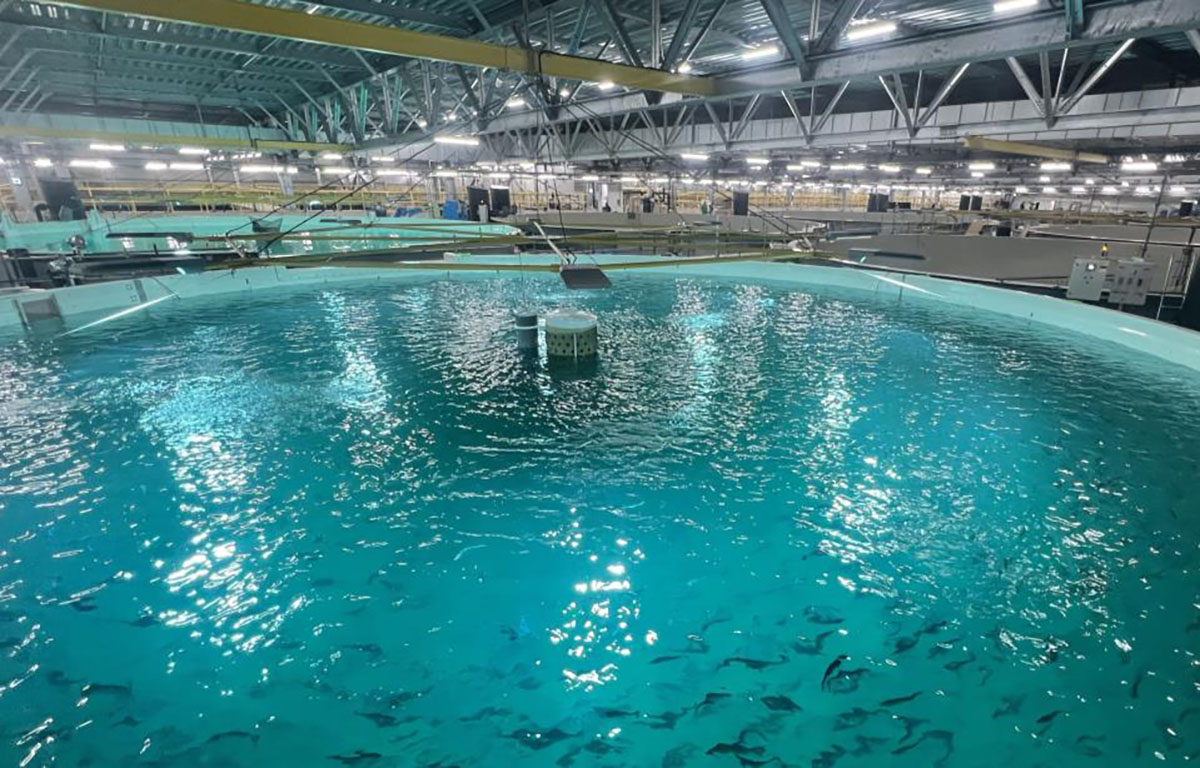
Land-based salmon-farming company Proximar Seafood said it is on track to reach its year-end biomass targets in 2025 but its harvests in Q3 2025 were impacted by a biofilter incident that occurred in 2024.
In its Q3 2025 update, Proximar Seafood said its farming conditions are strong and it is seeing high rates of superior grade salmon as it approaches its biomass target of 2,000 metric tons (MT).
“We are pleased to now see improved farming conditions yielding results with low natural mortality and improved growth rates,” Proximar Seafood CEO Joachim Nielsen said. “We expect to demonstrate the potential of our business model and our unique position as our production gradually gets back on track entering 2026, coupled with a positive market outlook and attractive price levels.”
The company said Q3 2025 was hit with a “prolonged period of lower average sized harvested fish,” which in turn lowered the average price its salmon achieved. Those smaller sized fish were related to the biofilter incident in Q4 2024, which forced the company to reduce feedings and resulted in slower growth of its salmon.
As a result of the lower harvest weights and lower prices, the company posted revenue of NOK 24 million (USD 2.37 million, EUR 2.04 million) in Q3 2025 – roughly on par with the NOK 23.8 million (USD 2.35 million, EUR 2.03 million) it posted in Q2 2025, which was also hampered by biomass issues caused by the biofilter problems.
The company’s EBITDA dropped to a loss of NOK 7.3 million (USD 722,000, EUR 623,000) in Q3 2025, down form a loss of NOK 1.7 million (USD 168,000, EUR 145,000) in Q3 2024.
Proximar Seafood said throughout Q3 2025, it took multiple measures to improve the growth rate of its salmon, which have begun to show positive results in October and November. Feeding volumes of its fish are now up to its original plans, and growth rates are back in line with its original projections.
The company said despite the slower growth caused by the incidents, its business philosophy continues to be proven by the high transportation costs other sources of salmon face when transporting salmon to Japan.
It also said Japan’s government recently emphasized the importance of food security for the country, which it aids by being a local source of seafood.
“With limited domestic production and strong consumer preference for premium seafood, land-based farming holds strong underlying drivers for long-term domestic demand,” Proximar Seafood said. “Japan’s growing emphasis on food security was highlighted by Prime Minister [Sanae] Takaichi’s support for land-based aquaculture in her policy speech in October.”
Proximar Seafood also recently refinanced its operations through a NOK 150 million (USD 14.8 million, EUR 12.8 million) rights issue and the conversion of a NOK 200 million (USD 19.8 million, EUR 17 million) bond into equity. The company said it has also reached agreements on some of its debts, extending maturities.
“Following the carried-out transactions, the relative ratio between equity and debt will be improved by approximately NOK 550 million [USD 54.4 million, EUR 46.9 million], with the effect showing in the Q4 2025 accounts,” the company said.
