

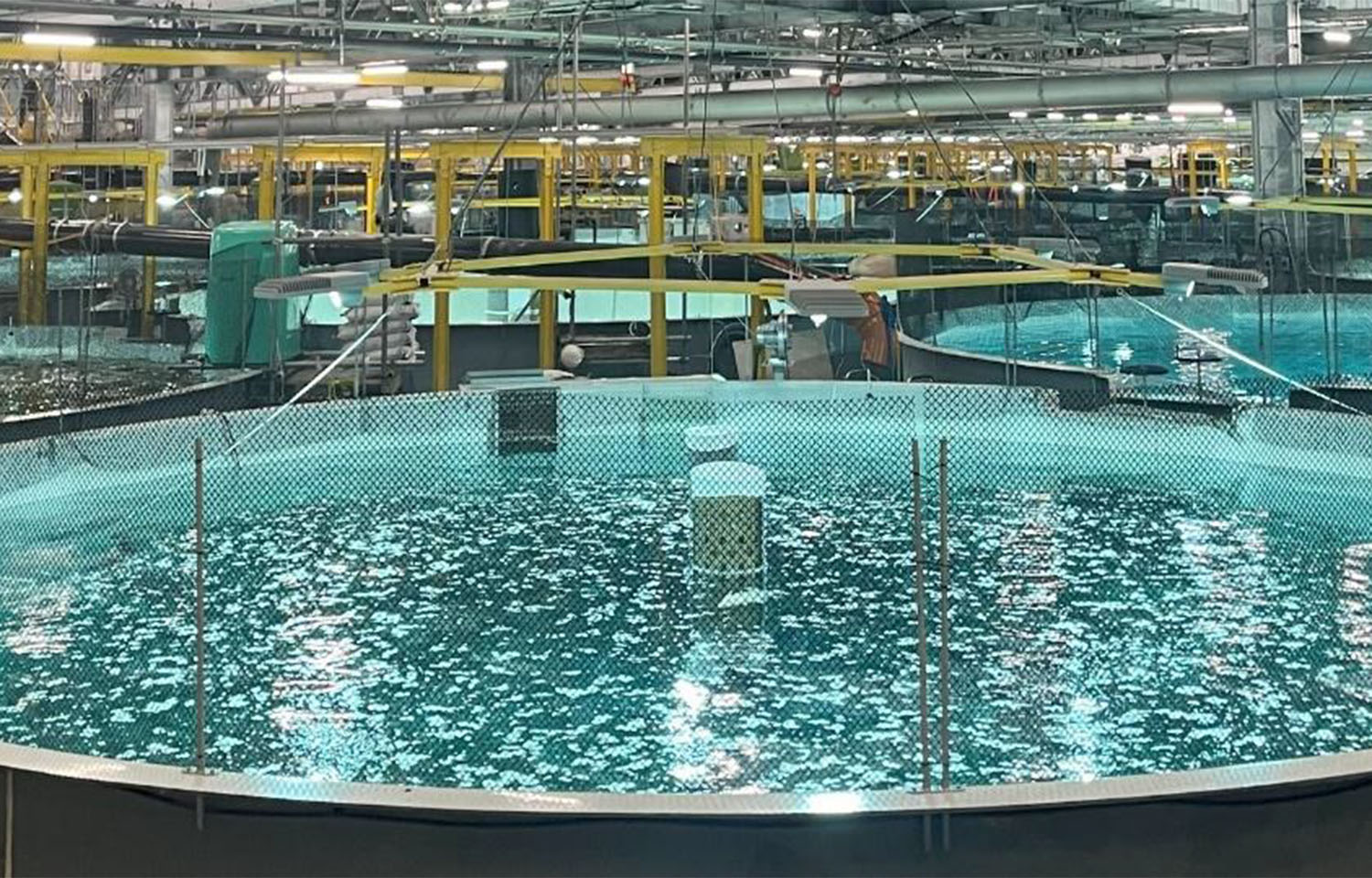
Proximar Seafood has reached full production capacity at its recirculating aquaculture system (RAS) salmon facility, but continued to be impacted by a biofilter incident that affected its financial results in Q2 and H1 2025.
The company said its Yokohama, Shizuoka Prefecture, Japan-based facility has crossed the 1,000 metric ton (MT) production mark and is now fully utilizing all modules at its facility – which began operations in October 2022. The company harvested 321 metric tons (MT) of head-on gutted (HOG) salmon in Q2 2025, bringing its total harvest in H1 2025 to 643 MT.
"We entered the second half with all modules in operation and expect growth rates and harvest weights to gradually increase,” Proximar Seafood CEO Joachim Nielsen said in a release. “Mortality is still low, and we expect to demonstrate the earnings potential of our model as our production gradually gets back on track through the second half of 2025 and going into 2026.”
The company said its survival rate, if one-off incidents are excluded, is above 99 percent. However, the company had a pump failure in May 2025 which killed 170,000 fish at its facility. Proximar later cited human error as the cause of the mortality event, and said a series of failures in both automated and manual pumping to prepare for a fish transfer caused oxygen levels to fall below critical levels.
With that incident taken into account, the company’s survival rate was 87.2 percent in Q2 2025.
With the 643 MT of HOG salmon the company harvested so far in 2025, Nielsen said the company has crossed over the 1,000 MT mark for live fish.
Proximar’s revenue reached NOK 23.8 million (USD 2.36 million, EUR 2.02 million) in Q2 2025 – the first Q2 which the company has earned revenue given its first-ever harvest didn’t occur until Q3 2024. For H1 2025, the company hit NOK 68.3 million (USD 6.8 million, EUR 5.8 million) in revenue.
The companies EBITDA, meanwhile, dropped to a loss of NOK 55.2 million (USD 5.5 million, EUR 4.7 million) in Q2 2025, down from a loss of NOK 2 million (USD 198,000, EUR 169,000) in Q2 2024. Proximar said one-time effects, in addition to fair value adjustments, impacted its operating results for “approximately NOK 28 million [USD 2.78 million, EUR 2.37 million]”
Overall, the company’s net loss in Q2 2025 jumped to NOK 95 million (USD 9.45 million, EUR 8.06 million), largely related to significantly higher operating expenses.
The company said its revenue was negatively impacted by lower harvest weights in its salmon, which in turn lead to lower prices per kilogram. Market-sized fish in Japan, which weighted at 3 kilograms or more, achieved a price of NOK 108 (USD 10.74, EUR 9.16) per kilogram. However, the average price achievement for Q2 2025 across all its salmon was NOK 75 (USD 7.45, EUR 6.36).
The company said it has had to reduce feeding on its fish due to biofilter incidents. In November 2024 the company suffered an equipment failure linked to a specific module, lowering its expected harvest totals and forcing the company to take measures to ensure adequate water quality for its salmon.
Proximar said because of its reduced feedings it cannot guarantee harvest weights for the 900,000 fish it projects to harvest in 2025.
“The priority is to get back to the production plan for 2026, and the company will continue to consider how to optimize production with this in focus,” Proximar said. “With full production capacity restored and a stronger financial position, the company expects gradually increased harvest weights and improved price realization in the second half of the year.”
