






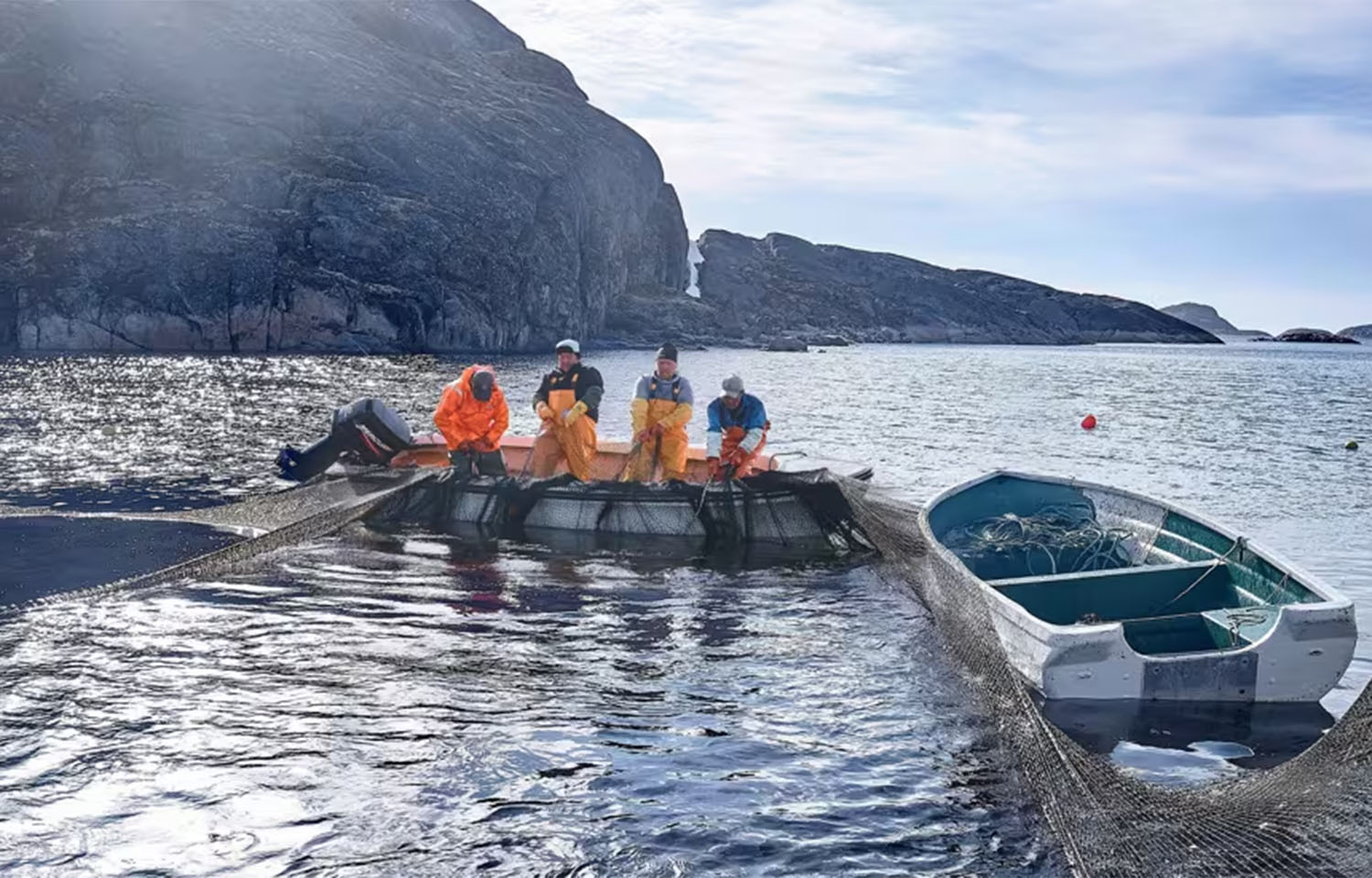
Fishing company Royal Greenland posted lower revenue but significantly improved profit before tax in H1 2025 as the company continues to work toward recovery after multiple challenging years.
The company posted revenue of DKK 2.61 billion (USD 409 million, EUR 349 million) in H1 2025, down from the DKK 2.64 billion (USD 413 million, EUR 353 million) it posted in the same period of 2024. The lower revenue in part came from challenging fishing conditions for several core species, the company said.
Despite the lower revenue and challenging conditions, the company’s EBITDA, EBIT, and profit before tax all improved on prior years.
The company’s EBITDA in H1 2025 reached DKK 102 million (USD 15.9 million, EUR 13.6 million), up from DKK 91 million (USD 14.2 million, EUR 12.2 million) in H1 2024. EBIT also increased to DKK 27 million (USD 4.2 million, EUR 3.6 million), up from a loss of DKK 11 million (USD 1.7 million, EUR 1.4 million).
Profit before tax showed a DKK 48 million (USD 7.5 million, EUR 6.4 million) improvement, rising to a loss of DKK 11 million (USD 1.7 million, EUR 1.4 million) in H1 2025 from a loss of DKK 59 million (USD 9.2 million, EUR 7.9 million) in 2024.
“Another step in the right direction, though overall still not satisfactory,” Royal Greenland said.
Multiple factors impacted the company’s income, including fishing challenges.
“Unstable and fragile ice formation in the northern Greenland fishing grounds has again limited inshore halibut fishing during the winter months, and in the western Greenland shrimp grounds, the decline in catch rates from last year continues,” Royal Greenland said. “Additionally, shrimp fishing efforts have been affected by shipyard stays for two trawlers and a late start for Tuullik in inshore shrimp fishing, replacing Lomur, which sank last year.”
Unstable weather in the spring also resulted in low landings of lumpfish roe and a delayed start to cod fishing, the company said. However, offshore halibut and cod fishing has remained stable, and in Canada – where the company owns Quin-Sea Fisheries – snow crab harvesting has gone well.
“The net effect of these fishing conditions is an 11 percent decline in sales volumes compared to the same period in 2024,” Royal Greenland said.
While volumes were lower, prices were higher. Sales prices per kilogram increased 9 percent, driving the positive momentum in earnings and profit.
Royal Greenland said its progress also came in the face of geopolitical tensions and the introduction of tariffs, which created market uncertainty.
“Trade policy unrest has so far only had a modest impact on Royal Greenland’s international sales, as strong demand for our core species has largely allowed customers and consumers to absorb the effects of imposed tariffs,” the company said.
The company also had to grapple with internal changes.
Royal Greenland fired its former CEO, Susanne Arfelt Rajamand, after just over two years with the company. Rajamand joined the company in 2023, and since that time, the company posted a string of poor performances, including big losses in 2023. Losses improved slightly in 2024 but were still enough that the board “concluded that the company requires a CEO with a different profile,” a company statement said in February 2025.
Royal Greenland said it has initiated recruitment for a new CEO and recently hired a new CFO after its long-time CFO Nils Duus Kinnerup stepped down.
During H1 2025, the company also hit a few new milestones as it revamps its fleet. The company received a new trawling vessel, the Kaassassuk, on 28 July, the last in a series of five trawler purchases the company made that date back to 2019.
Royal Greenland said that the new vessel marks a transition to a new strategy it has dubbed “INUA 2027.” The company said the new strategy is designed to bring the company back into profitability, adapting it to the challenging business climate.
“It will focus on creating a more targeted and simplified business model that reduces complexity and supports Royal Greenland’s ability to navigate in a volatile global context,” the company said.
Royal Greenland said the goal is to achieve an EBIT margin of 5 percent and a pre-tax profit of DKK 250 million (USD 39 million, EUR 33 million), by 2027.
Royal Greenland Interim CEO Preben Sunke said achieving the goal will require reducing costs and improving earnings amid changing markets.
“Royal Greenland has a special social responsibility as a company owned by the Greenlandic Government, and we take that very seriously,” Sunke said. “Therefore, we work every day to develop our business responsibly; we continuously look at how we can create increased value on the quality products we sell to customers worldwide while maintaining a continuous focus on the efficiency of the way we run the business. We do this so that we can ultimately create value for the business, our skilled employees, and the Greenlandic society.”
