






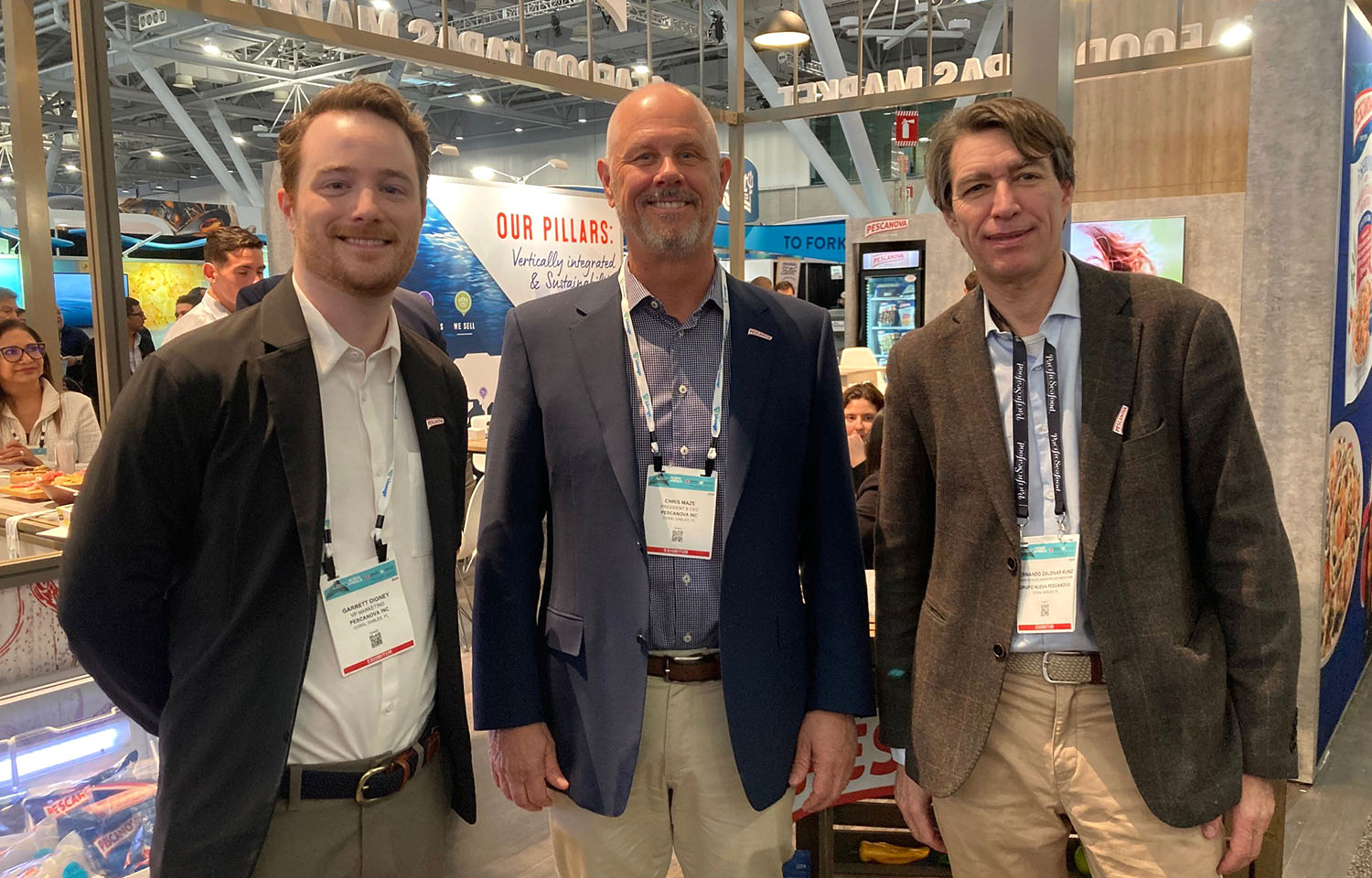
Cooke’s attempt to acquire a majority stake in Nueva Pescanova is no longer active, according to Fernando Zaldívar Kunz, the Pontevedra, Spain-based vertically integrated seafood firm’s group vice president of sales, marketing, and innovation.
Cooke entered into an exclusivity agreement with Abanca, Pescanova’s majority owner, to negotiate a purchase of an 80 percent stake in the company in April 2023, but the deal-making went cold in July after the two sides could not come to an agreement on the price. In October 2023, Abanca confirmed it had terminated the sale process.
“The Cooke process is over,” Zaldívar told SeafoodSource. “As publicly stated by our owner Juan Carlos Escotet, we are operating on a standalone basis. Our shareholder banker has publicized the fact that the selling process that we had with Cooke was over, that we will stay in standalone mode, and we have the full support from Abanca, who is our major shareholder.”
Zaldívar said Pescanova has identified the United States, France, and Italy as its prime growth markets, with an emphasis on foodservice.
“For 20 years, we are present in the US, it continues to be a very strategic market where we want to further invest. Committed to innovating fantastic new products and we are planning to strengthen the sales team, as we want to increase the speed of our growth,” he said. “We are pushing into Italy and France, which are two very big markets, and expanding our reach in Southern Europe, as we are [already] absolute leaders in Portugal, Spain, and strong in Greece.”
Pescanova is pushing its product development to broaden its reach, according to Zaldívar.
“Europe has very different markets, so the approach has to be different. France is a big fresh market and we are leaders in cooked shrimp, so there we are pushing very much to the fishmonger and the foodservice – foodservice for us is the name of the game everywhere around the globe, so this is our priority channel,” he said. “In Italy, octopus is very strong, all cephalopods are very strong, so we have different projects there and none of them is the same as the rest of Europe. We have a different path for each of our markets, but sometimes they [overlap], so it is vital that our marketing teams stay in touch and exchange information and so that when they see there is an opportunity, they maximize it.”
Zaldívar called subsidiary Pescanova USA’s product-development team, led by Pescanova USA President and CEO Chris Maze and Pescanova USA Vice President of Marketing Garrett Digney, “the best-in-class that we have right now in in the company.”
“We want to be a ‘glocal’ company – meaning we have a global footprint but we are specialized for the local market,” Zaldívar said. “I think what is relevant as well is we are not pushing the innovations from the headquarters out, but rather our national teams are free to work thinking about their own market depending on local needs, and then we see the possibility to expand it into other markets.”
Zaldívar named Pescanova USA’s “complete shrimp meals,” which had their formal debut at the 2023 Seafood Expo North America in Boston, Massachusetts, U.S.A., as the perfect example of how his company develops and rolls out products. Beginning with three varieties – Shrimp with Mediterranean-Style Scampi and Spaghetti, Shrimp with Tomato Feta Sauce and Rotini, and Shrimp with Pesto, Broccoli, and Linguini – Zaldívar said the products align with popular food trends in the U.S. but are also potentially exportable to other markets.
“The tomato and feta is the perfect flavor for Spain and other European markets. So it could easily be used in Europe. This best practice sharing is our strength as a multinational company,” Zaldívar said.
Digney said the tomato feta product is based off a viral TikTok video, boosted by the addition of 31-40 size shrimp sourced from India. He said all three products can be cooked in eight minutes and use natural butter. They are now being sold in more than 1,000 Kroger stores nationwide.
“All three are going to restaurant-quality flavors, inspired by Mediterranean recipes. Everyone knows what scampi is, that's more mainstream, so in the initial sales, that's the one people are grabbing the quickest. But it’s early – they’ve only been on the shelf for a month – so we’ll see what happens,” Digney said. “We tried to add the vegetable inclusion to add a little bit more of a health focus. When we were doing consumer research, we understood that Americans are starting to be more influenced by those healthier decisions, so we still have butter in the ingredients list, but incorporating [vegetables like] spinach and tomatoes just helps it become an easier decision for people.”
Pescanova USA also recently introduced a line of shrimp skewers, which include Garlic Butter, Sweet and Spicy, and Chipotle BBQ, using the company’s own shrimp farmed in Guatemala. They will be sold at Target stores across the U.S. beginning in May.
“They're marinated shrimp skewers served as an appetizer or hors d'oeuvre at a party, which we expect to be popular especially as we get into grilling season,” Digney said. “Target has been a great partner, carrying our Toss and Serve Shrimp and Protein Pasta. They're launching a big grilling campaign coming up, so these skewers will be a great addition.”
Maze said Pescanova USA is fully committed to innovating the seafood value-added category, leaning on the parent company’s expansive reach across species.
“We’re stepping up our value-added offerings to move into providing a complete meal. If we want to increase seafood consumption in the United States, we feel like the way to do that is to provide a complete meal solution, and it’s got to taste good and it's got to be convenient,” he said. “We're not limiting ourselves. While our background is as a Mediterranean heritage brand, there's still room for growth. So we leave that room open for our brand right now.”
Maze said the company is also offering private-label services, including for Performance Food Group and Sysco, and is leaning hard into foodservice.
“Depending on the species, up to 70 percent of certain categories go to foodservice. That's a huge deal for us,” Maze said. “Our foodservice [offerings are] really gaining momentum – [they’re] coming back after Covid, especially with some of our higher-end products. There just such demand there right now.
Maze said Pescanova USA is hiring two new foodservice-focus positions, and could hire more beyond that.
“Our foodservice customers know they have a one-stop shop where we control everything in the supply chain from shore to shelf. That, and our sustainability track record, is what separates us from other importers. Now that we’ve established that, we just need a crew dedicated to getting out there and sell not only them but to their customers as well, and that's a very personnel-intensive job and that's where we're investing right now,” Maze said. “We need more feet on the street. We’ve got to get everybody out there in front of all the operators, particularly for foodservice right now.”
Maze said Pescanova has also gone all-in on pushing its Namibian-sourced cape hake, a fishery in which it has invested more than EUR 39 million (USD 39.7 million) in recent years. The hake comes into the U.S. once-frozen in shatterpack fillets and portions, and is a cheaper alternative to cod. Three months ago, Maze said the company noted rapidly increasing interest in its cape hake as the U.S. market began to foresee a disruption in the supply chain coming as a result of the expanded U.S. ban on Russian seafood products. One of the first to jump was Performance Food Group, which recently put Pescanova’s cape hake under its Empire’s Treasure brand.
“What we're hearing is the summer is when they feel like the stuff that's in the pipeline is going to come to an end. People are starting to get ready for that now, and we have an amazing alternative available,” he said. “There was a little bit of an education needed on what exactly cape hake is, but now people are getting it, because it's really starting to gain momentum in foodservice. It's a mild whitefish that really fits in that same cost level and actually less expensive than cod.”
