





Ecuador’s shrimp industry has been in a period of constant growth for the last decade, and companies and organizations are working to make that growth continue.
Ecuador’s shrimp exports have increased year over year nearly every month for the past two years, and they are on pace to once again hit double-digit percentage growth in 2026. The country went from exporting 720 million pounds of shrimp in 2015 to 3 billion pounds of shrimp in 2025.
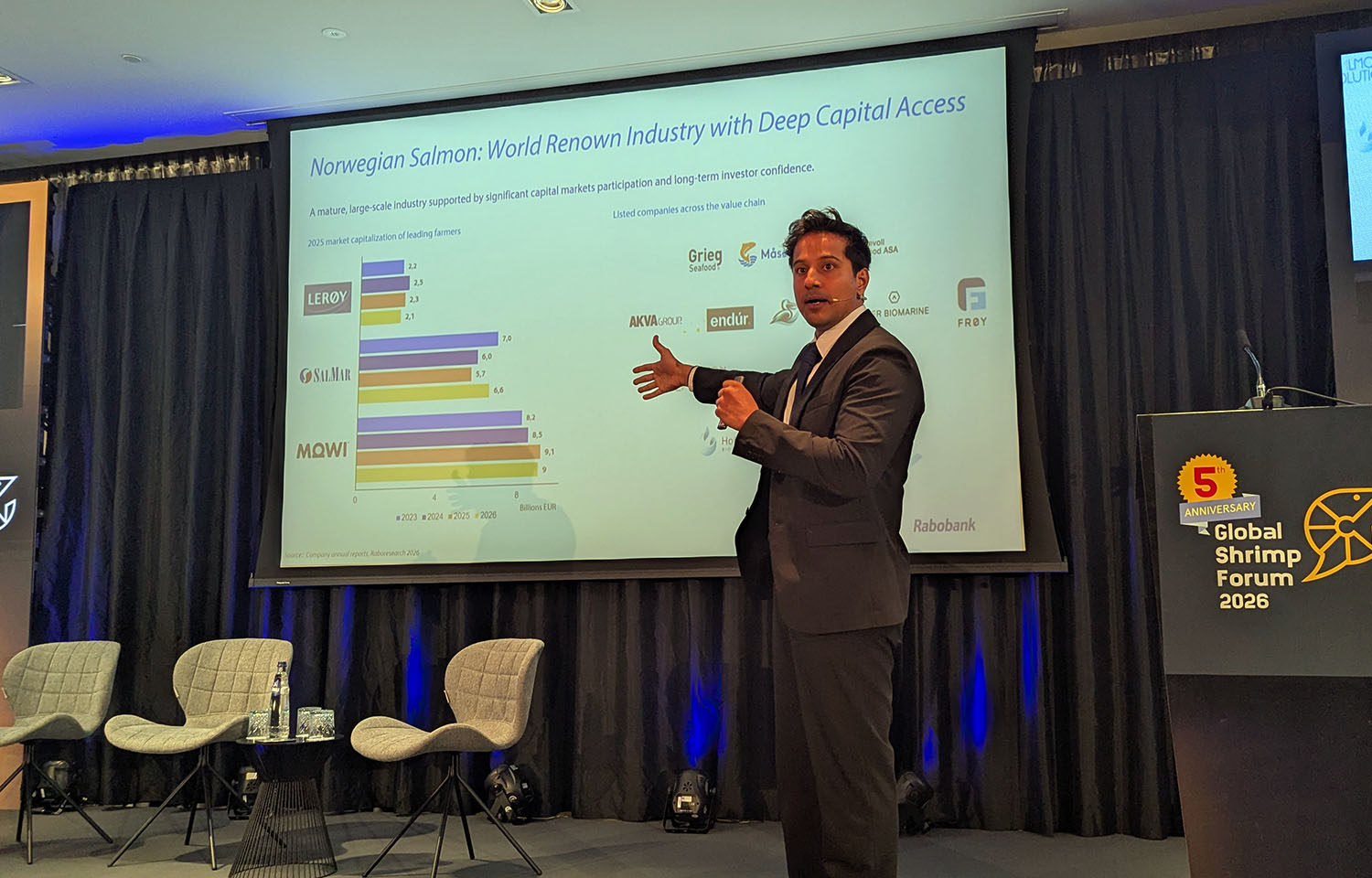
According to Rabobank Analyst Novel Sharma, that pace is setting up Ecuador’s shrimp industry to reach scales like that of the Norwegian salmon industry.
“Over the last few years these two sectors have displayed certain traits and progress which makes us believe that maybe these two sectors are not as dissimilar as we think,” Sharma said.
Sharma, speaking during the Global Shrimp Forum in Utrecht, the Netherlands, said Ecuador has doubled its export volume every five years, and has outpaced the Norwegian salmon industry in terms of value.
But there are a few differences remaining between the two sectors, Sharma said. One is the ratio of export volume to value – for Norwegian salmon, value increases are outstripping volume increases, where for Ecuador volume is increasing faster than export value. Another difference is in the market cap of the top companies in the space. The top three Norwegian salmon farming companies have USD 18 billion (EUR ) in market cap, and across the value chain in Norway’s salmon industry, everything from biotechnology and land-based farming technology providers to the salmon farmers themselves enjoy plentiful access to capital due to investor confidence in the industry,
“There is a financing ecosystem which is diverse when it comes to the Norwegian salmon industry,” Sharma said.
Ecuador is rapidly approaching Norway in terms of export volumes and similarity, according to Sharma. Its industry is primarily for export due to limited domestic consumption of its shrimp, and its export volumes are also similar. Where it differs could be part of the reason the industry doesn’t have the same easy access to financing as Norway.
Norway and Ecuador’s export dependence has over time resulted in different markets. In Ecuador, shrimp exports are almost entirely driven by China, and the industry is working to diversify into western markets. Norway has had the opposite trajectory, with most of its exports going to Europe, and the industry is making a concerted effort to expand in China.
Another key difference between salmon and shrimp is supply elasticity, Sharma said. Growth capacity in the salmon industry is structurally constrained through either licensing or availability of new sites, and the longer growth time of salmon means the industry cannot quickly adapt to demand.
“It keeps a tighter market, which leads to structurally higher profitability, higher margins, but at the same time, it does lead to higher price volatility,” Sharma said.
Salmon production takes longer to adjust to pricing influence due to multi-year growth cycles, meaning it takes more time for production and pricing to reach an equilibrium.
Ecuadorian shrimp, and shrimp in general, has significantly shortened production cycles by comparison, resulting in much higher supply elasticity. If pricing increases, shrimp producers the world over can respond and have a batch of shrimp on the market in 3 to 4 months.
“This sometimes can lead to an oversupply situation because multiple producers global can respond to short-term demand signals, which in a way reduces their ability in terms of price and power,” Sharma said.
Ecuador also differs in its market share in its primary species. According to current statistics, the country has 28 percent of the global shrimp marketplace, whereas Norway has 50 percent of the market share.
Sharma said another key difference between the two industries is the scale of the top companies in the space. On the top level, salmon companies have a much higher market cap than shrimp companies – but that could be changing.
“Over the last four or five years, Ecuador has also reached a scale that is comparable to some of the other salmon farming companies in the industry,” he said. “The scale that has been experienced on an industry level has also translated to some of the top players.”
Ecuador’s top-five shrimp companies had a higher revenue growth rate than Norway’s top salmon companies, for example.
Sharma said the question going forward for the Ecuadorian shrimp industry is what path it will take to continue growing.
“What will be next? Will it be vertical integration? Will it be more diversification?” Sharma said. “Will we eventually see an Ecuadorian shrimp ‘Mowi’?”
